
Llobregat Delta nature reserves (El Prat and Viladecans)
Natural parkThe Llobregat Delta nature reserves are the protected lagoons, marshes, pinewoods and beaches left on the flat river plain south-west of Barcelona, right beside Barcelona-El Prat airport. Catalunya.com puts them about 2 km from the airport and 12 km from the centre of Barcelona, with buses L94 and L95 from Ronda Universitat and access by the C-31 coast motorway. Entry is free during opening hours. They suit birdwatchers, walkers and travellers with a few hours before a flight; skip them if you want wild, quiet country, because the airport, motorways and port are right next door.
Quick facts
- Names: Espais Naturals del Delta del Llobregat (Catalan), Espacios Naturales del Delta del Llobregat (Spanish); in English often just the Llobregat Delta. The best-known reserves are El Remolar-Filipines in Viladecans and the river areas of Cal Tet and Ca l’Arana in El Prat de Llobregat.
- Where: the coastal strip of El Prat de Llobregat, Viladecans, Sant Boi de Llobregat and Gavà, Baix Llobregat, Barcelona province. The airport itself lies inside the delta (Catalunya.com).
- Coordinates: 41.2813, 2.0706 (Estany del Remolar, the Remolar lagoon; OpenStreetMap).
- Protection: declared in 1987; a Natura 2000 Special Protection Area for birds (ZEPA) and Special Area of Conservation. Catalunya.com gives the protected area as 969 ha; Catalan Wikipedia says the bird protection area was enlarged in 2024.
- Birds: more than 360 species recorded, one of the highest totals on the Iberian Peninsula (Catalunya.com).
- Entry: free during opening hours; guided tours and group visits on 934 793 201 (Catalunya.com, checked November 2026).
Access and parking
From the airport: the reserves start about 2 km from the terminals; on OpenStreetMap the Remolar lagoon is about 1 km in a straight line from the Terminal 1 car parks. We could not confirm a walking route, so plan on a bus or taxi.
By bus from Barcelona: Catalunya.com lists lines L94 and L95 from Ronda Universitat in central Barcelona. We did not check stop names or timetables; look them up before you go.
By car: take the C-31 Castelldefels motorway towards the airport. Catalunya.com gives the entrance to the Remolar-Filipines area at kilometre 11 of the C-31. The C-31 cuts the old Filipines marsh in two: Filipines Nord lies north of the road and El Remolar-Filipines, the part you visit, south of it (Catalan Wikipedia). The river areas of Cal Tet and Ca l’Arana are reached from El Prat, along the Camí de Cal Tet. We could not confirm parking capacity at either site.
What to expect
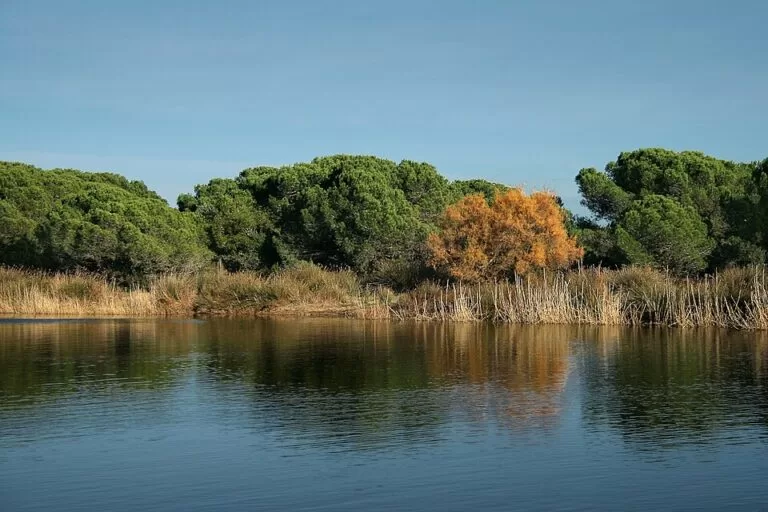
The delta is a flat plain of fields, pinewoods, wetlands, lagoons and beaches. Catalunya.com describes the plain as stretching between the Garraf massif and Montjuïc, up to the narrow pass of Sant Andreu de la Barca, and says it is young: it appeared in Roman times and kept growing until the 19th century. Old river mouths left the coastal lagoons; Catalan Wikipedia says only La Ricarda and El Remolar still keep a natural landscape, and that together the delta’s wetlands are the third most important in Catalonia.
The protected land is split into separate pieces, each with paths, hides and towers:
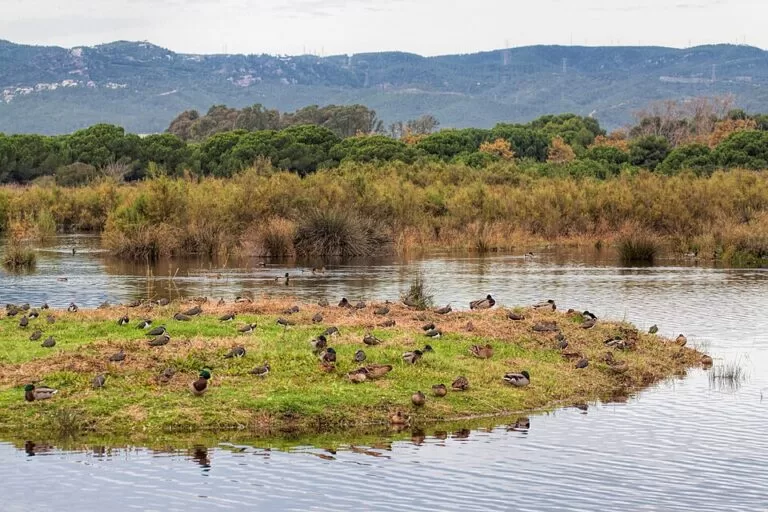
- El Remolar-Filipines and Viladecans beach (188 ha): the Remolar lagoon, the Filipines marshes, the Sant Climent stream, the Cal Francès pinewood and part of Viladecans beach. Grey herons, cormorants, ducks and lapwings are easy to see here (Catalunya.com).
- The natural areas of the Llobregat river (about 145 ha), on the right bank of the last stretch of the river: reed beds, pinewoods, beach and the lagoons of Cal Tet and Ca l’Arana, “a miniature delta” in Catalunya.com’s words.
- The Can Camins pinewood and El Prat beach (48 ha): stone pines on old dunes behind the beach.
- Can Dimoni ponds (31 ha): three small lakes among the farmland of Sant Boi, known for roosting herons and cattle egrets.
- La Murtra pond and La Maiola pinewood, between Viladecans and Gavà: little bittern, kingfisher and little ringed plover live around the pond.
The landscape has been reshaped many times. In 2004, to enlarge the port of Barcelona, the last 3.5 km of the river were moved 2.5 km to the south; the new Cal Tet lagoon and aquifer recharge ponds were built as compensation (Catalan Wikipedia).
Birds and wildlife
The delta sits on the migration route between Europe and Africa along the western Mediterranean, so birds stop here to rest, moult, feed, nest and spend the winter. Catalunya.com names large populations of black-winged stilts, Kentish plovers, little ringed plovers and little grebes, wintering ducks, and three species in serious danger: the Eurasian bittern, the Balearic shearwater and the osprey. There is a native population of Spanish pond turtles and of the Spanish toothcarp, a small endemic fish. Kentish plovers nest on the beaches, and parts of the sand are closed in the nesting season.
For birdwatchers, Catalunya.com singles out moustached warbler and crakes in late March, western swamphen and bittern from the hides, collared pratincole from the Sabogal hide at Cal Tet, and shearwaters, razorbills and skuas off the beaches.
Practical details
- Opening hours: summer, Monday to Friday 8:00–15:00 and weekends 9:00–18:00; winter, every day 9:00–18:00. Areas with controlled access close on 1 and 6 January and 25 and 26 December (Catalunya.com, checked November 2026).
- Routes: marked routes on foot and by bike, including the Cal Tet and Ca l’Arana river itineraries, La Vidala and the Filipines marsh, the Sant Climent stream, La Murtra, Can Dimoni, the Can Camins and La Maiola pinewoods, and the beaches of Viladecans and El Prat.
- Facilities: hides, lookout towers, signposted routes and classrooms; visitor activities in spring, autumn and winter.
- Museum: the Prat Museum in Torre Balcells, El Prat, has an Interpretation Centre of the Llobregat Delta with photographs, models, dioramas and films on the delta’s birds, and guided visits to the delta on Saturdays (Catalunya.com).
Accessibility and safety
The paths are flat. Catalunya.com lists accessible spaces and facilities for wheelchair users and people with reduced mobility, but no facilities for people with visual or hearing impairments; check which hides are step-free before you go. Stay on the marked paths: beach and dune areas are closed in the nesting season, and La Ricarda beach has no public access at all.
Best time to visit
Catalunya.com says any season works but recommends spring and winter: March and April for migrants and the first summer visitors, winter for ducks, bittern and shearwaters off the beach. Summer brings wading birds to the marshes; note the shorter weekday hours then.
Nearby alternatives
- HolaCamp Barcelona, 2.5 km away: the campsite by the beach at Gavà.
- Gavà Mines, 6.7 km away: Neolithic mines for the green stone variscite.
- Castelldefels Castle, 7.7 km away: the castle above Castelldefels beach.
- Church of Colònia Güell, 9.8 km away: Gaudí’s crypt, up the Llobregat valley.
- Montjuïc Castle, 12.1 km away: the fortress at the other end of the delta plain, above the port of Barcelona.
FAQ
How do I get to the Llobregat Delta from Barcelona?
By bus L94 or L95 from Ronda Universitat, or by car on the C-31; the Remolar-Filipines entrance is at kilometre 11 (Catalunya.com).
Is the Llobregat Delta free to visit?
Yes. You can walk the areas freely and without charge during opening hours. Guided tours and group activities are booked on 934 793 201.
What are the opening hours of the Remolar-Filipines reserve?
In summer Monday to Friday 8:00–15:00 and weekends 9:00–18:00; in winter every day 9:00–18:00. Controlled areas close on 1 and 6 January and 25 and 26 December (checked November 2026).
Can I visit the delta before a flight?
Yes. The reserves are about 2 km from the airport, and Catalunya.com suggests them for your last few hours before flying. Allow time for the bus or taxi.
Sources and freshness
Checked 9 November 2026 · 7 sources Show
Checked 9 November 2026. Catalunya.com (Catalan Tourist Board): Delta del Llobregat Protected Nature Area (areas, sizes, hours, routes, wildlife, access), Espai d’Interès Natural del Delta del Llobregat (distances, buses, birding seasons), Prat Museum and Viladecans. Background: Catalan Wikipedia on the Llobregat Delta and Filipines Nord. Location and straight-line distances: OpenStreetMap contributors. The consortium’s own website could not be reached while checking. Not confirmed: bus stop names and timetables, parking, which hides are step-free.
This place is part of our Costa de Barcelona travel guide: the city beaches, Maresme and Garraf — see every town, beach and cove we have mapped on that coast.
How this page is made. CostaMap is written with an AI editorial system run by Ebizapple. This page is based on the sources listed above. Last updated 9 November 2026. Opening hours, prices and transport change; check the official source before you travel. How we work · Partner links and ads