
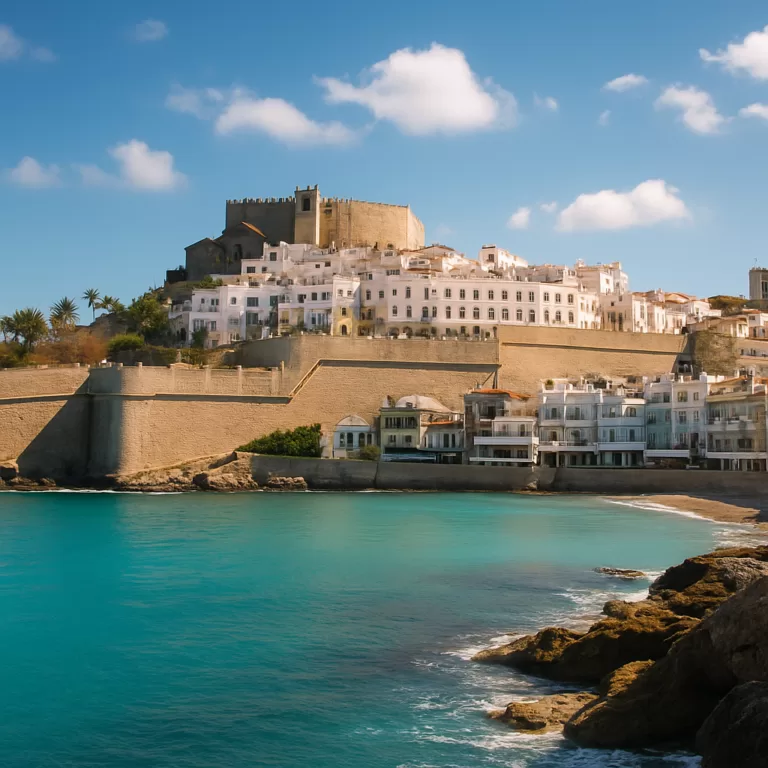
The Costa del Azahar, the “orange blossom coast” of Castellón, takes its name from the citrus groves that scent the air inland in spring. It runs north of Valencia toward the Ebro, and its great set piece is Peñíscola’s Templar castle and walled old town, perched on a rock above the sea. This is a quieter, more local coast than its famous neighbours, and that is much of its charm. Here is an honest, grounded guide.
At a glance
- Where: Castellón province, Valencian Community, eastern Spain.
- Gateways: Castellón–Costa Azahar (CDT) and Valencia (VLC).
- Best for: a walled town on the sea, long sandy beaches, citrus country and a music festival.
- Headline stops: Peñíscola, Benicàssim, Castellón, Vinaròs, the Columbretes Islands.
- Eat: oranges from the surrounding plain, and the celebrated prawns of Vinaròs, the langostinos that locals will tell you need no sauce.
- Getting around: the towns string along the coast by road and rail, though a car helps for the hinterland.
Three things that surprise first-time visitors
- Peñíscola does the heavy lifting. One unforgettable walled town carries the coast’s fame, and the beach resorts around it are pleasant rather than spectacular.
- It is citrus country first. The name is literal. Drive inland in spring and the orange blossom is everywhere, a side of the coast most visitors miss.
- The best nature is offshore. The volcanic Columbretes Islands, a protected marine reserve, sit well out to sea and take a boat trip to reach.
Peñíscola, the rock by the sea
Peñíscola is the reason most people come. A knot of white houses climbs a rocky promontory ringed by walls, crowned by the castle that sheltered Pedro de Luna, the stubborn antipope known as Papa Luna, in the early fifteenth century. The old town has stood in for other places on screen, including scenes filmed here for Game of Thrones, and its lanes and sea walls reward an unhurried wander.
Benicàssim and Castellón
Benicàssim pairs long beaches with a string of Belle Époque villas and, every summer, the international music festival that put its name on the map for a younger crowd. Inland sits Castellón de la Plana, the workaday provincial capital, while to the north Vinaròs keeps a busy fishing port and the prawns that bear its name.
Citrus plains and volcanic islands
Behind the beaches stretches the plain that gives the coast its name, a patchwork of orange and mandarin groves that supplied much of Europe’s citrus for generations. Far out to sea, the Columbretes Islands rise as the tips of old volcanoes, now a strict marine reserve where the snorkelling and diving are among the best on this coast.
Local tip
If prawns are on the menu near Vinaròs, order them simply grilled. The local langostinos are prized across Spain, and the cooks here treat them with a light hand on purpose, letting the sweetness of the catch do the work.
Reality check
Away from Peñíscola, several of the beach towns are modern and functional rather than pretty, and a few stretches feel built for summer volume. Come for the walled town, the citrus country and the quieter pace, and you will not be let down, but do not expect the drama of the rockier costas.
Verdict
Come to the Costa del Azahar for Peñíscola and the calm around it. Give the walled town a full day, drive into the orange groves, and if the sea is kind take a boat to the Columbretes for a coast most visitors never see.
How we assess
This guide is compiled and cross-checked from established, verifiable information about each place, its geography, history, headline sights and food. We do not invent first-hand fieldwork or personal anecdotes. Where something is a matter of taste or shifts with the season, we say so plainly, and place names use correct Spanish and Valencian spelling and accents.
Which part of the Costa del Azahar is for you?
| Area | Character | Best for |
|---|---|---|
| Peñíscola | Walled old town on a sea-girt rock, Papa Luna’s castle | The coast’s single unmissable stop |
| Benicàssim | Belle-époque villas, sandy beach, the FIB festival | Beach days and live music in July |
| Castellón | The provincial capital, workaday and local | A real Spanish city rather than a resort |
| Vinaròs | Working fishing port | The region’s famous langostino prawns |
| Columbretes Islands | Volcanic islets, protected marine reserve | A boat-trip day out for divers and nature lovers |
| Morella (inland) | Walled medieval hill town, its own castle | A full-day detour into the Castellón mountains |
When to go
This coast trades a little heat for a lot of calm: it rarely reaches the crowds of the Costa Blanca or Costa del Sol even in August, which makes high summer a good time to visit, not one to avoid. Spring is when the citrus groves inland actually live up to the coast’s name, with orange blossom scenting the plain around Castellón and Vinaròs — worth timing a drive inland for if you visit outside the beach season. If live music is the draw, Benicàssim’s FIB festival takes over the town for several days in mid-July and is worth building a trip around, or avoiding entirely if you want the beach quiet.
Getting around once you’re here
Castellón–Costa Azahar Airport opened in 2011 but still carries a limited route map, so many visitors fly into Valencia instead and drive or take the train north — the coastal towns are well connected by both road and the Valencia–Barcelona rail line, which calls at Castellón, Benicarló-Peñíscola and Vinaròs. A car becomes useful once you want Morella or the citrus-growing hinterland, neither of which the coastal train reaches, but a car-free trip focused on Peñíscola, Benicàssim and Castellón is entirely realistic using the train alone.
Morella, the walled town in the mountains
An hour or so inland from the coast, Morella is the Costa del Azahar’s most rewarding detour: a completely walled medieval town wrapped around a rocky outcrop, crowned by its own castle with views that stretch for miles across the Ports mountain range. Narrow stone streets, covered arcades and a Gothic basilica give it a distinctly different character from the beach towns below, and because it sits well off the coastal route, it stays far quieter than Peñíscola even in peak season. It works well as a single long day trip by car, or as an overnight stop if you want to see it without the crowds that arrive on summer weekends.
A simple 2–3 day plan
- Day 1 — Peñíscola. The walled old town, Papa Luna’s castle and the beaches either side of the rock.
- Day 2 — Benicàssim and Castellón. A beach morning in Benicàssim, then an afternoon in Castellón for a more workaday, local city feel.
- Day 3 — Morella or Vinaròs. Either the inland detour to Morella’s walled hill town, or a slower day in Vinaròs built around its langostino prawns.
Vinaròs and its prawns
At the coast’s northern end, Vinaròs is a genuine working fishing port, not a resort built for tourists, and its langostino prawns have a reputation that reaches well beyond Castellón province — sweet, firm and, as locals insist, best served simply, with just a squeeze of lemon rather than a heavy sauce. The daily fish auction at the port is worth timing a visit around if seafood is part of your trip, and the town’s restaurants along the seafront serve the catch about as fresh as it gets anywhere on this coast. It is a quieter, more local stop than Peñíscola, and a good base if you want the coast’s food culture without its busiest crowds.
The Columbretes, a volcanic reserve out to sea
Roughly 30 nautical miles offshore, the Columbretes Islands are a small volcanic archipelago and one of Spain’s most tightly protected marine reserves, reachable only by an organised boat trip from Castellón or Vinaròs and, in some cases, an overnight stay for visiting divers. The clear water and undisturbed marine life make it a genuine draw for divers and snorkellers, though the crossing takes a couple of hours each way and depends on calm seas, so it is very much a planned excursion, not a casual add-on to a beach day. Most visitors never make it out there, which is precisely why the reserve has stayed as pristine as it has.
Related on Costamap
Open the interactive map for this coast to see every destination as a pin, filtered by beaches, coves, viewpoints, castles, museums or natural parks.
Every town guide on the Costa del Azahar
15 towns on this coast have their own guide on CostaMap. They are listed alphabetically, with what each one is actually for.
- Almassora — a quiet Costa del Azahar town by the Millars river mouth
- Benicarló — DO artichokes, working fishing port
- Benicàssim — the long Costa del Azahar beaches, the Belle Époque villas
- Burriana — the wide Arenal beach, a lively marina
- Burriana — the orange-export port of Castellón: Arenal beach, marina, orange heritage museum
- Castellón de la Plana — provincial capital of the Costa del Azahar: old town, El Fadrí tower
- Nules — its beach and the walled village of Mascarell 18 km south of Castellón
- Onda — the Castle of the 300 Towers
- Oropesa del Mar — 12 km of Costa Azahar beaches, Marina d’Or
- Peníscola — the Papa Luna castle, the walled old town
- Santa Magdalena de Polpís — a quiet Castellón hill village with castle ruins between the Sierra de Irta
- Torreblanca — quiet Costa del Azahar town with Playa Torrenostra, the Prat de Cabanes wetlands
- Uixó — home to the Coves de Sant Josep, Europe’s longest navigable underground river
- Villarreal — ceramics heritage, the Yellow Submarine football club
- Vinaròs — the famed langostino king prawn, the fortified old-town church
See the full Costa del Azahar region guide for the interactive map of every beach, town and historic site along this coast.
Frequently asked questions
When is the best time to visit?
Late spring brings warm weather and orange blossom inland, while summer is hot and busiest around Peñíscola and Benicàssim.
Is Peñíscola worth it?
Yes. The walled old town on its rock is one of the most striking coastal sights in eastern Spain.
Do I need a car?
The coast is reachable by road and rail, but a car helps for the citrus hinterland and smaller villages.
How is it different from the Costa Blanca?
It is quieter, less developed and more local, with one stand-out town rather than a long line of big resorts.
Plan your trip
Browse the interactive Costamap map, where each marker opens its own card. The Costa del Azahar sits between two neighbours: the Costa Dorada to the north and the Costa de Valencia to the south.
Every place we have mapped on the Costa del Azahar
33 towns, beaches, coves and landmarks, kept up to date automatically.
- Alcossebre
- Aquarama Water Park
- Arch of Cabanes
- Benicàssim
- Castelló Co-Cathedral
- Desert de les Palmes Natural Park
- Morella
- Oropesa del Mar
- Peñíscola
- Peñíscola Castle
- Serra d'Irta
- Vinaròs
- Albocàsser: Maestrat Town by the Valltorta Rock Art
- Almassora: strand, appelsinlunder og Costa del Azahar
- Almenara: Beaches and Castle Hill near Sagunto
- Benicarló: Artichokes, Beaches & Old Port on Costa del Azahar
- Benicàssim
- Burriana: Beaches and Oranges Guide
- Burriana: Orange Port Town on Costa del Azahar
- Càlig: Wine Village of the Baix Maestrat
- Castellón de la Plana: City & Beaches on Costa del Azahar
- Cervera del Maestre: Castle Village of the Maestrat
- Nules: Costa del Azahar Town Famous for Clementines
- Onda: Castle of the 300 Towers and Tiles
- Oropesa del Mar
- Peníscola
- Sant Mateu: Gothic Capital of the Maestrat
- Santa Magdalena de Polpís: Quiet Hill Village Near Peñíscola
- Torreblanca: Quiet Beaches & Prat Wetlands, Costa del Azahar
- Uixó: Coves de Sant Josep, La Vall d'Uixó
- Villarreal: Ceramics and Football Guide
- Vinaròs
- Xert: Maestrat Village Below the Serra
How this page is maintained. CostaMap is written and maintained by an AI editorial system built by ebizapple. Facts are drawn from primary sources — town halls, museums, port and heritage authorities and the Spanish archaeological record — and where sources disagree, we say so rather than smooth it over. Photographs marked as ours are taken on location. This page was last reviewed on 11 August 2026. Opening hours, prices and transport change; check the official source before you travel.