
Doñana National Park
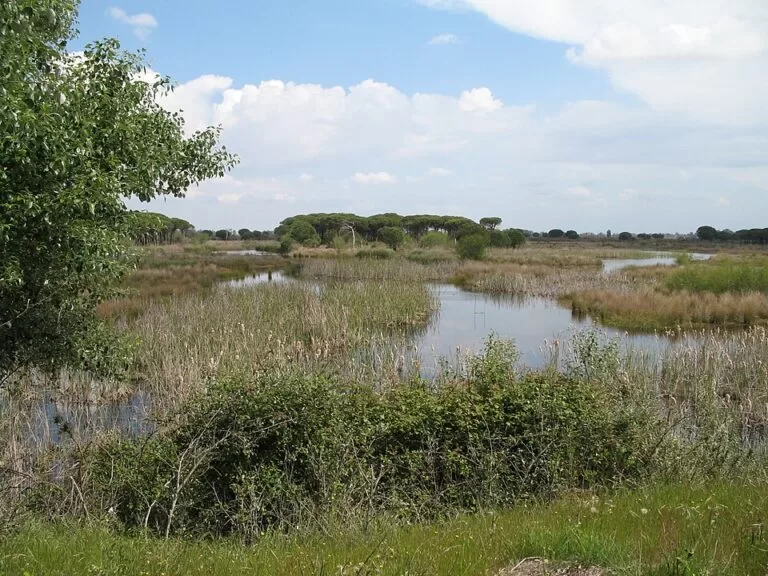
Natural parkDoñana National Park is a 54,252-hectare reserve of marshes, lagoons, pine woods, moving dunes and empty Atlantic beach between the Guadalquivir river and Matalascañas, in the provinces of Huelva and Seville, and one of Europe’s most important wetlands for birds. Most of the park can only be seen on an official guided tour by 4×4 or by boat, so start at a visitor centre such as El Acebuche near Matalascañas, or La Rocina beside El Rocío, and book ahead. Short boardwalk trails and the beach are free. It suits birdwatchers and nature lovers; skip it if you want to roam freely by car.
Quick facts
- Names: Parque Nacional de Doñana in Spanish; the wider protected area, including the natural park around it, is the Espacio Natural de Doñana.
- Where: south-west Andalusia, in the provinces of Huelva and Seville, in the delta of the Guadalquivir river.
- Coordinates: 37.0466, -6.5662 (El Acebuche visitor centre, Almonte).
- Size: 54,252 ha, plus a peripheral protection zone of 74,278.95 ha (Spanish national parks network).
- Declared: national park by decree of 16 October 1969; reclassified in 1978 and enlarged in 2004.
- International status: Biosphere Reserve (1981), Ramsar wetland (1982), Council of Europe Diploma (1985), UNESCO World Heritage (1994), IUCN Green List (2015).
- Managed by: the Junta de Andalucía since 1 July 2006.
- Beach: 33 km of open beach inside the park, between Sanlúcar de Barrameda and Matalascañas.
Access and visitor centres
By car: from Seville, take the A-49 towards Huelva, leave at the Bollullos Par del Condado / La Palma exit and follow the A-483 through Almonte to El Rocío and Matalascañas. From Huelva, take the A-494 to Matalascañas and then the A-483 towards El Rocío (national parks network, access). Sanlúcar de Barrameda, on the Cádiz side, is reached on the A-471 from Lebrija or the A-480 from Jerez.
By bus: buses reach El Rocío, from where you can walk to the La Rocina centre. El Acebuche and the Palacio del Acebrón can only be reached by private vehicle. The Fábrica de Hielo centre in Sanlúcar has public transport from Seville and Cádiz.
Visitor centres (Spain.info):
- El Acebuche: A-483 at km 38.7, turn-off about 3 km from Matalascañas. Starting point of the official 4×4 tours, with information, a live video screen of Iberian lynx, an audiovisual room, footpaths, a shop and a café (Andalusia tourism). OpenStreetMap shows car parks beside it.
- La Rocina: A-483 at km 27.5, 1 km from El Rocío, at the start of a path along the Rocina stream, with traditional thatched huts.
- Palacio del Acebrón: 6 km along a paved track from La Rocina.
- José Antonio Valverde: in the marshes of Aznalcázar (Seville), reached only on unpaved tracks; ask about road conditions first.
- Fábrica de Hielo: on the river front in Sanlúcar de Barrameda.
What to expect
The national parks network describes Doñana as a mosaic of beach, dunes, cotos (stabilised sands with scrub and pine) and marsh. The marsh matters most: it is a staging, breeding and wintering ground for thousands of European and African birds, and the park is home to two endangered species, the Spanish imperial eagle and the Iberian lynx. Spain.info adds moving dunes, some more than 30 m high, that advance from the beach and bury the pines in their path, and flamingos feeding in the marsh.
Seeing the inside of the park means joining one of three official itineraries run by licensed companies: a 4×4 route from El Acebuche to La Plancha and back, a river route by boat from Sanlúcar de Barrameda to La Plancha and back, and a northern 4×4 route from El Rocío to the José Antonio Valverde centre and back. Guides speak at least Spanish and English (national parks network, itineraries). Andalusia tourism describes the El Acebuche 4×4 tour as a 70 km circuit through moving dunes, marsh and scrub with a guide-driver.
Without a tour, you can walk freely on the 33 km of beach and on the old drove roads Raya Real and Camino de Moguer, both starting in El Rocío, and use the free boardwalk trails and bird hides at the visitor centres.
The park has a long history as a hunting estate. Alfonso X made it a royal hunting ground after 1248, and the name is traced to the 16th century, when a Doña Ana built a house here and a later duke built a palace for his wife, another Doña Ana. In 1963 the Spanish state, working with WWF, bought about 7,000 ha to create the Doñana Biological Reserve; the national park followed six years later (national parks network, history).
Practical details
- Booking: places on guided itineraries are limited, so book in advance (national parks network). Prices are set by the operators and were not published on the official pages we checked.
- Bring: binoculars, which the park calls almost essential for watching wildlife, plus water and sun protection.
- Rules: stay on marked paths, take your litter home, keep quiet and follow the instructions of park staff.
- Information: the visitor centres have park guides who answer questions and explain the ways to visit.
Accessibility and safety
The national parks network says all the visitor centres have been adapted to reduce physical, intellectual and language barriers, the footpaths are laid on wooden boardwalks, and the bird hides have adaptations for wheelchairs. Most information is in Spanish and English, and some centres have Braille leaflets. The 4×4 tours run on sand tracks through dunes and marsh. In summer, carry water and sun protection.
Best time to visit
The park itself recommends autumn and winter: fewer visitors, mild temperatures and the wintering birds. Spring is the peak at the José Antonio Valverde centre, where the largest gatherings of birds in Doñana occur (Andalusia tourism). Expect crowds around El Rocío during the Rocío pilgrimage, held between May and June, and on 26 June, when the Saca de las Yeguas brings the park’s semi-wild mares through the village to Almonte (Spain.info).
Nearby alternatives
- Almonte, 24 km away: the town that the El Acebuche centre and El Rocío belong to.
- Moguer, 35 km away: a white town near the Tinto river.
- Palos de la Frontera, 35 km away: the port linked to Columbus’s first voyage.
- Sanlúcar de Barrameda, 35 km away: the river-mouth town with the Fábrica de Hielo centre and the boat trips into the park.
- Chipiona, 36 km away: a beach town on the Cádiz side of the estuary.
Distances are in a straight line from El Acebuche; Sanlúcar and Chipiona are on the far side of the Guadalquivir, so the road distance is much longer.
FAQ
Can you visit Doñana National Park on your own?
Partly. You can walk the 33 km of beach, the drove roads from El Rocío and the boardwalk trails at the visitor centres for free. The interior can only be visited on official guided itineraries by 4×4 or boat.
Do you need to book a Doñana tour?
Yes, booking ahead is advised because places are limited. Tours leave from El Acebuche, from El Rocío and, by boat, from Sanlúcar de Barrameda.
Will I see a lynx in Doñana?
It is not guaranteed. The Iberian lynx lives in the park, but it is rare and shy; the El Acebuche centre shows a live video screen of lynx.
Is there parking at El Acebuche?
Yes. OpenStreetMap shows car parks next to the visitor centre, which is about 3 km from Matalascañas off the A-483.
What is the best time to visit Doñana?
Autumn and winter, according to the park, for wintering birds and mild weather. Spring is the busiest time for birds in the northern marshes.
Sources and freshness
Checked 6 November 2026 · 3 sources Show
Checked 6 November 2026. Official:
- Spanish national parks network (MITECO) on Doñana: fact sheet, history, access, itineraries and visiting rules
- Spain.info, Doñana (visitor centre addresses, dunes, events)
- Andalusia tourism on El Acebuche, La Rocina, Doñana and a licensed tour company. Location, car parks and distances: OpenStreetMap. Tour prices and timetables were not published on the official pages we checked
This place is part of our Costa de la Luz, Spain: beaches, towns, sherry and map — see every town, beach and cove we have mapped on that coast.
How this page is made. CostaMap is written with an AI editorial system run by Ebizapple. This page is based on the sources listed above. Last updated 6 November 2026. Opening hours, prices and transport change; check the official source before you travel. How we work · Partner links and ads