
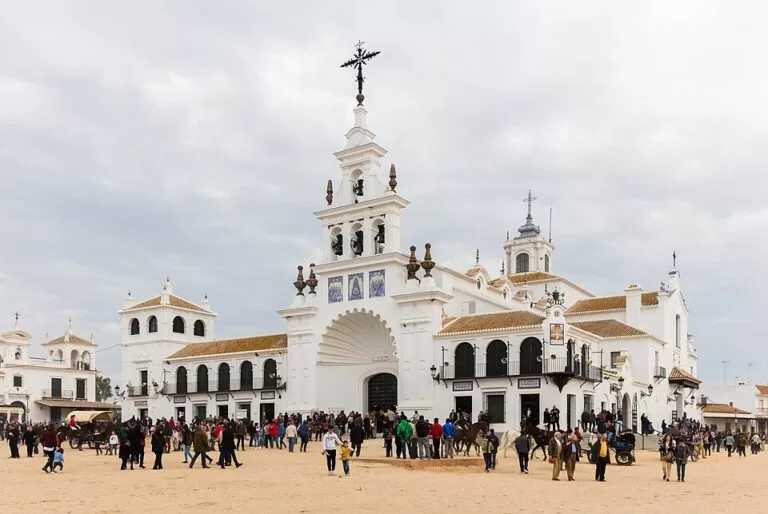
El Rocío is the village of sand streets and white houses on the edge of the Doñana marshes, in the municipality of Almonte (Huelva), on the A-483 about 15 km inland from Matalascañas. It grew up around the shrine of the Virgen del Rocío, the “Blanca Paloma”, and at Pentecost more than a million people arrive for the Romería del Rocío, Spain’s best-known pilgrimage. The rest of the year it is a quiet place to see the shrine, look out over the marsh from the village edge and start a visit to Doñana from the La Rocina visitor centre, 1 km away. It suits birdwatchers, photographers and anyone curious about Andalusian traditions; skip it at Pentecost unless you want the crowds.
Quick facts
- Names: El Rocío, also “la aldea” (the village); the shrine is officially the Santuario de Nuestra Señora del Rocío, usually called the Ermita del Rocío.
- Where: a village of Almonte (Huelva), on the A-483 between Almonte and Matalascañas, at the door of Doñana National Park (Andalusia tourism board).
- Coordinates: 37.1307, -6.4847 (the shrine).
- Distances: 15 km from Matalascañas (Andalusia tourism board); 17 km from the town of Almonte (spain.info).
- Protection: the village and its shrine were declared a Bien de Interés Cultural, as a historic site, in 2006 (Spanish Wikipedia).
- Romería 2027: 14–17 May 2027, according to spain.info; Pentecost Sunday is 16 May.
Access and parking
By car: from Huelva or Seville take the A-49 motorway and then the A-483 south through Almonte; El Rocío and Matalascañas are both on the A-483 (Andalusia tourism board). From Huelva it is exit 50 of the A-49, from Seville exit 48.
Parking: OpenStreetMap shows several small car parks on the west side of the village, about 200 m from the shrine near the marsh viewpoint, and one about 60 m north of the shrine. We could not confirm whether any of them charge. During the Romería, the tourism board warns of traffic jams of several hours; normal parking does not apply then.
By bus: the DAMAS bus company links the three centres of Almonte (the town, El Rocío and Matalascañas) with Huelva, Seville and other towns (Andalusia tourism board). Check timetables with the operator; there is a bus stop on the main road through the village (OpenStreetMap).
By train and air: the nearest railway stations are La Palma del Condado (14 km), Huelva (45 km) and Seville (60 km). The nearest airports are Seville (64 km), Jerez (146 km) and Faro in Portugal (156 km), all as given by the tourism board.
What to expect
The Andalusia tourism board describes a village of small white houses with a lot of tradition, all around the shrine of the Virgen del Rocío (Andalucía.org). The streets are sand, not tarmac, and low houses have porches and posts for tying up horses (Spanish Wikipedia). The tourism board notes that horse culture has made the village the main venue for show-jumping in its district.
- The Ermita del Rocío: the large white shrine on the edge of the marsh. The present building, by the architects Antonio Delgado y Roig and Alberto Balbontín de Orta, was finished in 1969; earlier shrines stood here since the Middle Ages, and the first written reference to Santa María de las Rocinas is from 1335. The Virgin’s statue dates from the 14th century (Andalusia tourism board; Spanish Wikipedia).
- The marsh front: the village looks south over the marsh, part of the Doñana protected area. OpenStreetMap marks a viewpoint, the Mirador del Rocío, about 200 m west of the shrine.
- La Rocina visitor centre: 1 km from the village towards Matalascañas on the A-483, and reachable on foot from El Rocío. It has an exhibition on the Romería in a traditional hut and the Charco de la Boca footpath (Doñana National Park, MITECO).
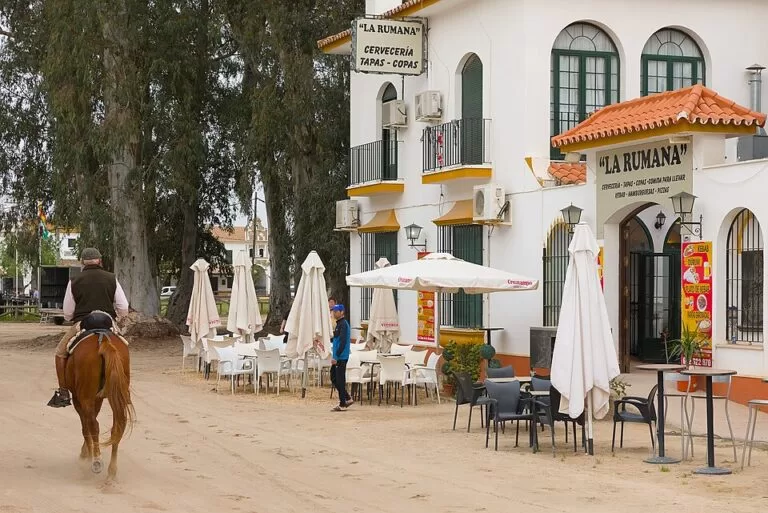
The Romería. Held 50 days after Easter, the pilgrimage brings close to a hundred brotherhoods from Huelva, Seville, Cádiz and further away. They travel for days on horseback, in carts or on foot by four main routes, including one from Sanlúcar through Doñana, and camp out at night. The high point comes in the early hours of Pentecost Monday, when the people of Almonte jump the altar railings, the “salto de la reja”, to carry the Virgin out of the shrine in procession through the village (spain.info; Andalusia tourism board). Another tradition, on 26 June, is the Saca de las Yeguas, when the wild mares that graze in the park are rounded up (spain.info).
Practical details
- Doñana visits: to enter the interior of the national park you need a guided tour. The licensed company Marismas del Rocío runs four-hour trips of about 80 km in all-terrain vehicles from its base on the A-483 (Andalusia tourism board). Book ahead.
- La Rocina hours: November–January 9:00–15:00 and 16:00–18:00; February–October 9:00–15:00 and 16:00–19:00; Sundays from 15 June to 15 September 9:00–15:00 only. Closed on 1, 5 and 6 January, 24, 25 and 31 December and during the Romería (MITECO, checked November 2026).
- Palacio del Acebrón: another visitor centre, 6 km from La Rocina along a tarmac track that you can drive, cycle or walk, with the Charco del Acebrón footpath (MITECO).
Accessibility and safety
Deep sand streets are hard going for wheelchairs, pushchairs and anyone unsteady on their feet. Share the streets with horses and carriages. During the Romería the village is extremely crowded, with heat, dust and traffic jams of several hours; the tourism board advises patience, and walking with a brotherhood if you do the pilgrim route.
Best time to visit
For quiet and for birds, come outside the Romería, on a weekday; spain.info notes that the marshes are a staging, breeding and wintering site for thousands of European and African birds, so autumn to spring is the season for them. Early morning and the hour before sunset give the softest light over the marsh. Pentecost is the time to see the Romería, but book accommodation far ahead and expect crowds; the visitor centres close then. Devotees visit the shrine every week of the year (Andalusia tourism board).
Nearby alternatives
- Doñana National Park, 12 km away: Europe’s great wetland, with visitor centres at La Rocina, El Acebuche and El Acebrón.
- Almonte, 15 km away: the town that El Rocío belongs to, in the Condado.
- Playa de Matalascañas, 16 km away: the long resort beach where Doñana’s open coast begins.
- Bollullos Par del Condado, 24 km away: bodegas of the Condado de Huelva wine route.
- Playa de Mazagón, 30 km away: a long beach under fossil dunes and pine woods.
Distances are in a straight line from the shrine.
FAQ
When is the El Rocío pilgrimage in 2027?
Spain.info lists 14–17 May 2027. The Romería is always at Pentecost, 50 days after Easter, and ends on Pentecost Monday.
Can you visit El Rocío outside the Romería?
Yes. The shrine and the village are open all year, and devotees visit every week. It is a good base for La Rocina and the Palacio del Acebrón visitor centres of Doñana.
How do I get to El Rocío from Seville?
By car on the A-49 to exit 48 and then the A-483 through Almonte. DAMAS buses link El Rocío with Seville and Huelva.
Is there parking in El Rocío?
Yes, there are small car parks on the west side near the marsh and one north of the shrine. During the Romería roads are jammed and normal parking does not apply.
Sources and freshness
Checked 7 November 2026 · 3 sources Show
Checked 7 November 2026. Official:
- Andalusia tourism board pages on the village of El Rocío (description, access by car, bus, train and air), El Rocío, El Rocío listing, the Romería del Rocío and Marismas del Rocío
- spain.info on the pilgrimage and Doñana National Park
- Doñana National Park (MITECO) on the La Rocina and Palacio del Acebrón visitor centres. The Almonte town hall site could not be reached. Background and history: Spanish Wikipedia on El Rocío and the shrine. Location, parking and distances: OpenStreetMap contributors (ODbL). Photos: Wikimedia Commons, licences as credited
This place is part of our Costa de la Luz, Spain: beaches, towns, sherry and map — see every town, beach and cove we have mapped on that coast.
How this page is made. CostaMap is written with an AI editorial system run by Ebizapple. This page is based on the sources listed above. Last updated 6 November 2026. Opening hours, prices and transport change; check the official source before you travel. How we work · Partner links and ads