
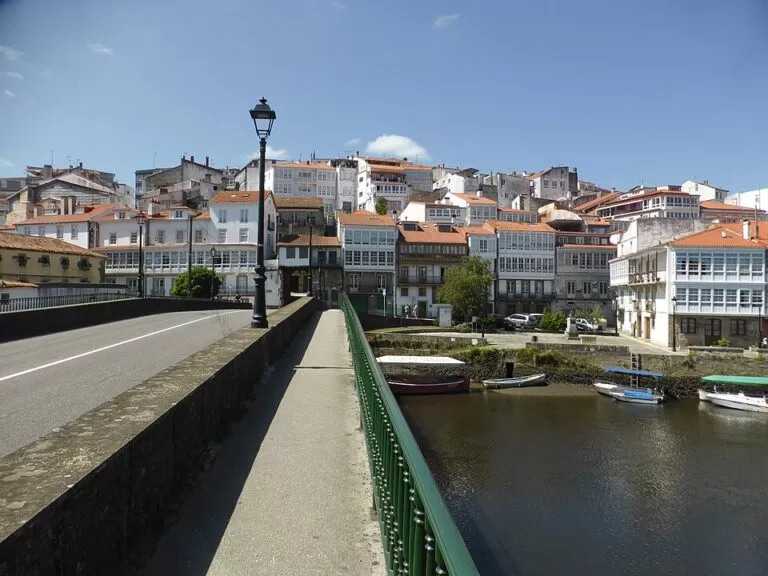
Betanzos is a small historic town at the head of the Ría de Betanzos in A Coruña province, Galicia, about 18 km east of A Coruña city in a straight line. Its old centre sits on a hill between the rivers Mendo and Mandeo, with three Gothic churches, glazed balconies and the tomb of the Andrade lords, and it is a stop on the English Way to Santiago. You get there by the A-6 or AP-9, or by train to Betanzos-Infesta. It suits a half-day or day trip from A Coruña or Ferrol for history, food and festivals; skip it if you want a beach town.
Quick facts
- Names: Betanzos in Galician and Castilian; the Romans called it Brigantium, according to spain.info. Spanish Wikipedia gives the old nickname “Betanzos de los Caballeros”.
- Where: As Mariñas district, province of A Coruña, at the inner end of the Ría de Betanzos, where the Mendo joins the Mandeo.
- Coordinates (Praza dos Irmáns García Naveira): 43.2793, -8.2105.
- Population: 13,533 (INE 2025, via Spanish Wikipedia).
- Status: the old quarter is a Historic-Artistic Site and a Ben de Interese Cultural (Turismo de Galicia).
- History: one of the seven capitals of the old Kingdom of Galicia (spain.info).
- Known for: Gothic churches, the Parque do Pasatempo, the San Roque paper balloon in August, the Feira Franca medieval fair, and its potato omelette.
Getting there and parking
By car: Turismo de Galicia says the A-6 highway, the AP-9 motorway and the N-VI road all serve Betanzos. A Coruña is about 18 km away in a straight line, Ferrol about 23 km and A Coruña airport (Alvedro) about 14 km.
By train: Betanzos-Infesta station is about 1.5 km south-west of the old centre. It is the junction where the line to Ferrol leaves the A Coruña line (Spanish Wikipedia). We could not confirm current timetables.
Parking: OpenStreetMap marks a free surface car park at Betanzos-Infesta station and surface parking on Avenida de Fraga Iribarne, about 750 m west of the main square. The old town streets are steep and narrow; park below and walk up.
On foot: Betanzos is on the English Way (Camiño Inglés) from Ferrol to Santiago. Pilgrims cross the Ponte Vella over the Mandeo into town.
What to see
The old town. Turismo de Galicia calls Betanzos’s historic centre one of the most beautiful in Galicia. It was once walled and keeps houses with arched doorways of medieval tradition, and quiet streets lined with balconies and glazed galleries (Turismo de Galicia, As Mariñas). The official list of its monuments includes the 17th-century Hospital de San Antonio, the 18th-century town hall, the Pazo de Lanzós and the Pazo de Bendaña (both 15th century with later work), the convent of Santo Domingo and the 18th-century building of the Archive of the Kingdom of Galicia, now the Museo das Mariñas.
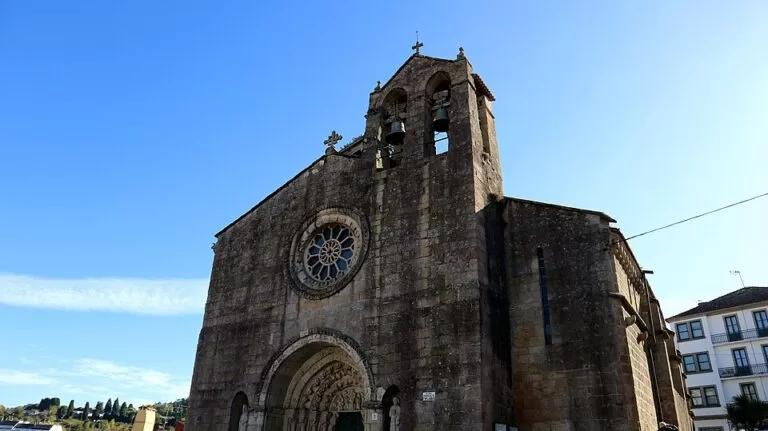
Three Gothic churches. Turismo de Galicia calls Betanzos the “capital of Galician Gothic”. Spain.info names three churches that give the town its character: Santiago, Santa María do Azougue and San Francisco. San Francisco (13th–14th century) holds medieval sarcophagi, among them the tomb of Fernán Pérez de Andrade, carried on a wild boar and a bear, the animals of his family. Spanish Wikipedia notes that he was known as O Bo, “the Good”, and that Enrique II gave him the lordships of Ferrol, Pontedeume and Vilalba. Santa María do Azougue is Gothic with a Baroque remodelling, and the church of Santiago dates from the 15th century.
Parque do Pasatempo. A park built in the late 19th and early 20th century by the García Naveira brothers, emigrants who returned from America. Turismo de Galicia calls it the first theme park in the West, and spain.info says its makers were ahead of the concept of a modern theme park.
The ría and the rivers. Until the 18th century the port of Betanzos was one of the main fishing and trading centres of the old Kingdom of Galicia; river sediment later filled the estuary. Today the Ría de Betanzos has one of the largest areas of coastal mudflats in Galicia, protected as the Betanzos-Mandeo Natura 2000 site, and a small port where the two rivers meet (Turismo de Galicia).
Food and wine
Turismo de Galicia sends visitors to Betanzos for its potato omelette, and Spanish Wikipedia describes the local style as barely set. Spain.info mentions the local wine, light and fruity, served in simple taverns marked only by a bay branch over the door. The wines of the area are protected as Viños da Terra de Betanzos, which also covers Bergondo, Coirós, Miño, Paderne, Abegondo, Oza-Cesuras and Sada.
Festivals
San Roque (14–25 August). On 16 August the town launches what Turismo de Galicia calls the world’s largest paper balloon, followed by fireworks. On two days, boats decorated with flags and lanterns carry crowds up the Mandeo to the meadows of Os Caneiros for a picnic, leaving from the Paseo da Tolerancia (Turismo de Galicia).
Feira Franca Medieval (July). Held since 1998 in memory of the free fair granted to the town in 1467. The streets are hung with banners, there are about 150 stalls, re-enactments and a horseback tournament in the Praza dos Irmáns García Naveira (Turismo de Galicia). Spanish Wikipedia places it on the second weekend of July; check the fair website for the year’s dates.
Practical details
- The churches and the park have their own opening times, which we could not confirm. Ask at the town’s tourist office before planning around a visit inside.
- Expect crowds and closed streets during San Roque in August and the medieval fair in July.
Accessibility and safety
The old town is on a hill, so expect steep, cobbled streets and steps. The riverside around the Ponte Vella and the main squares below the hill are flatter. Watch for traffic on the narrow streets without pavements.
Best time to visit
Any time of year for the old town and the churches. Come in mid-August for San Roque and the balloon, or in July for the medieval fair, if you like festivals and do not mind crowds. Outside those dates the town is quiet.
Nearby alternatives
- A Coruña, about 18 km west: the city, its glazed galleries and its town beaches.
- Tower of Hercules, about 20 km west: the Roman lighthouse, still working, a World Heritage Site.
- Fragas do Eume Natural Park, about 19 km north-east to the Caaveiro monastery: Atlantic riverside forest above Pontedeume.
- Ferrol, about 23 km north: the 18th-century naval city with the Magdalena quarter and the Arsenal.
- Cedeira, about 44 km north: a fishing town on a small ría below the Capelada cliffs.
Distances are in a straight line from the Praza dos Irmáns García Naveira. Closer still, the Pazo de Mariñán in Bergondo, about 5 km north beside the ría, has formal gardens that can be visited during visiting hours (Turismo de Galicia).
FAQ
Is Betanzos worth visiting?
Yes, for a few hours. It has one of the best-kept old towns in Galicia, three Gothic churches, the Pasatempo park and good food, and it is less than half an hour by road from A Coruña.
How do I get from A Coruña to Betanzos?
By car on the A-6, AP-9 or N-VI, or by train to Betanzos-Infesta, about 1.5 km from the old town. The straight-line distance is about 18 km.
Where can I park in Betanzos?
OpenStreetMap shows a free car park at Betanzos-Infesta station and surface parking on Avenida de Fraga Iribarne, about 750 m from the main square. Park below the old town and walk up.
When is the San Roque balloon in Betanzos?
On 16 August, during the San Roque festivities that run from 14 to 25 August. The boat trips to Os Caneiros happen on two days of the festivities.
Sources and freshness
Checked 9 November 2026 · 11 sources Show
Checked 9 November 2026. Official: Turismo de Galicia, As Mariñas (old town, Pasatempo, omelette, festivals, wine), Ría de Ares e Betanzos (capital of Galician Gothic), Zona Antiga de Betanzos (monuments and dates), Betanzos-Mandeo (port history, mudflats, access, Chelo), San Roque, Feira Franca Medieval and Pazo de Mariñán gardens; spain.info, Betanzos (Brigantium, capital of the kingdom, churches, Andrade tomb, wine). Background: Spanish Wikipedia (population, Andrade lordships, omelette style, fair weekend) and Spanish Wikipedia on Ferrol (Betanzos-Infesta junction). The town hall website could not be reached when we checked. Station, car parks and straight-line distances: OpenStreetMap contributors (ODbL). Photos: Wikimedia Commons, licences as credited.
How this page is made. CostaMap is written with an AI editorial system run by Ebizapple. This page is based on the sources listed above. Last updated 9 November 2026. Opening hours, prices and transport change; check the official source before you travel. How we work · Partner links and ads