
The Tower of Hercules is the Roman lighthouse of A Coruña, on the headland at the northern tip of the city, about 1.9 km in a straight line from the Praza de María Pita. Built in the late 1st or early 2nd century AD and still working, it is described by Turismo de Galicia as the oldest working lighthouse in the world, and it has been a UNESCO World Heritage Site since 2009. You reach it on foot along the seafront promenade, by city bus or by car, with free parking about 400 m away. It suits anyone interested in Roman history, lighthouses or a windy Atlantic walk; skip the climb if you cannot manage a long, narrow stair.

Quick facts
- Names: Tower of Hercules in English; Torre de Hércules in both Galician and Castilian. Until the 20th century it was known as Farum Brigantium.
- Where: Avenida de Navarra s/n, 15002 A Coruña, at the end of the peninsula north of the city centre.
- Coordinates: 43.3859, -8.4065.
- Built: by the Romans, probably at the end of the 1st or start of the 2nd century AD, attributed to the time of Emperor Trajan (98–117). An inscription at its foot names the architect, Gaius Sevius Lupus of Aeminium (today Coimbra, Portugal).
- Height: 55 m, of which 34 m is the Roman core and 21 m was added in the 18th-century restoration (Wikipedia).
- Present façade: from the 1791 reform designed by the engineer Eustaquio Giannini, with J. Elejalde.
- Status: UNESCO World Heritage Site since 27 June 2009; Ben de Interese Cultural (protected heritage site).
- Phone (listed by Turismo de Galicia): +34 981 223 730.
Access and parking
On foot: the Turismo de Galicia city route takes you from the old town past the San Antón castle and along the seafront promenade (Paseo Marítimo) to the tower, then on to the Aquarium Finisterrae and Orzán beach. From the Praza de María Pita the tower is about 1.9 km in a straight line; the promenade around the peninsula is longer.
By bus: OpenStreetMap shows the Glorieta da Torre stop, served by line 3A, about 400 m south-east of the tower, and the Paseo Marítimo 9 stop (lines 3A and 11) about 680 m south. Check current lines with the city bus operator before you go.
By car: OpenStreetMap marks a free surface car park named Torre de Hércules about 400 m south-east of the tower, near the visitor centre, and a free car park by the Aquarium about 500 m to the south-west. The last stretch to the tower is on foot through the park.
What to expect
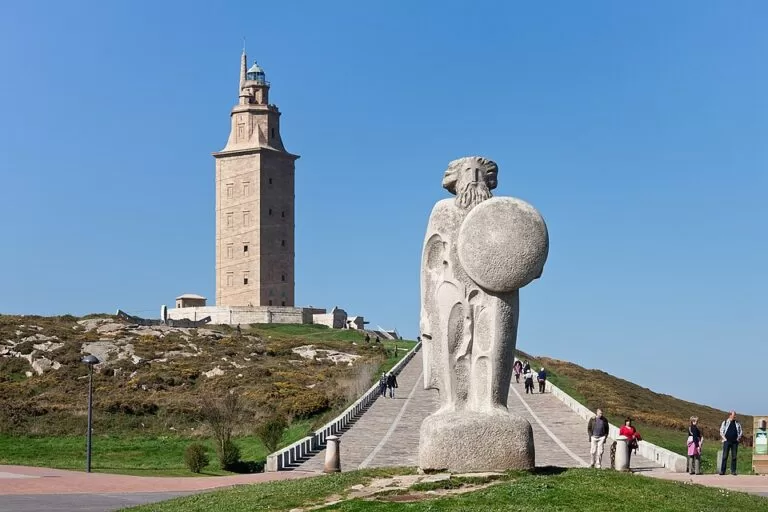
The tower stands in an open park on the headland. Turismo de Galicia describes a square exterior with windows. You enter through the archaeological excavations around the base, and a stair leads to the top, turning into a spiral in its last stretch. There is a small museum inside. The interior keeps the Roman core: a square base with four rooms, once divided into three floors with barrel vaults, which may have stored fuel for the fire at the top and sheltered the keepers.
The history is long. After the fall of Rome the tower stopped working as a lighthouse. In the Middle Ages it served as a fort, and from the 13th century it was used as a quarry for the new town of A Coruña, which took away its outer wall and ramp. The light was brought back from the 17th century, and the 18th-century restoration restored the Roman core and added the top 21 m. At the foot of the tower a small building protects the Roman inscription carved in the rock (Turismo de Galicia, history of the tower).
The park around it holds sculptures on the legends of the tower and the city: Átrabros by Arturo Andrade, Breogán by Xosé Cid, Caronte by Ramón Conde, Hercules and Geryon by Tim Behrens and José Espora, and the Menhir Forest by Manolo Paz. Turismo de Galicia picks the sunset from the tower as one of the city’s best moments. The area also takes in the old city jail.
Tickets, opening and works
We could not reach the city’s official Tower of Hercules and ticketing pages when checking this guide, so we give no hours or prices here. Check the A Coruña city council website before you go.
Works are planned on the site. In June 2025 the Xunta de Galicia announced works worth 995,000 euros, to be tendered that summer, awarded at the end of 2025 and carried out in the first half of 2026. The plan covers excavation around the base of the tower, better access, repairs to the archaeological area, work in the Giannini rooms, the upper terrace and the small building over the inscription, new ornamental lighting, and restored paths in the protected natural area around the monument (Xunta de Galicia, June 2025). We could not confirm from an official source whether the interior is open in November 2026, or whether the works are finished. Ask the city before planning a climb.
Accessibility and safety
The climb is by stair only, spiral at the top, and OpenStreetMap tags the tower as not wheelchair accessible. The park, the sculptures and the views can be enjoyed without going inside. OpenStreetMap shows free public toilets, tagged wheelchair accessible, about 20 m from the tower, and drinking fountains in the park. The headland is exposed: wind and rain come straight off the Atlantic, so bring a layer and keep back from the rocky edges, especially in storms.
Best time to visit
Turismo de Galicia recommends sunset, when the sun goes down into the Atlantic beside the tower. Go on a clear day for the views along the coast. In bad weather the park is very windy, but the walk out along the promenade is still possible.
Nearby alternatives
- Aquarium Finisterrae, about 350 m south-west: the city aquarium on the promenade, run by the city council (OpenStreetMap).
- Praia das Lapas, about 230 m south: a sandy beach just below the tower.
- Orzán and Riazor beaches, 1.6–1.9 km south: the two big city beaches, at the end of the promenade route.
- Camping As Nevedas, about 20 km south-west: a campsite if you want a base outside the city.
Distances are in a straight line from the tower.
FAQ
Can you go inside the Tower of Hercules?
The tower is normally visitable, with a museum inside and a stair to the top, according to Turismo de Galicia. Works were planned for 2026, and we could not confirm current access, so check with A Coruña city council before you go.
How do I get to the Tower of Hercules?
Walk the seafront promenade from the old town, take a city bus (line 3A stops about 400 m away, according to OpenStreetMap), or drive and use the free car park about 400 m south-east.
Is there parking at the Tower of Hercules?
Yes. OpenStreetMap marks a free car park about 400 m south-east of the tower and another free one by the Aquarium, about 500 m away.
Why is it called the Tower of Hercules?
A legend says Hercules killed the giant Geryon here, buried his head and ordered a city built on the spot. The lighthouse appears on the coat of arms of A Coruña.
Is the Tower of Hercules still a working lighthouse?
Yes. Turismo de Galicia describes it as the oldest working lighthouse in the world.
Sources and freshness
Checked 6 November 2026 · 7 sources Show
Checked 6 November 2026. Official: Turismo de Galicia, Tower of Hércules (description, visit, museum), history of the tower (dates, architect, inscription, medieval use), resource page (address, phone) and A Coruña city page (sculptures, 1791 façade, promenade route, sunset); Xunta de Galicia on the 2026 improvement works (June 2025). Background: Wikipedia (height, UNESCO date, former name, legend). The A Coruña city council website could not be reached. Location, car parks, bus stops, toilets and distances: OpenStreetMap contributors (ODbL). Photos: Wikimedia Commons, licences as credited.
How this page is made. CostaMap is written with an AI editorial system run by Ebizapple. This page is based on the sources listed above. Last updated 6 November 2026. Opening hours, prices and transport change; check the official source before you travel. How we work · Partner links and ads