
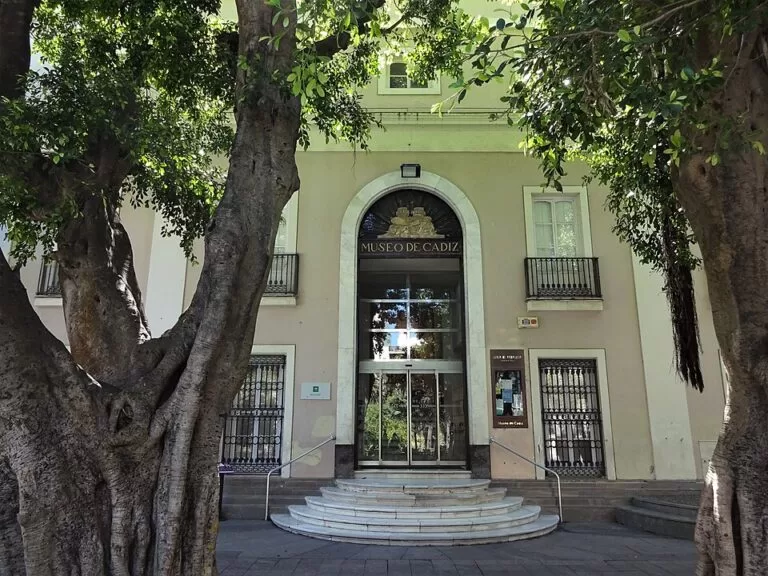
The Museum of Cádiz (Museo de Cádiz) is the provincial museum on the Plaza de Mina, in the north of Cádiz’s old town, 0.7 km from the cathedral and 1.2 km from the railway station. It is known for two marble Phoenician sarcophagi of the 5th century BC, for Zurbarán paintings from the Charterhouse of Jerez, and for the Tía Norica puppets. It suits anyone spending a day in Cádiz; skip it only if you have no interest in either ancient history or Spanish painting.
Quick facts
- Names: Museo de Cádiz; in English, the Museum of Cádiz or Cádiz Museum.
- Where: Plaza de Mina s/n, 11004 Cádiz.
- Coordinates: 36.5349, -6.2963.
- Sections: archaeology on the ground floor, fine art on the first, ethnography (the Tía Norica puppets) on the second.
- Formed: in 1970, when the provincial fine arts and archaeology museums, already in the same building, were merged.
- Building: a neoclassical building on land of the former convent of San Francisco, by Juan Daura, opened in 1838; a Bien de Interés Cultural.
- Entry: free for citizens of the European Union (Wikipedia).
- Phone: +34 956 008 150 or +34 856 105 023 (Andalusia tourist board).
Access and parking
On foot: the Plaza de Mina is a garden square a block in from the Alameda seafront. The cathedral is 0.7 km south and Cádiz railway station 1.2 km south-east, both in a straight line.
By bus: OpenStreetMap shows stops at Alameda Clara Campoamor, about 220 m north-east, and at Plaza de España, about 300 m east.
Parking: OpenStreetMap shows the Parking San Antonio, an underground paid car park with 468 spaces open 24 hours, about 240 m west of the museum, under the Plaza de San Antonio. Street parking in the old town is very limited.
What to expect
Archaeology. The highlight is the pair of Phoenician anthropoid sarcophagi of the 5th century BC (spain.info), the only two Phoenician sarcophagi found in Spain. The male one turned up by chance on 30 May 1887 in the Punta de la Vaca necropolis, and its discovery led to the creation of the museum’s archaeology section (English Wikipedia gives 1877 and the city shipyard instead). Its female counterpart, now called the Dama de Cádiz, was found almost a century later, on 26 September 1980, during building work in the calle Ruiz de Alda. Both were carved in the Phoenician city of Sidon. Research on the bones has since shown that the person buried in the “lady” was a robust man aged about 45 to 50 (Wikipedia). Roman finds come from Baelo Claudia, Medina Sidonia, Sancti Petri and Gades itself.
Fine art. The art collection began in 1835 with paintings taken from dissolved monasteries, including Zurbarán’s works from the Charterhouse of Jerez (Wikipedia). The Andalusia tourist board lists baroque rooms with works by Zurbarán, Alonso Cano, Rubens and Murillo, then paintings from the 16th to the 20th century: 19th-century genre and history painting, and 20th-century artists such as Sorolla and Zuloaga (andalucia.org). All the Zurbaráns come from the Jerez Charterhouse except Pentecost (Spanish Wikipedia).
The puppets. The top floor holds the Tía Norica puppets, a Cádiz puppet-theatre tradition dated to around 1790 and known for its Christmas nativity shows in the 19th century; the old company’s last show was in 1977. The oldest pieces passed to the museum, and the set was declared a Bien de Interés Cultural (Wikipedia).
Practical details
- Time needed: 1.5 to 2 hours for all three floors; about an hour for the archaeology alone.
- Tickets: free for EU citizens according to Wikipedia; we could not confirm the 2026 price for other visitors.
- Opening hours: we could not confirm 2026 hours; the Junta de Andalucía’s museum pages could not be reached when we checked. Check before you go.
- Next door: Casa Pinillos, a historic house on the same square, is marked as a sight on OpenStreetMap.
- Contact: museocadiz.ccul@juntadeandalucia.es (Andalusia tourist board).
Accessibility and safety
The Andalusia tourist board marks the museum as accessible for people with disabilities, with services for disabled visitors. The Plaza de Mina is flat and pedestrian-friendly. We could not confirm lift access to every floor, so ask at the entrance if stairs are a problem.
Best time to visit
Any time of year. In summer it makes a cool break from the beach in the middle of the day; in winter it is an obvious choice on a rainy day. It is a short walk from the cathedral, so the two fit easily into one morning.
Nearby alternatives
- Cádiz, 0.7 km away: our guide to the city on its narrow peninsula.
- Cádiz Cathedral, 0.7 km away: the domed cathedral on the seafront.
- Puerto Sherry, 6 km away across the bay: the marina at El Puerto de Santa María.
- El Puerto de Santa María, 9 km away: the sherry port across the bay.
- Jerez Archaeological Museum, 21.5 km away: Jerez’s own archaeology museum, with a 7th-century BC Greek helmet.
Distances are in a straight line from the museum.
FAQ
Is the Museum of Cádiz free?
Entry is free for citizens of the European Union, according to Wikipedia. We could not confirm the current price for other visitors.
Where is the Museum of Cádiz?
On the Plaza de Mina in the north of the old town, 0.7 km from the cathedral. Coordinates: 36.5349, -6.2963.
Is there parking near the Museum of Cádiz?
Yes. The underground Parking San Antonio, with 468 paid spaces and open 24 hours according to OpenStreetMap, is about 240 m away.
What are the Phoenician sarcophagi?
Two marble coffins carved in human form in Sidon in the 5th century BC and found in Cádiz in 1887 and 1980. They are the only Phoenician sarcophagi found in Spain and are shown on the ground floor.
How long should I allow?
About 1.5 to 2 hours for the whole museum, or an hour if you only see the archaeology.
Sources and freshness
Checked 6 November 2026 · 7 sources Show
Checked 6 November 2026. Official: Andalusia tourist board, Museo de Cádiz (address, sections, painters, phones, accessibility); spain.info (sections, sarcophagi date). Background: Wikipedia on the Museum of Cádiz (1970 merger, origins, EU free entry), Museo de Cádiz (building, Roman finds, paintings), Dama de Cádiz (sarcophagi finds) and Tía Norica. The Junta de Andalucía’s museum pages could not be reached for hours and prices. Location, parking, bus stops and distances: OpenStreetMap contributors (ODbL). Photos: Wikimedia Commons, licences as credited.
This place is part of our Costa de la Luz, Spain: beaches, towns, sherry and map — see every town, beach and cove we have mapped on that coast.
How this page is made. CostaMap is written with an AI editorial system run by Ebizapple. This page is based on the sources listed above. Last updated 6 November 2026. Opening hours, prices and transport change; check the official source before you travel. How we work · Partner links and ads