
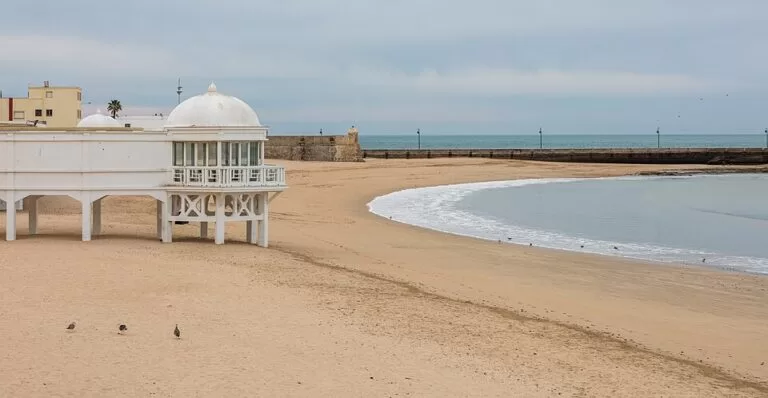
La Caleta is the beach of Cádiz’s old town: a 495 m curve of fine golden sand between the castles of Santa Catalina and San Sebastián, with the white 1926 bathing pavilion standing on stilts in the middle. You walk there from the historic centre, or take city bus line 7 to the stop beside the sand. The water is calm, there are lifeguards, toilets and showers, and the beach holds a Blue Flag. It suits anyone staying in Cádiz who wants a swim without leaving the old town; skip it if you want space, because it is the city’s most popular beach and fills up fast.
Quick facts
- Names: La Caleta, or Playa de La Caleta; Spanish for “the little cove”.
- Where: west side of Cádiz’s historic centre, below the Avenida Duque de Nájera, in the La Viña district.
- Coordinates: 36.5313, -6.3059.
- Size: 495 m long and 50 m wide (Andalusia tourism).
- Sand and water: fine golden sand; calm water.
- Awards: Blue Flag, Q for Tourism Quality and ISO 14001, as listed by Andalusia tourism.
- Facilities: lifeguards, cleaning, toilets, showers, shade areas, umbrella hire, services for disabled visitors.
- Entry: free.
Access and parking
On foot: La Caleta is part of the old town. From the cathedral it is about 1 km west through the narrow streets of La Viña. The regional tourism site rates walking access to the sand as easy.
By bus: OpenStreetMap shows line 7 stopping at “Hospital de Mora – F. Ciencias Empresariales”, right above the beach, and at “Simón Bolívar”, about 200 m north.
Parking: parking in the old town is scarce. OpenStreetMap shows a small paid surface car park about 150 m east of the beach, the paid Aparcamiento Santa Catalina about 340 m north, and the underground Parking El Tenis about 360 m away. In summer, come by bus or on foot.
What to expect
Andalusia’s official tourism site calls La Caleta the most popular beach in Cádiz: an urban beach with heavy use, a small area of sand and a striking setting. Restaurants, beach bars and flamenco venues line the area around it. Boats are moored in the bay, and anchoring on blocks is allowed.
The castles. At the north end, the Castillo de Santa Catalina sits on rocks out in the sea. It was built in the 17th century with a star-shaped plan of Italian influence, later served as a military prison, and was declared a Bien de Interés Cultural in 1985. Today it is a cultural space with temporary exhibitions, workshops and summer concerts in its parade ground (Andalusia tourism). At the south end, a causeway built in 1860 runs from the old Caleta gate, along the Paseo Fernando Quiñones, to the Castillo de San Sebastián (Spanish Wikipedia).
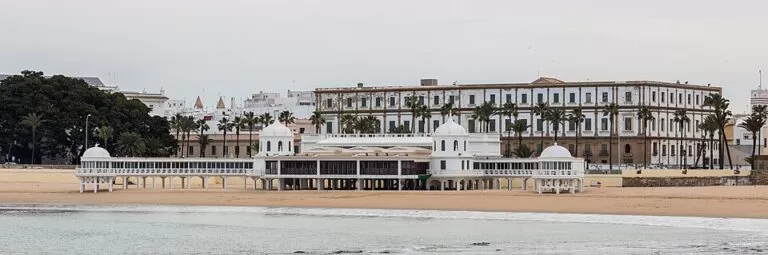
The bathing pavilion. The Balneario de Nuestra Señora de la Palma y del Real opened in 1926, replacing older wooden bathing huts. It stands on pillars on the sand, and today it houses the Andalusian Centre for Underwater Archaeology (Spanish Wikipedia), so it is not a beach bar.
History and film. Spanish Wikipedia describes La Caleta as the natural harbour where Phoenician, Carthaginian and Roman ships anchored. It has been a film set for Die Another Day, Alatriste and Manolete, and it turns up again and again in Cádiz carnival songs.
Practical details
- Services: lifeguards, rescue equipment, beach cleaning, public toilets, showers, shade areas and umbrella hire (Andalusia tourism).
- Toilets: OpenStreetMap marks a wheelchair-accessible toilet about 50 m from the sand and a free one near Santa Catalina castle.
- Tourist information: the beach’s listing gives +34 956 222 668 and caleta.turismo@cadiz.es.
- Events: at the end of August, the Entierro de la Caballa (“burial of the mackerel”) marks the end of summer on the beach, with a mock procession and carnival groups (Spanish Wikipedia).
Accessibility and safety
Andalusia tourism lists La Caleta as accessible for people with disabilities, with services for disabled visitors. The beach lies below the old sea wall, so you go down to the sand from the promenade. The water is usually calm, but the Atlantic tide is large here and at high tide much of the beach is covered, so check the tide before you lay out your towel. Swim when the lifeguards are on duty.
Best time to visit
In July and August, arrive in the morning for a spot on the sand, and check the tide: at low water the beach is much wider. Late August brings the Entierro de la Caballa. Outside summer, it is a quiet place to walk out along the causeway towards San Sebastián.
Nearby alternatives
- Museum of Cádiz, 0.9 km away: the city’s main museum, a short walk away.
- Cádiz Cathedral, 1 km away: the cathedral of Cádiz, in the old town.
- Cádiz town guide, 1.2 km away: the wider guide to the city and its other beaches.
- Puerto Sherry, 7.2 km away across the bay: the marina at El Puerto de Santa María.
- Castle of San Marcos, 10.1 km away: the castle in El Puerto de Santa María.
Distances are in a straight line from the beach.
FAQ
Can you swim at La Caleta in Cádiz?
Yes. The water is calm, and the beach has lifeguards and a Blue Flag. At high tide the beach is narrow, so check the tide times.
Is there parking at La Caleta?
Only a little. There is a small paid car park about 150 m away and paid car parks at Santa Catalina and El Tenis, 340–360 m away. The bus (line 7) or walking is easier.
How do I get to La Caleta from Cádiz centre?
Walk about 1 km west from the cathedral through the La Viña district, or take bus line 7 to the Hospital de Mora stop above the beach.
Can you visit the Balneario on La Caleta?
It is not a bar or a bathing house any more: the 1926 pavilion now houses the Andalusian Centre for Underwater Archaeology.
Which James Bond film was shot at La Caleta?
Die Another Day was filmed here. The beach has also appeared in Alatriste and Manolete.
Sources and freshness
Checked 6 November 2026 · 5 sources Show
Checked 6 November 2026. Official: Andalusia tourism on La Caleta (size, sand, services, accessibility, awards, contact) and Castillo de Santa Catalina. Background: Spanish Wikipedia on Playa de La Caleta (history, causeway, films, Entierro de la Caballa) and the Balneario. Location, bus stops, parking, toilets and distances: OpenStreetMap contributors.
This place is part of our Costa de la Luz, Spain: beaches, towns, sherry and map — see every town, beach and cove we have mapped on that coast.
How this page is made. CostaMap is written with an AI editorial system run by Ebizapple. This page is based on the sources listed above. Last updated 6 November 2026. Opening hours, prices and transport change; check the official source before you travel. How we work · Partner links and ads