
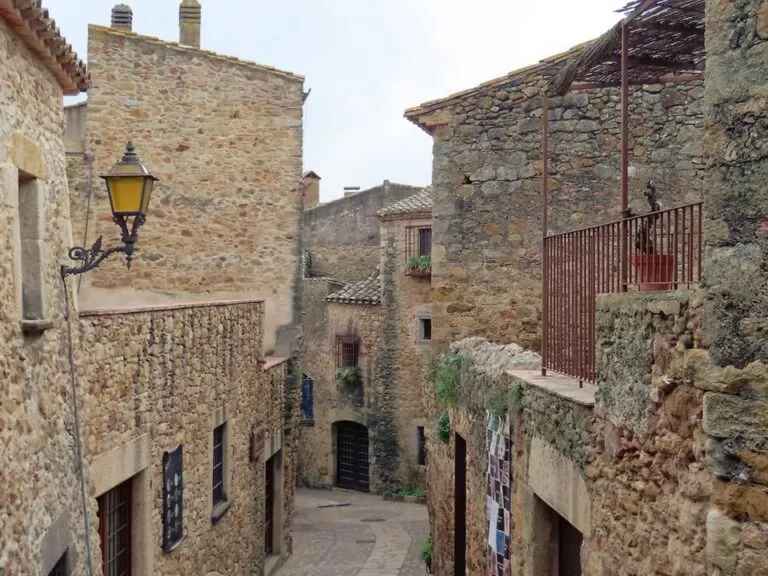
Pals old town, known locally as El Pedró, is a small walled medieval quarter on a hilltop in the Baix Empordà, about 5.5 km in a straight line from Begur and 4.6 km from Peratallada. You park in the car parks below the hill, mostly paid, and walk up through stone lanes to the Torre de les Hores, the church of Sant Pere and the Josep Pla viewpoint over the Empordà plain and the Medes Islands. It suits people who like old villages and views; skip it if you only want a beach, or if stairs and cobbles are a problem.
Quick facts
- Names: Pals old town, historic centre or medieval quarter; in Catalan the neighbourhood is called El Pedró (also “barri del Pedró”). The name Pals comes from the Latin palus, “marshy land”.
- Where: on the hill of Puig Aspre, in the municipality of Pals, Baix Empordà (Girona). The municipality reaches the coast, but the old town is inland.
- Coordinates: 41.9714, 3.1445.
- Main sights: the town walls with four square 12th-century towers, the round Torre de les Hores, the Gothic church of Sant Pere, the Gothic arch on Plaça Major, Ca la Pruna and the Mirador d’en Josep Pla.
- Status: declared a Historic-Artistic Ensemble in 1973.
- Entry: the streets are free to walk. Most car parks around the hill are paid.
- Town hall: Plaça Major 7, tel. 972 636 161 (catalunya.com).
Access and parking
By car: the old town sits on top of the hill, above the newer part of Pals. Inside the medieval core you walk; the Catalan tourist board advises getting around the centre on foot and using a vehicle only for the beaches and residential areas (catalunya.com).
Parking: OpenStreetMap maps several paid surface car parks on the east side of the hill, 150–250 m from the centre, with payment terminals and free public toilets; one of them is reserved for coaches. A short stretch of free street parking lies about 130 m south of the centre, and a larger free car park about 500 m south. We could not confirm tariffs or seasons for the paid car parks.
By bus: the tourist board says there are buses to Palafrugell, Torroella de Montgrí and Girona, especially in summer. OpenStreetMap shows the “Pals, Marquesina” stop about 230 m south-east of the old town. Check timetables before you rely on them.
What to expect
The tourist board calls Pals one of the most picturesque villages on the Costa Brava. The old town was badly damaged during the Spanish Civil War and then abandoned; it was restored over about thirty years from 1948, led by the mayor Pere Servià and the doctor Jaume Pi i Figueres. Pals is first documented at the end of the 9th century, when both the town and the castle are mentioned.
The walled enclosure is one of the best preserved in the Empordà: the walls are almost complete, with only a few sections altered or knocked down, and four square towers from the 12th century still stand. At the top, the castle has gone except for its keep, the round Torre de les Hores, which stands on a podium of natural rock. It is Romanesque, from the 12th century; a small Gothic belfry was added in the 15th century.
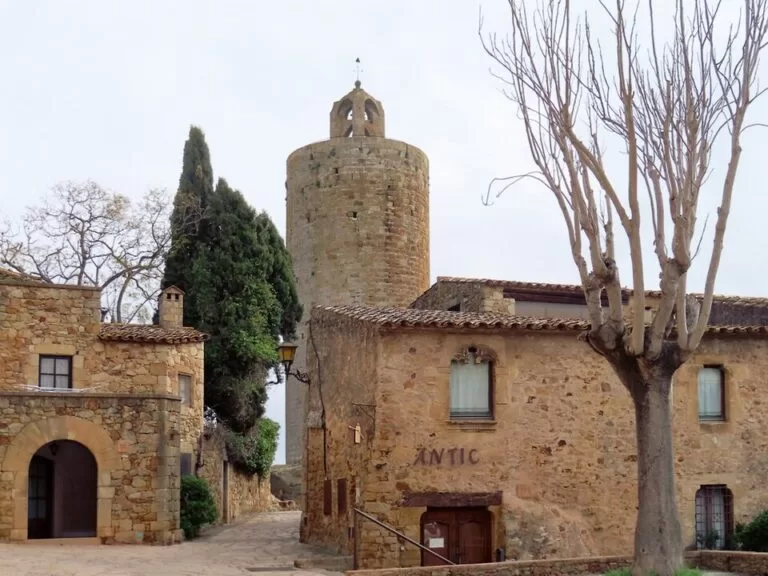
Next to the tower, the church of Sant Pere is documented from 994. The building you see is Gothic, with a single nave and an apse that is semicircular outside and polygonal inside, rebuilt in 1478; the façade is 18th century. On Plaça Major, a Gothic arch marks the old exit from the walled enclosure. The covered lanes hold craft shops, souvenir shops and art galleries.
Ca la Pruna, a Renaissance-style fortified house from the 15th–16th centuries, is the town’s culture house. The tourist board lists an underwater archaeology museum, a permanent exhibition on wines and cavas, and temporary exhibitions there. We could not confirm opening hours or prices.
Finish at the Mirador d’en Josep Pla, on the north-west edge of the old town, named after the writer who praised this view over the Empordà plain to the Medes Islands.
Practical details
- Markets: a weekly market every Tuesday of the year, and a second-hand market on Saturdays (catalunya.com).
- Events: the Festa Major is on the first weekend of August. In October the rice harvest is one of the town’s main festivities.
- Toilets: OpenStreetMap shows free public toilets near Ca la Pruna and beside the east car parks, both tagged wheelchair-accessible.
- Water: public drinking-water taps are mapped near the town hall and around the old town.
- Tourist information: an information point is mapped next to Ca la Pruna; we could not confirm its hours.
Accessibility and safety
The old town is on a hill. OpenStreetMap tags most lanes as setts or rough, unhewn cobblestone, and several sections of Carrer Major and Carrer Abeuredor are steps, some without a handrail. Expect slopes, steps and uneven stone; wheelchair users will find the upper part, around the tower and church, hard to reach. Wear shoes with grip after rain. The tourist board notes that the tramuntana, the local north wind, can exceed 100 km/h.
Best time to visit
The tourist board names summer and weekends as good times, but those are also the busiest. For quieter lanes, come early in the day or outside July and August. Summers are dry and hot; the rainiest period runs from October to May. If you want to see the rice harvest festival, come in October.
Nearby alternatives
- Peratallada, 4.6 km away: a smaller walled village with a rock-cut moat and castle keep.
- Begur, 5.5 km away: a historic centre close to some of the best-known Costa Brava beaches.
- Iberian Town of Ullastret, 6.6 km away: the Iberian settlement the tourist board suggests from Pals.
- Cala Sa Tuna, 7.1 km away: one of the Begur coves.
- Illes Medes, 10.6 km away: the islands you see from the Josep Pla viewpoint.
Distances are in a straight line from Pals old town.
FAQ
Is there parking in Pals old town?
Not inside the medieval core. Paid car parks lie on the east side of the hill, 150–250 m from the centre, with a short stretch of free street parking and a free car park further south.
Is Pals worth visiting?
For a short walk, yes: the walls, the Torre de les Hores, the church of Sant Pere and the Josep Pla viewpoint are all within a few hundred metres. Allow about an hour, longer with a meal or a visit to Ca la Pruna.
How far is Pals from the beach?
The old town is inland. The municipality’s own beach, Platja de Pals, runs for more than 3.5 km between Begur and Torroella de Montgrí; you need a car, bike or bus to reach it.
How do I get to Pals by bus?
Buses link Pals with Palafrugell, Torroella de Montgrí and Girona, more often in summer. The nearest stop to the old town is “Pals, Marquesina”, about 230 m away.
What day is the market in Pals?
Tuesday, every week of the year. There is also a second-hand market on Saturdays.
Sources and freshness
Checked 6 November 2026 · 3 sources Show
Checked 6 November 2026. Official: Catalan Tourist Board pages on Pals (history, restoration, walls, church, Ca la Pruna, viewpoint, beach, buses, markets, events, climate) and Pals old town (walls, Torre de les Hores, Sant Pere). The Pals town hall website could not be reached from our tools. Location, car parks, toilets, taps, bus stop, street surfaces, steps and distances: OpenStreetMap contributors (ODbL). Photos: Wikimedia Commons, licences as credited.
How this page is made. CostaMap is written with an AI editorial system run by Ebizapple. This page is based on the sources listed above. Last updated 6 November 2026. Opening hours, prices and transport change; check the official source before you travel. How we work · Partner links and ads