
A Coruña is the port city on Galicia’s north-west coast, built on a peninsula with the old town and harbour on one side and the Orzán and Riazor beaches on the other. A seafront promenade runs almost all the way round, past the Roman Tower of Hercules. You arrive by train (the station is about 2.4 km from the main square), by plane at the airport about 8 km south, or by car. It suits travellers who want a walkable city with urban beaches, museums and seafood; skip it if you are looking for a quiet resort or warm sea water.
Quick facts
- Names: A Coruña is the official Galician name; La Coruña in Castilian, Corunna, still often used in British English.
- Where: north-west Galicia, capital of the province of A Coruña, on the Ría da Coruña.
- Coordinates (Praza de María Pita): 43.3710, -8.3959.
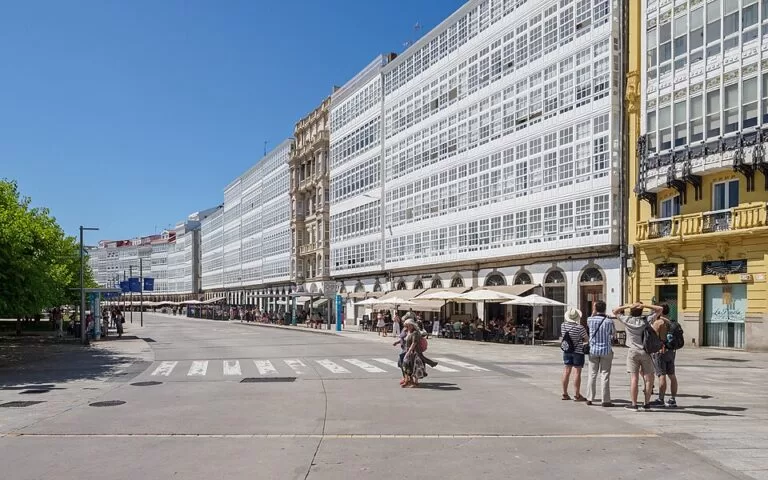
- Nickname: the “Glass City”, for the 19th-century white glazed balconies on Avenida da Mariña (spain.info).
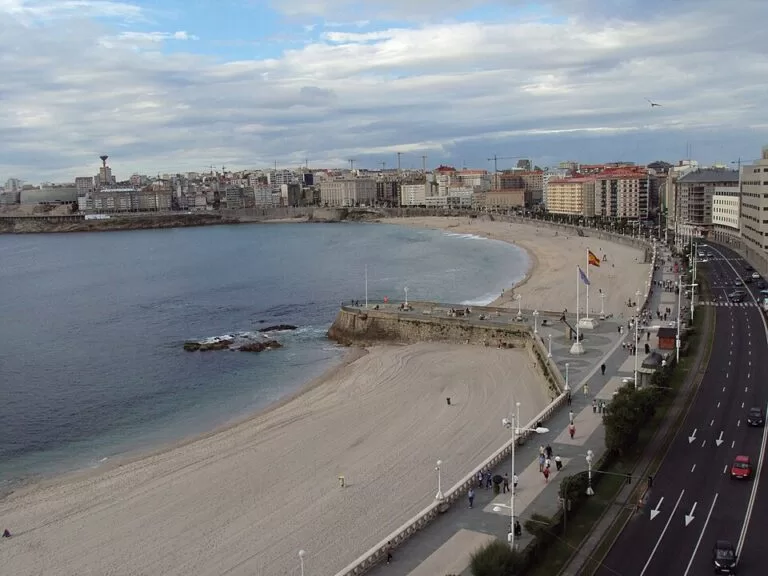
- City beaches: Orzán, about 700 m long and 30 m wide, and Riazor, about 570 m long and 25 m wide, separated by a breakwater (spain.info, Turismo de Galicia).
- Landmark: the Tower of Hercules, a Roman lighthouse and UNESCO World Heritage Site.
- Main festivals: San Xoán bonfires on the night of 23–24 June; the María Pita festivities in August; the patron saint’s day, Virxe do Rosario, on 7 October (Turismo de Galicia).
Getting there and parking
By train: A Coruña railway station is on Avenida do Ferrocarril, about 2.4 km in a straight line south-west of the Praza de María Pita (OpenStreetMap).
By plane: A Coruña airport (Alvedro) is in Culleredo, about 8 km south of the centre in a straight line (OpenStreetMap).
By car: the city centre is compact. OpenStreetMap shows several paid underground car parks close to the sights: Orzán-Riazor under the beach promenade, Praza de Pontevedra near Riazor, and Cantóns, listed with 948 spaces, in the centre. Park once and walk; the old town and the beaches are under 1 km apart.
What to see
Old town (Cidade Vella). Turismo de Galicia’s city walk starts at the Obelisco, follows Real and Rego de Auga streets, the oldest shopping streets, to the Praza de María Pita with its early-20th-century town hall. Above the square lie the 12th-century Church of Santiago, the oldest church in the city according to spain.info, the Collegiate Church of Santa María del Campo with its museum of religious art, and the square and convent of Santa Bárbara. The Gardens of San Carlos sit on an old bastion from 1843 and hold the tomb of the British general Sir John Moore, killed at the Battle of Elviña (Corunna) in 1809.
Port and galleries. Opposite the port, Avenida da Mariña is lined with the white glazed balconies that gave the city its nickname. At one end of the harbour, the late-16th-century Castle of San Antón now houses the archaeological museum (spain.info).
Promenade and Tower of Hercules. From the old town the promenade leads round the peninsula to the Roman lighthouse and its sculpture park, then on past the Aquarium Finisterrae to Orzán beach. See our Tower of Hercules guide.
Museums. Turismo de Galicia and spain.info list the Fine Arts Museum, the Science Museum (Casa das Ciencias), the Domus and the National Science and Technology Museum. Spain.info also describes a Picasso route: the artist lived in A Coruña for almost four years as a child.
Beaches: Orzán and Riazor
The two city beaches form one long curve of golden sand on the Atlantic side of the city, about 0.8–1.1 km west of the Praza de María Pita. Turismo de Galicia notes the waves are good for surfing, and spain.info lists both with moderate waves and surf areas. Spain.info lists toilets, showers and footwashes on both, and sun lounger rental on Riazor. Spain.info rates their occupancy as high. Each June, on the night of San Xoán, the sand fills with bonfires and families grilling sardines.
Food
Turismo de Galicia points to the streets around the Praza de María Pita for the highest concentration of restaurants: Florida, A Franxa, San Nicolás, Galera and Barrera, in the old fish-market quarter. Seafood from the port is the local speciality, along with empanadas, cheese and Galician wine. For typical taverns away from the old town, the same page names the Catro Camiños, A Gaiteira and Os Castros districts.
Accessibility and safety
Much of the centre is flat along the port and the promenade, but the old town climbs uphill from the Praza de María Pita. OpenStreetMap tags a toilet block near Orzán beach as wheelchair accessible; we could not confirm beach access for wheelchairs. The Atlantic is cold and the beaches face open waves: swim only where and when lifeguards are on duty, and keep off the breakwaters in rough weather.
Best time to visit
Summer brings the beach season and the August María Pita festivities. Turismo de Galicia lists music festivals through the year: Música con Raíces in April, the Mozart festival in May and June, and an opera season in September and October. The promenade and the old town work in any season; bring a rain layer outside summer.
Nearby alternatives
- Tower of Hercules, 1.9 km north-west: the Roman lighthouse at the tip of the peninsula.
- Camping As Nevedas, about 20 km south-west: a campsite outside the city.
- Santa Cristina, Bastiagueiro and Mera: beaches on the east side of the Ría da Coruña, named by Turismo de Galicia.
Distances are in a straight line from the Praza de María Pita.
FAQ
Is A Coruña worth visiting?
If you like walkable cities by the sea, yes: a Roman lighthouse, a medieval old town, glazed galleries, museums and two city beaches all lie within about 2 km of the main square.
Can you swim at Riazor and Orzán?
Yes, both are sandy city beaches with services, according to spain.info. The water is Atlantic and the waves are moderate; Turismo de Galicia notes they are good for surfing.
Where should I park in A Coruña?
Use one of the paid underground car parks shown on OpenStreetMap, such as Orzán-Riazor by the beaches or Cantóns near the centre, and walk from there.
How far is the airport from the city?
A Coruña airport (Alvedro) is about 8 km south of the Praza de María Pita in a straight line.
When is San Xoán in A Coruña?
On the night of 23 to 24 June, with bonfires on Riazor beach and in the city’s neighbourhoods.
Sources and freshness
Checked 6 November 2026 · 7 sources Show
Checked 6 November 2026. Official: Turismo de Galicia, A Coruña city page (walking route, museums, food streets, festivals) and Ría da Coruña (beaches, surfing); spain.info, A Coruña (history, churches, galleries, San Antón, Picasso), Riazor beach and Orzán beach (size, services). Background: Wikipedia (names, province). The A Coruña city council and city tourism websites could not be reached. Location, station, airport, car parks, toilets and distances: OpenStreetMap contributors (ODbL). Photos: Wikimedia Commons, licences as credited.
How this page is made. CostaMap is written with an AI editorial system run by Ebizapple. This page is based on the sources listed above. Last updated 6 November 2026. Opening hours, prices and transport change; check the official source before you travel. How we work · Partner links and ads