
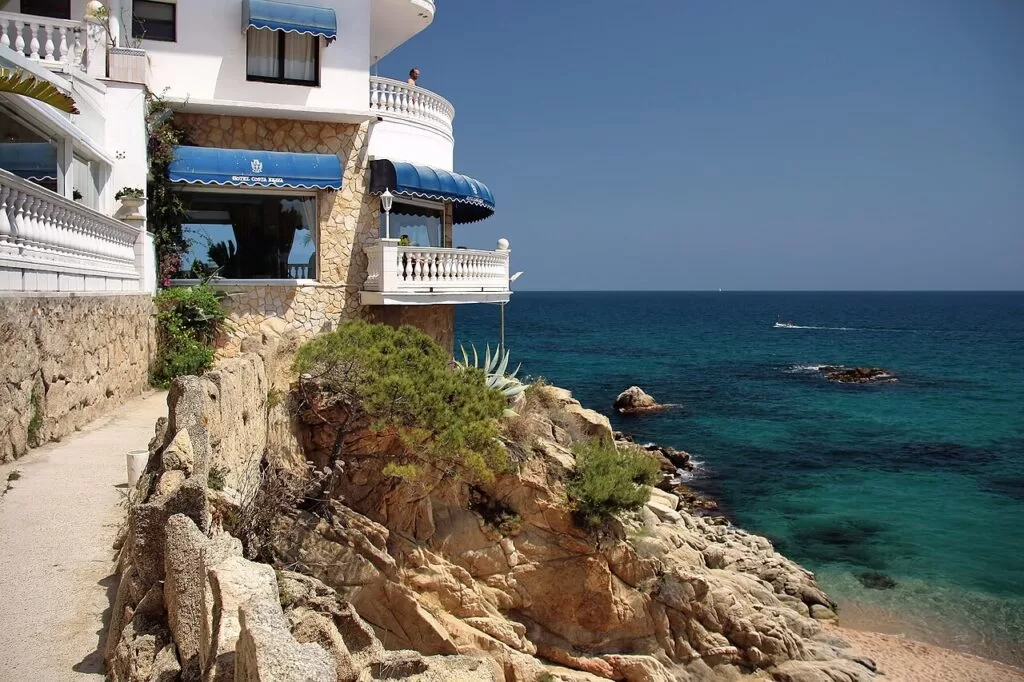
Platja d’Aro is a resort town on the central Costa Brava, built along the Platja Gran, a beach of almost 2.5 km between the mouth of the Ridaura and the Cavall Bernat rock. It belongs to the municipality of Castell-Platja d’Aro, together with the old village of Castell d’Aro and the garden suburb of S’Agaró. It suits families and people who want a long beach with a lively promenade, shops and plenty of accommodation; skip it if you want a quiet fishing village, and go to the coves of Palafrugell or Begur instead.
Quick facts
- Names: Platja d’Aro (Catalan), Playa de Aro (Spanish). The municipality is Castell-Platja d’Aro i S’Agaró.
- Where: Baix Empordà (Girona), between Sant Feliu de Guíxols to the south and Sant Antoni de Calonge and Palamós to the north.
- Coordinates: 41.8185, 3.0688 (town centre).
- Main beach: Platja Gran, also called Platja Llarga, almost 2.5 km long and about 50 m wide on average, with coarse sand (Catalunya.com).
- Symbol: the Cavall Bernat, a large granite rock at the north end of the beach.
- Marina: Port d’Aro, at the south end of the beach.
- Historic centre: Castell d’Aro, about 3 km inland, a Historic-Artistic Monument (Cultural Asset of National Interest) (Catalunya.com).
Getting there and parking
By car: from the AP-7 motorway, leave at exit 9 (Vidreres/Lloret de Mar) and follow the C-35 towards Sant Feliu de Guíxols and Platja d’Aro; the C-31 continues north to Palamós (route as given by Visit Begur for the coast road). We found no official information on public car parks or summer charges.
By bus: OpenStreetMap shows bus stops on Avinguda del Cavall Bernat at the north end of town, among others. We could not open the operator’s timetables, so check them before you travel.
From the airports: Girona–Costa Brava (GRO) and Barcelona El Prat are the airports for this coast; Visit Begur’s road route from Barcelona airport runs to Platja d’Aro on the C-35.
What to expect
Platja d’Aro is one of the main tourist centres on the Catalan coast, with a wide range of leisure activities (Catalunya.com). Spain.info notes that it has some of the greatest variety of accommodation on this stretch, right beside the beaches (Spain.info).
Platja Gran: an urban beach with a sandy bottom and a fairly steep entry into the water. It has toilets, showers, lifeguards, a first-aid post, ramps for people with reduced mobility, beach bars, sunbed and parasol rental, children’s play areas and water-sports centres. At the north end, opposite the Cavall Bernat, the rocky Punta d’en Ramis hides the small Cala Rovira; at the south end the beach joins the Platja del Port and the Port d’Aro marina. A busy promenade with bars, restaurants and hotels runs the whole length, and in summer the beach is crowded despite its size (Catalunya.com).
Sa Conca: west of the marina, opposite S’Agaró, is Sa Conca, 125 m of coarse sand among pines with clear water, which Catalunya.com counts among the prettiest beaches on the Costa Brava. The entry into the sea is steep and it is very busy in summer. A rocky islet separates it from the small Cala d’Oriços (Catalunya.com).
Coves: the municipality also has tiny coves such as Cala del Pi and Sa Cova (Catalunya.com).
Things to do
- Walk the camí de ronda: the coastal path, which follows the GR 92 here, runs behind Sa Conca and on towards Sant Feliu de Guíxols past small coves to the large Sant Pol beach. Our guide to the camí de ronda from S’Agaró to Platja d’Aro covers the walk around S’Agaró.
- Els Estanys park: 150,000 m² in the centre of Platja d’Aro, with a central pond and viewpoints, where up to 250 bird species can be seen (Catalunya.com).
- Castell d’Aro: a historic village of narrow streets, stone houses and arches. Its roots go back to the Middle Ages, around the 11th-century church of Santa Maria and the Benedormiens castle, which was destroyed in the 19th century (Spain.info). In L’Estació park in Castell d’Aro, children can ride the Little Train of the Vall d’Aro, a miniature railway on the site of the old station.
- History: prehistoric burial monuments show early settlement, and the Pla de Palol archaeological site has Roman remains (Spain.info).
- Hiking inland: routes lead into the hills to the Font del Ferro and Font de la Boixa springs, the 16th–17th-century farmhouse of Mas Daussà and the Roques Martines viewpoint over the coast (Spain.info).
- Family events: the tourist office runs a family treasure hunt through Castell d’Aro, Platja d’Aro and S’Agaró, and every summer brings children’s activities and Xalaro, presented as the first family tourism festival on the Costa Brava (Catalunya.com).
Accessibility and safety
The Platja Gran lists ramps for people with reduced mobility, lifeguards and a first-aid post (Catalunya.com); we could not confirm lifeguard dates and hours. The entry into the water is fairly steep on both the Platja Gran and Sa Conca, so keep a close eye on small children.
Best time to visit
Platja d’Aro is a summer resort, and in July and August the beaches are crowded despite their size (Catalunya.com). June and September are quieter. Outside the season, the coastal walks, Els Estanys park and Castell d’Aro can be visited without crowds; we could not confirm which beach businesses stay open.
Nearby alternatives
- Camí de Ronda S’Agaró to Platja d’Aro, 3.3 km away: the coastal walk around S’Agaró and its coves.
- Sant Antoni de Calonge, about 4 km north: the beach town next door, with almost a kilometre and a half of Blue Flag sand.
- Port de Palamós, 5.5 km away: the fishing and leisure port of Palamós.
- La Fosca (Palamós), 7.5 km away: a sheltered sandy bay below the castle of Sant Esteve.
- Cala Estreta (Palamós), 10.1 km away: wild coves reached on foot north of Palamós.
- Camping Ridaura, 9.2 km away: a campsite inland, which gives Sant Feliu de Guíxols, 8 km away, as its nearest beach.
Distances are in a straight line from the town centre.
FAQ
How long is the beach at Platja d’Aro?
The Platja Gran is almost 2.5 km long and about 50 m wide, from the mouth of the Ridaura to the Cavall Bernat rock (Catalunya.com).
Is Platja d’Aro good for families?
Yes. The main beach has lifeguards, play areas and full services, and the town has Els Estanys park, the Little Train in Castell d’Aro and summer family activities. Note the fairly steep entry into the sea.
What is the Cavall Bernat in Platja d’Aro?
A large granite rock at the north end of the Platja Gran, considered the symbol of the town.
How do I get to Platja d’Aro from Barcelona?
By car, take the AP-7 to exit 9 and the C-35 towards Sant Feliu de Guíxols and Platja d’Aro. Buses also serve the town; check the operator’s timetable.
What is the prettiest beach near Platja d’Aro?
The official tourism site singles out Sa Conca, a 125 m beach among pines in front of S’Agaró, as one of the prettiest on the Costa Brava. Arrive early in summer.
Sources and freshness
Checked 6 November 2026 · 3 sources Show
Checked 6 November 2026. Official:
- Catalunya.com on Platja Gran, Platja d’Aro, Sa Conca and Castell-Platja d’Aro and S’Agaró
- Spain.info on Platja d’Aro (history, walks) and Palamós and the coast
- Visit Begur on the road route. The Platja d’Aro tourism website was not reachable from here. Location and bus stops: OpenStreetMap (ODbL). Photo: Wikimedia Commons, licence as credited
How this page is made. CostaMap is written with an AI editorial system run by Ebizapple. This page is based on the sources listed above. Last updated 6 November 2026. Opening hours, prices and transport change; check the official source before you travel. How we work · Partner links and ads