
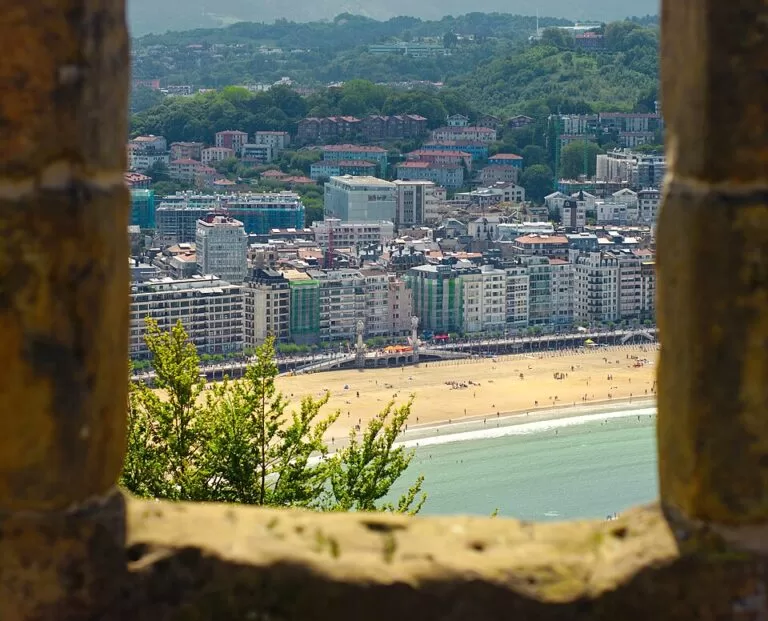
La Concha Beach (Playa de La Concha, Kontxa hondartza in Basque) is San Sebastián’s main city beach: 1,350 m of fine golden sand curving round the Bay of La Concha in the centre of the city, between Mount Urgull and the Pico del Loro, with Santa Clara Island in the middle of the bay. You walk to it from the Old Town or the city centre; the railway and bus stations are under 1 km from its eastern end. It suits families, swimmers and anyone staying in the city; skip it in high summer if you dislike crowded sand, and go to Zurriola if you want surf.
Quick facts
- Names: La Concha Beach in English, Playa de La Concha in Spanish, Kontxa hondartza in Basque. Donostia is the Basque name of San Sebastián.
- Where: the centre of Donostia / San Sebastián, Gipuzkoa, Basque Country, on the Bay of La Concha.
- Coordinates (middle of the beach): 43.3155, -1.9900.
- Size: 1,350 m long and 40 m wide (spain.info, turismo.euskadi.eus).
- Sand and water: fine golden sand; moderate waves; high occupancy; an urban beach (spain.info).
- Lifeguards: 10:00 to 20:00 in summer (turismo.euskadi.eus).
- Dogs: not allowed, according to OpenStreetMap.
- Entry: free.
Getting there and parking
On foot: the beach runs along the Paseo de La Concha, which begins at the end of Avenida de la Libertad and ends at the El Antiguo tunnel (turismo.euskadi.eus). The Old Town and the city centre are a few minutes’ walk from its eastern end, and a 7 km seafront promenade joins it to Ondarreta and Zurriola beaches.
By train or bus: CostaMap’s San Sebastián guide, based on OpenStreetMap, places the main-line station, the Euskotren station Amara-Donostia and the bus station 700–800 m from the eastern end of the beach. The Basque tourism site recommends the Donostiatransport.eus app for city buses and car parks.
By bike: the promenade has a bike lane (bidegorri) along its length (turismo.euskadi.eus).
Parking: OpenStreetMap shows paid underground car parks close to the eastern end, among them Cervantes – La Concha, tagged as wheelchair accessible, and San Martín. Spain.info lists the Paseo de la Concha as the access road. We could not confirm prices.
What to expect
Spain.info describes the beach as sheltered from the wind by the surrounding hills and recommends it for families with small children; it has an area with parasols and sun loungers. The Basque tourist board says it invites a dip or a stroll even in winter. It is a city beach in every sense: the promenade above it, with the painted wrought-iron balustrade designed by Juan Rafael Alday at the start of the 20th century, is lined with grand buildings such as the Hotel Londres, the Miramar Palace and the Clocks, a classic meeting point (turismo.euskadi.eus).
On the sand itself stands La Perla, a former royal bathhouse (spain.info) and today the city’s only thalassotherapy centre (turismo.euskadi.eus). At the western end, the small Pico del Loro cape separates La Concha from Ondarreta; above it the regent Queen María Cristina built the Miramar Palace as her summer residence. Its gardens are open to the public, while the building is normally closed (turismo.euskadi.eus).
Activities: the Basque tourist board lists surfing, windsurfing, canoeing, bodyboarding, beach volleyball and beach football. La Concha is a reserve surf spot for big days, with mainly right-hand peaks; El Pico del Loro is the best known and suits bodyboarders. In summer a floating structure with slides and springboards is moored in the middle of the bay.
Services
According to Turismo Euskadi and spain.info: lifeguards, a security service, toilets, showers and foot washes, changing rooms, parasol and sun-lounger hire, pedal-boat and canoe hire, a beach bar, surf courses, a sports area with beach volleyball, bicycle parking, a tourist office and cleaning. The San Sebastián marina is about 1 km away.
Accessibility and safety
The promenade is flat and has a bike lane. Spain.info lists access on foot as easy. OpenStreetMap tags a paid public toilet near the eastern end as wheelchair accessible. Swim in summer when lifeguards are on duty, between 10:00 and 20:00 (turismo.euskadi.eus). In an emergency call 112.
Best time to visit
July and August bring the warmest weather and the most people; spain.info rates the beach’s occupancy as high. June and September are calmer for a swim, although the film festival fills the city in September. For a walk along the promenade, any month works.
Nearby alternatives
- San Sebastián, 0.4 km away: our city guide, with Ondarreta, Zurriola, the Old Town and transport.
- Isla de Santa Clara, 1.0 km away: the island in the bay, reached by boat from the port in summer.
- Monte Igueldo, 1.7 km away: the funicular and viewpoint above Ondarreta.
- Pasai Donibane, 5.8 km away: the fishing village on Pasaia bay.
- Pasaia to San Sebastián walk (GR 121), 5.7 km away: the cliff path over Monte Ulia that ends near this beach.
- Zarautz Beach, 14.1 km away: the longest beach on the Basque coast, to the west.
Distances are in a straight line from the middle of the beach.
FAQ
Can you swim at La Concha Beach?
Yes. It is sheltered by the surrounding hills, has moderate waves (spain.info) and lifeguards from 10:00 to 20:00 in summer (turismo.euskadi.eus).
How long is La Concha Beach?
1,350 m long and 40 m wide (spain.info).
Is there parking at La Concha Beach?
Not on the sand. OpenStreetMap shows paid underground car parks near the eastern end, including Cervantes – La Concha; most visitors walk from the centre.
Are dogs allowed on La Concha Beach?
OpenStreetMap tags the beach as no dogs. Check the signs on the promenade for current rules.
Is La Concha good for surfing?
Only on big days, when it is a reserve spot with mainly right-hand peaks; Zurriola in Gros is the city’s surf beach (turismo.euskadi.eus).
Sources and freshness
Checked 9 November 2026 · 5 sources Show
Checked 9 November 2026. Official:
- Turismo Euskadi, La Concha Beach (size, activities, surf, lifeguards, services)
- Turismo Euskadi, Paseo de La Concha (promenade, balustrade, La Perla)
- Turismo Euskadi, Miramar Palace
- spain.info, La Concha beach (size, waves, occupancy, services)
- spain.info, Donostia-San Sebastián (Pico del Loro, La Perla, Miramar). Car parks, toilets, dog tag and distances: OpenStreetMap contributors (ODbL). The city tourism website could not be reached from our research tools. Photo: Wikimedia Commons, licence as credited
How this page is made. CostaMap is written with an AI editorial system run by Ebizapple. This page is based on the sources listed above. Last updated 9 November 2026. Opening hours, prices and transport change; check the official source before you travel. How we work · Partner links and ads