
Campo Lameiro Rock Art Park (Petroglyphs, Pontevedra)
Historic siteThe Campo Lameiro Rock Art Park (Parque Arqueolóxico da Arte Rupestre, PAAR) is the Xunta de Galicia’s open-air site for Galician petroglyphs, in the hills of O Campo Lameiro, about 15 km north-east of Pontevedra in a straight line. You drive there on the PO-230 and park by the interpretation centre; from there signed paths lead past rocks carved with deer, riders, cup marks and concentric circles, plus a reconstructed Bronze Age village. It opens Tuesday to Sunday (closed Mondays), admission is paid, and guided walks run at set times. It suits families, walkers and anyone curious about prehistory; skip it if you cannot walk on uneven woodland paths or only have a beach day in mind.
Quick facts
- Names: Parque Arqueolóxico da Arte Rupestre (Galician), Parque Arqueológico del Arte Rupestre de Campolameiro (Spanish), often shortened to PAAR; in English “Campo Lameiro petroglyphs” or “Rock Art Park”.
- Where: rúa Praderrei, San Miguel do Campo, 36119 O Campo Lameiro (Pontevedra province), inland from the head of the Ría de Pontevedra.
- Coordinates: 42.5419, -8.5302 (interpretation centre, OpenStreetMap).
- Opened: 6 July 2011, run by the Xunta de Galicia (regional government).
- Size: 22 hectares, with nine rock-art stations and about twenty carved rocks spread over some 3 km (Galician Wikipedia).
- Protection: the carvings were declared Historic-Artistic Monuments in 1974 and the whole area an Archaeological Zone on 20 June 2002 (Galician Wikipedia).
- Entry: paid; cards accepted. We could not confirm the current price.
- Closed: every Monday.
Access and parking
By car: the park lies on the PO-230 in the parish of O Campo, about 15 km north-east of Pontevedra in a straight line; English Wikipedia puts the municipal capital, A Lagoa, 20 km from Pontevedra.
Parking: OpenStreetMap marks a car park about 80 m from the interpretation centre and a second surface car park about 600 m south-east. The tourist board lists access for private vehicles; we could not confirm whether parking is charged.
By bus or taxi: we found no confirmed bus service to the park. The provincial tourist board gives the nearest transport as Radio Taxi Poio (about 23 km) and Pontevedra bus station (about 23.5 km), so plan on a car or a taxi from Pontevedra.
What to expect
The provincial tourist board calls Galicia’s petroglyphs one of the most important groups of open-air rock art in Europe, and the park was built to balance conservation, research and visits. Start at the interpretation centre, which Galician Wikipedia describes as a 5,000 m² building with projection rooms, exhibitions and a library, then follow the paths out onto the hillside.
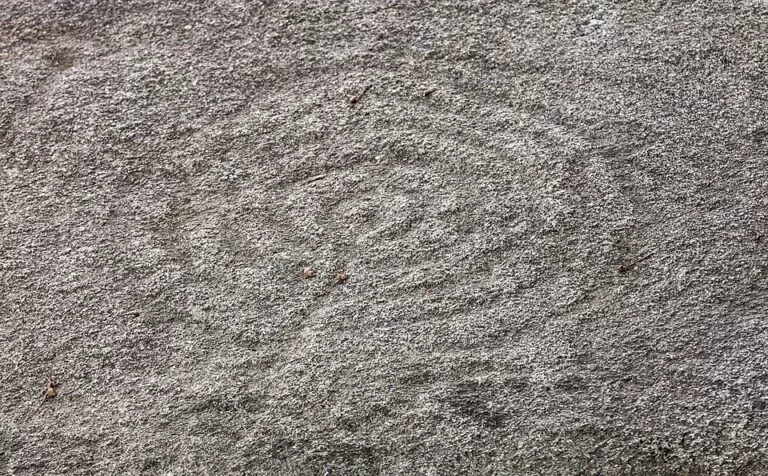
The carvings mix geometric designs, such as cup marks, crosses and concentric circles, with animals: deer, horses and snakes, typical of the Atlantic rock art of Galicia and northern Portugal. Galician Wikipedia picks out these rocks:
- Laxe dos Carballos: a large stag with antlers, its eyes and mouth marked and spears in its back, surrounded by smaller deer, circles and lines of cup marks. The circles in the photo above are on this rock.
- Laxe da Forneiriña: a large animal with deer and circles.
- Outeiro dos Cogoludos: deep, clear grooves, three horsemen one above the other and a large panel of concentric circles.
- Laxe dos Cabalos: two horses with riders that look as if they are racing.
- Outeiro da Pena Furada: the only group here with labyrinth figures.
The park also includes a reconstruction of a Bronze Age village.
Practical details
Opening hours and guided walks as listed by the Rías Baixas tourist board, checked November 2026:
- 1 November to 28 February: Tuesday to Sunday 10:00–16:00; guided walk at 12:30, booking required.
- 1 March to 30 June: Tuesday to Sunday 10:00–19:00; guided walks at 12:30 and 17:30.
- 1 July to 31 August: Tuesday to Sunday 11:00–21:00; guided walks at 12:30, 17:30 and 19:00.
- October: Tuesday to Sunday 10:00–19:00; guided walks at 12:30 and 17:30.
- September: the listing does not give September hours; check before you go.
- Languages: information in Galician, Spanish, English and French; guided walks in Galician and Spanish.
- Services: public toilets, left-luggage, bookings and family activities (tourist board). OpenStreetMap marks a picnic area next to the centre.
Accessibility and safety
The tourist board lists adapted infrastructure and adapted toilets at the centre. The rock-art paths cross a wooded hillside, so expect slopes, roots and loose surfaces; we could not confirm a step-free route to the carvings. Wear shoes with grip, carry water in summer and do not stand or walk on the carved rocks.
Best time to visit
Spring and early autumn, when the hours are long and the paths are cooler than in July and August. In winter the park closes at 16:00 and the only guided walk must be booked. A dry day is better, because wet granite is slippery.
Nearby alternatives
- Pontevedra Old Town, 15.4 km: granite squares, the Pilgrim’s church and the free Museum of Pontevedra.
- Poio Monastery, 16.5 km: a Benedictine monastery with cloisters, a 200 m² Camino mosaic and Galicia’s largest hórreo.
- Combarro, 18.9 km: the fishing village of hórreos on the shore of the ría.
- Cambados, 23.3 km: Albariño wine town on the Ría de Arousa.
For more rock art on the coast, the Mogor petroglyphs in Marín, 23 km south-west, are known for their labyrinths and have a free interpretation centre by Mogor beach (Rías Baixas tourist board). Distances are in a straight line from the park.
FAQ
Where are the Campo Lameiro petroglyphs?
In the Rock Art Park in O Campo Lameiro, inland in Pontevedra province, about 15 km north-east of Pontevedra in a straight line, on the PO-230.
Is the Campo Lameiro Rock Art Park open on Mondays?
No. It opens Tuesday to Sunday; hours run from 10:00–16:00 in winter to 11:00–21:00 in July and August.
Do you need to book a visit?
Not to enter. From November to February the single guided walk at 12:30 needs booking ahead.
How do I get to Campo Lameiro without a car?
We found no confirmed bus to the park. The simplest option is a taxi from Pontevedra.
How old are the petroglyphs?
The park presents them as prehistoric Atlantic rock art; we did not find a firm date for these rocks in the official listing. The Mogor centre dates its carvings to 1800–600 BC.
Sources and freshness
Checked 9 November 2026 · 6 sources Show
Checked 9 November 2026. Official: Rías Baixas tourist board (Deputación de Pontevedra), Parque arqueológico del arte rupestre de Campolameiro and the English page (purpose, address, 2025–2026 hours, guided walks, languages, payment, services, opening date), Mogor petroglyphs interpretation centre. Background: Galician Wikipedia (size, stations, protection dates, rocks, centre, village) and English Wikipedia (distance to Pontevedra). The park’s own site (paar.es) could not be reached from our research network. Location, roads, car parks and distances: OpenStreetMap contributors (ODbL). Photo: Wikimedia Commons, licence as credited.
How this page is made. CostaMap is written with an AI editorial system run by Ebizapple. This page is based on the sources listed above. Last updated 9 November 2026. Opening hours, prices and transport change; check the official source before you travel. How we work · Partner links and ads