
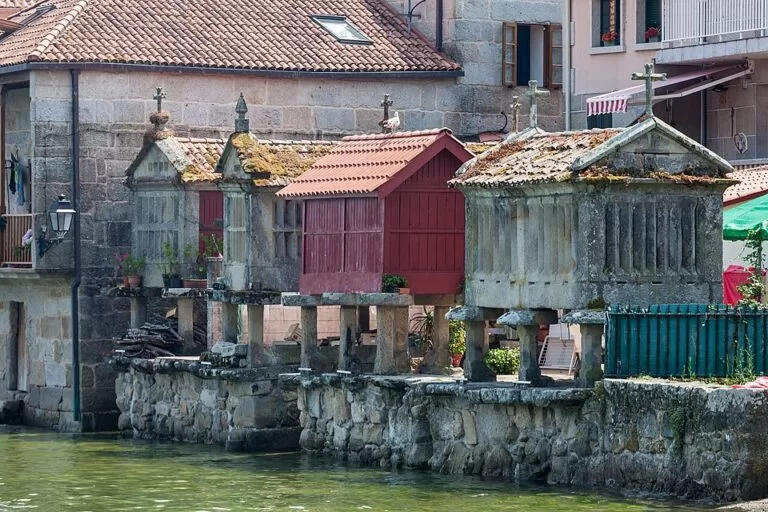
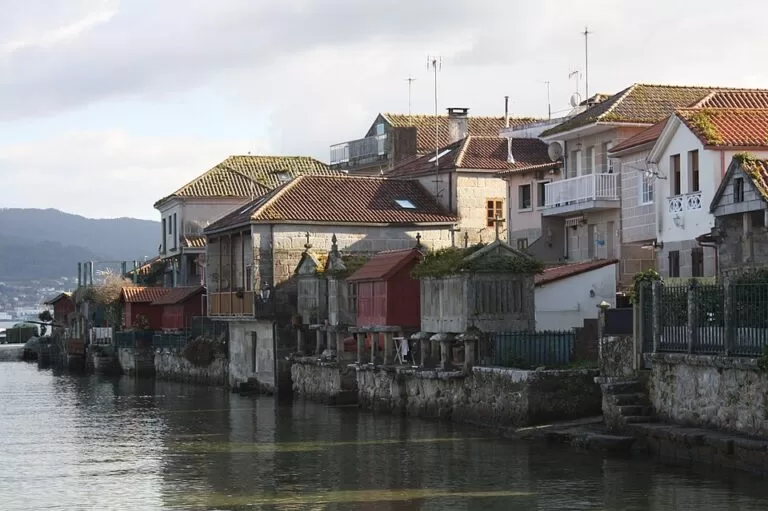
Combarro is a small fishing village on the Ría de Pontevedra, in the municipality of Poio, known for the stone and wooden granaries (hórreos) that stand in a row right on the water’s edge. It lies 5 km west of Pontevedra on the PO-308 coast road, with free car parks and Monbus stops on the edge of the old quarter. The historic core, declared a Historic-Artistic Site in 1972, is a few lanes of granite houses, stone crosses and more than sixty hórreos, about thirty of them by the sea. It suits anyone touring the Rías Baixas for a walk of an hour or two and a seafood lunch; skip it if you want a beach day or need step-free streets.
Quick facts
- Names: Combarro in both Galician and Spanish. The granaries are hórreos; in Combarro people call them palleiras, because their roofs were once thatched with straw (palla).
- Where: north shore of the Ría de Pontevedra, municipality of Poio (Pontevedra province), on the PO-308. Pontevedra old town is 5 km east in a straight line.
- Coordinates: 42.4317, -8.7052 (Peirao da Chousa square, at the entrance to the old quarter).
- Status: Historic-Artistic Site (Conjunto Histórico) since 1972.
- Hórreos: more than sixty, about thirty of them by the sea, in stone or wood, mostly from the 18th and 19th centuries (Rías Baixas tourist board).
- Entry: the village is open streets, free at all times.
- Tourist office: run by the Concello de Poio, on the edge of Peirao da Chousa square.
Access and parking
By car: Combarro sits on the PO-308, the road that follows the north shore of the ría from Pontevedra towards Sanxenxo. The old quarter is pedestrian, so park on the edge and walk in.
Parking: OpenStreetMap shows three free surface car parks run by the Concello de Poio (P1, P2 and P3) about 270–300 m north-west of Peirao da Chousa; only P2 is marked open to the public, the other two as private, so follow the signs on site. Further free surface parking lies by the marina, 240–400 m south. The marina’s multi-storey car park, about 200 m away, is tagged as paid with 200 spaces.
By bus: OpenStreetMap places two Monbus stops named Combarro on the main road, about 180 m from the square. We could not check the current timetable; ask at the Pontevedra bus station or the tourist office.
On foot: the Spiritual Variant of the Portuguese Way to Santiago passes through the village, and you will see its signs in the lanes.
What to expect
The Rías Baixas tourist board describes a fishing village built on granite: the rock shows in the façades, squares, stairways and streets. Fishermen’s houses are narrow, with arcades below and stone, wooden or iron balconies above. Nets and pots are piled by the water, and small boats rest on the shore.
The hórreos were granaries and pantries. Each stands on stone feet, with a round slab (tornarratos) on top of each foot to keep rats out. Inside, maize finished drying, and so did sardines and anchovies, according to the route guide published by Turismo de Galicia. Their roofs carry a cross or a small pinnacle, Christian and pagan symbols meant to protect the harvest.
That guide suggests a loop through the old quarter. In short:
- Peirao da Chousa: the start, by the water, with hórreos of stone, wood and both, and a communal wash-house still in use.
- Praza de San Roque: built on bare rock, with grooves worn by carts, probably carrying seaweed used as fertiliser, and two stone crosses (cruceiros).
- Igrexa de San Roque: the 18th-century parish church. The cross on its atrium wall was drawn by the artist Castelao in his book on Galician stone crosses. The parish dates from 1868, when Combarro became independent of Poio monastery.
- A Rúa and Praza da Fonte: more crosses; the one in Praza da Fonte is dated 1771.
- A Rúa Cega: the “blind street”, whose houses do not face the sea and have wider doors for carts and cattle.
- O Padrón: the classic view of tiny houses with steps down to the water and a line of hórreos along the shore. At low tide you may see shellfish gatherers at work.
- O Peirao and Rúa do Mar: the old fish landing, now restaurant terraces, reached on foot only when the tide allows; then the street packed with hórreos and souvenir shops, back to the square by the A Gurita stairs.
Practical details
- Food: the old quarter is full of bars and restaurants. Turismo de Galicia names maize-flour empanada with cockles and grilled sardines as the local dishes to try.
- Shops: souvenir and craft shops line Rúa do Mar and A Rúa, many selling home-made orujo liqueurs. Combarro is in the Rías Baixas wine area, and grape skins left over from Albariño are distilled here.
- Market: a street market fills Praza da Chousa every Tuesday (Turismo de Galicia route guide).
- Boat trips: the same guide says Cruceros Pelegrín runs catamaran trips around the ría from Combarro port between March and November, passing Tambo island and the mussel rafts. We did not check this year’s schedule or prices.
- Beaches: small beaches touch the old quarter (Praia de Rualeira and Praia do Padrón on OpenStreetMap), but they are not the reason to come.
Accessibility and safety
The village is built on the rock: lanes are cobbled or bare granite, with steps, slopes and narrow passages, and several paths run right along the water without railings. Expect it to be hard going with a wheelchair or pushchair; OpenStreetMap marks the tourist office itself as having limited wheelchair access. O Peirao can only be reached on foot when the tide is out, so check the tide before heading that way.
Best time to visit
Go at low tide if you want to walk out to O Peirao and watch the shellfish gatherers. For festivals, Turismo de Galicia lists the sea procession of the Virgen del Carmen on 16 July, when fishermen decorate their boats; flower carpets in the main streets for Corpus Christi; and the Armadiña Rock festival in Praza da Chousa over three days in August.
Nearby alternatives
- Monastery of San Xoán de Poio, 2.4 km away: in its grounds stands the largest hórreo in Galicia by surface area, on 51 feet, plus a church, cloisters and a large mosaic of the Way of St James (Rías Baixas tourist board).
- Parque da Memoria, at A Seca nearby: a monument to emigrants and exiles promoted by Nobel Peace Prize winner Adolfo Pérez Esquivel, whose father left from Combarro.
Distances are in a straight line from Peirao da Chousa.
FAQ
How do I get to Combarro?
Drive or take a Monbus bus along the PO-308 from Pontevedra, 5 km east in a straight line. The stops named Combarro are about 180 m from the old quarter.
Is there parking in Combarro?
Yes. OpenStreetMap shows free town-hall car parks about 300 m north-west of the old quarter and free surface parking by the marina to the south, plus a paid multi-storey car park at the marina.
How many hórreos are there in Combarro?
More than sixty, according to the Rías Baixas tourist board, about thirty of them by the sea. Most date from the 18th and 19th centuries.
How long do you need in Combarro?
The historic quarter is small. The Turismo de Galicia loop covers eleven stops; allow an hour or two, more if you stop to eat.
Sources and freshness
Checked 6 November 2026 · 4 sources Show
Checked 6 November 2026. Official: Rías Baixas tourist board (Deputación de Pontevedra), Combarro: stroll among hórreos by the sea and a unique set of palleiras (1972 status, number and age of hórreos, Poio monastery hórreo); Turismo de Galicia, Combarro route guide (PDF) (walking loop, history, festivals, market, catamaran, food). Location, car parks, bus stops, tourist office and distances: OpenStreetMap contributors (ODbL). Photos: Wikimedia Commons, licences as credited.
How this page is made. CostaMap is written with an AI editorial system run by Ebizapple. This page is based on the sources listed above. Last updated 6 November 2026. Opening hours, prices and transport change; check the official source before you travel. How we work · Partner links and ads