
Pontevedra old town is the historic centre of the capital of the Rías Baixas: a compact, car-free grid of granite squares, arcades and churches on the Lérez river, declared a Historic-Artistic Site in 1951. The train and bus stations sit about 1.3 km south-east of Praza da Ferraría, and Vigo airport is 30 km away; drivers leave the car in an underground car park on the edge and walk in. You can see the main sights in half a day, and the Museum of Pontevedra is free. It suits anyone who likes walking, old stone squares and tapas bars; skip it if you only want beaches, which are a short drive away.
Quick facts
- Names: Pontevedra in Galician and Spanish; the old town is the centro histórico or zona monumental. Squares have Galician names (Praza da Leña, Praza da Ferraría), used on this page, and Spanish ones (Plaza de la Leña, Plaza de la Herrería) used in the tourist office’s English pages.
- Where: city of Pontevedra, at the head of the Ría de Pontevedra, Galicia.
- Coordinates: 42.4314, -8.6442 (Praza da Ferraría).
- Status: Historic-Artistic Site since 1951 (Pontevedra tourist office).
- Getting around: the main streets are closed to traffic; the city says more than 70% of urban journeys are on foot or by bike.
- Entry: streets and squares are free; the Museum of Pontevedra is free.
- Tourist office: Turismo de Pontevedra, Praza de España (corner of Avenida Montero Ríos), tel. 986 090 890.
Access and parking
By train or bus: Pontevedra’s train and bus stations are separate buildings in the same pedestrian area, about 1.3 km in a straight line south-east of Praza da Ferraría. The tourist office puts the train from Vigo at about 20 minutes. Vigo airport (Peinador) is 30 km away and Santiago airport 74 km.
By car: the city asks visitors to park and walk. OpenStreetMap shows paid underground car parks on the edge of the old town: Praza de España (about 280 m west of Praza da Ferraría), Santa Clara (203 spaces, 300 m east) and under the Mercado de Abastos (350 m north). OpenStreetMap also shows a free car park at the fairground (Recinto Feiral), 570 m north-east, and the tourist office points to the free “dissuasive” car park at Tafisa by the Lérez river.
City buses are routed around, not through, the central core.
What to expect
The old town is best seen square by square. The tourist office’s squares guide picks these out:
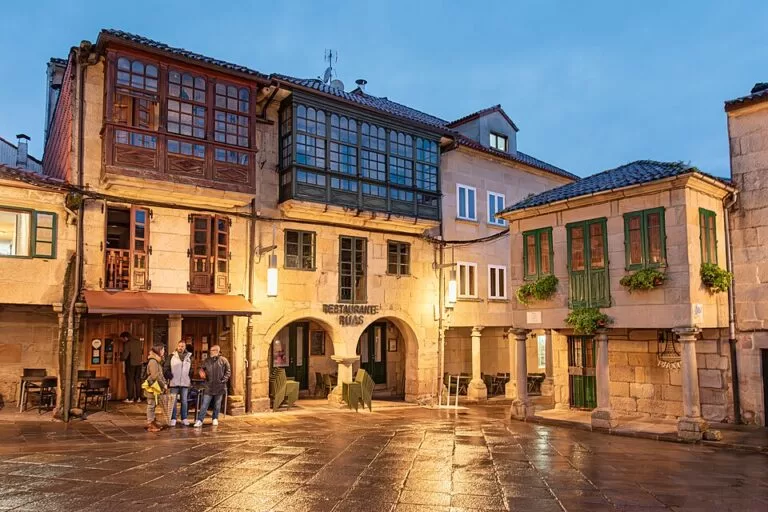
- Praza da Leña: the small arcaded square in the photo, with a stone cross in the middle. Three of the museum’s buildings stand here.
- Praza do Teucro: once the noblest square, named after the Greek hero said in local legend to have founded the city. The façade of the Pazo de Gago y Montenegro is a fine piece of Galician Baroque heraldry. The city counts 114 lineages in its coats of arms.
- Praza da Ferraría: once the blacksmiths’ square and, in the 17th and 18th centuries, a bullring. Its Casto Sampedro gardens hold a 16th-century fountain next to the church of San Francisco.
- Praza das Cinco Rúas: where five streets meet, with a stone cross of 1773 and a plaque on the house where the writer Valle-Inclán lived.
- Praza da Verdura: the old vegetable market square, with the Casa da Luz, a former power station with a tall brick chimney (Pontevedra was the first Galician city with electric light), and the Eiras pharmacy of 1876.
- Praza de Méndez Núñez: with a statue of Valle-Inclán (2003).
Three buildings stand out (tourist office essentials):
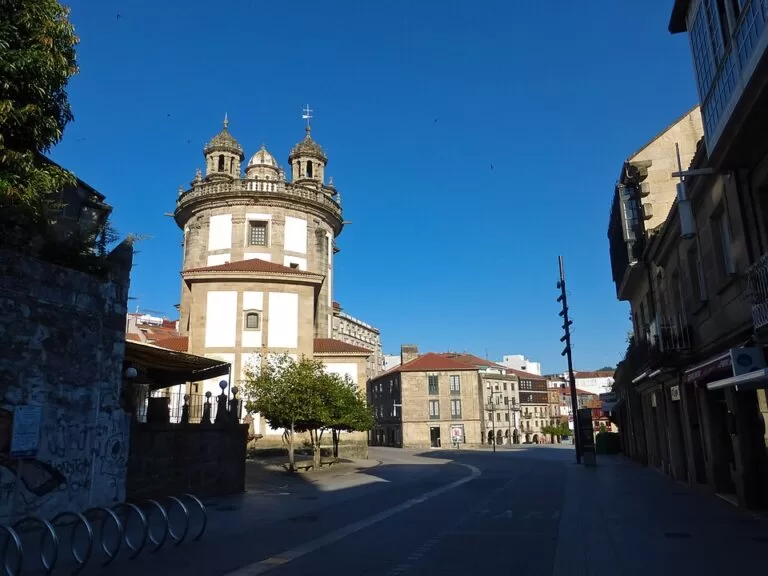
- Santuario da Virxe Peregrina: late 18th century, with a floor plan shaped like a scallop shell, the pilgrims’ symbol. The Pilgrim Virgin is patron of the province and of the Portuguese Way to Santiago; her feast is the second Sunday of August.
- Basilica of Santa María a Maior: 16th century, built by the sailors’ guild, late Gothic with Manueline and Renaissance touches and a Plateresque façade.
- Museum of Pontevedra: six buildings, of which three can be visited, including the Castelao building (Spanish and Galician art) and the ruins of Santo Domingo, a 14th–15th-century Dominican church.
Opening hours (checked November 2026)
From the city’s 2026 opening-hours sheet, which warns that times can change:
- Museum of Pontevedra: Tuesday to Saturday 10:00–21:00; Sundays and holidays 11:00–14:00; free.
- Ruins of Santo Domingo: Tuesday to Saturday 10:00–14:00 and 16:00–19:30; Sundays and holidays 11:00–14:00.
- Santuario da Peregrina: daily 08:00–21:30.
- Basilica of Santa María: daily 9:30–13:30 and 17:00–21:00.
- Archbishops’ Towers interpretation centre (CITA): temporarily closed for works.
- Mercado de Abastos gastro space: Tuesday to Sunday 12:00–16:00 and 20:00–23:00.
Avoid tourist visits during mass. Turismo de Pontevedra runs guided tours of the old town at Easter and in summer (in 2026, 22 June to 30 September); see its guided tours page.
Accessibility and safety
The main streets are pedestrian with wide pavements, according to the city, but the old town is paved in granite, which can be slippery when wet, and we could not confirm step-free routes everywhere. OpenStreetMap marks the Museum of Pontevedra and the Peregrina sanctuary as having limited wheelchair access and the Praza de España car park as wheelchair accessible.
Best time to visit
Any time of year works for a walk. In summer the tourist office runs guided tours and night tours of the lit-up bridges at weekends in July, August and early September. The Peregrina feast is the second Sunday of August. Its tourist page gives average temperatures of 24°C in the warm season and 14°C in the cool season.
Nearby alternatives
- Combarro, 5 km away: the fishing village with more than sixty hórreos, about thirty of them on the shore.
- Illa das Esculturas, 1.1 km away: an island in the Lérez river with granite sculptures by twelve artists, plus two added in 2026, and riverside paths.
- Cíes Islands, 31 km away: the national park islands off Vigo, reached by ferry with a free Xunta permit in season.
Distances are in a straight line from Praza da Ferraría.
FAQ
Is Pontevedra old town worth visiting?
Yes, if you like historic towns: the tourist office calls it one of the best-preserved historic centres in Galicia, protected since 1951, and it is small and traffic-free.
Where do I park in Pontevedra?
Use an underground car park on the edge of the old town, such as Praza de España or Santa Clara, or a free car park such as Tafisa by the river or the fairground, then walk.
How do I get from the station to the old town?
Walk. The train and bus stations are about 1.3 km in a straight line from Praza da Ferraría.
Is the Museum of Pontevedra free?
Yes. In 2026 it opens Tuesday to Saturday 10:00–21:00 and Sundays and holidays 11:00–14:00.
How long do you need in Pontevedra old town?
Half a day covers the main squares, the Peregrina and Santa María; add a few hours for the museum.
Sources and freshness
Checked 6 November 2026 · 9 sources Show
Checked 6 November 2026. Official: Turismo de Pontevedra (Concello de Pontevedra), historic centre, essentials, squares, getting here, getting around, tourist information, guided tours and the 2026 opening hours (PDF). Location, car parks, stations and distances: OpenStreetMap contributors (ODbL). Photos: Wikimedia Commons, licences as credited.
How this page is made. CostaMap is written with an AI editorial system run by Ebizapple. This page is based on the sources listed above. Last updated 6 November 2026. Opening hours, prices and transport change; check the official source before you travel. How we work · Partner links and ads