
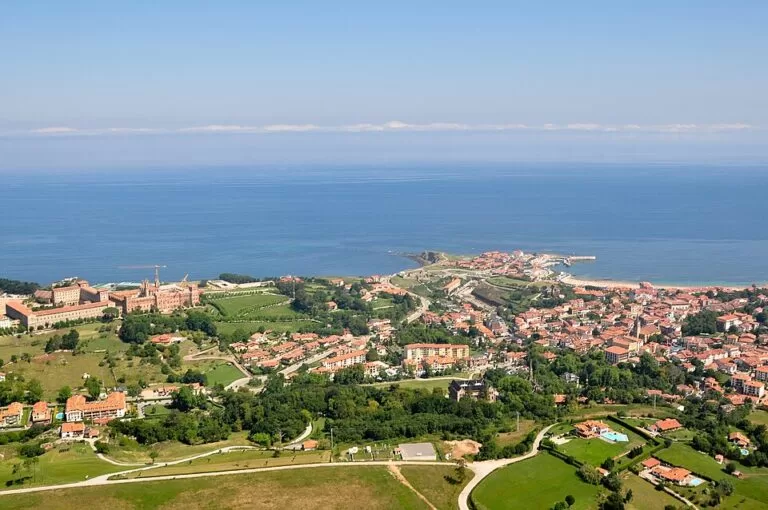
Comillas is a small seaside town on the western coast of Cantabria, about 50 km west of Santander, best known for El Capricho, one of the few buildings Antoni Gaudí designed outside Catalonia. You reach it by car or by La Cantábrica bus, and everything worth seeing sits within a short walk: Gaudí’s villa, the neo-Gothic Sobrellano palace, the old Pontifical University on the hill and a town beach below the old fishing port. It suits people who like architecture and a quiet base on the coast; skip it if you want a big resort with nightlife.
Quick facts
- Names: Comillas, a town and municipality in Cantabria. Locally it is also called la villa de los arzobispos (the town of the archbishops), after the churchmen trained at its seminary.
- Where: western coast of Cantabria, about 50 km from Santander (Spain.info).
- Coordinates: 43.3837, -4.2927 (El Capricho, at the edge of the old town).
- Population: 2,141 in the town itself (INE 2024, via Wikipedia).
- Protection: the town has been a conjunto histórico (protected historic town) since 1985.
- Main sights: El Capricho (Gaudí, 1883–85), Palacio de Sobrellano and its chapel-pantheon, the old Pontifical University, the cemetery with Josep Llimona’s angel, the port and Playa de Comillas.
- Beach: Playa de Comillas, a sand beach of roughly 880 m between the port and the Santa Lucía headland (measured on OpenStreetMap).
Access and parking
By car: Comillas lies on the coast road west of Santander; Spain.info puts it about 50 km from the city. The old town is compact, so park once and walk.
Parking: OpenStreetMap shows a paid surface car park on the edge of the centre, next to the main bus stop, about 170 m from El Capricho, and several paid car parks along the seafront by the beach. Free options on the map are the Aparcamiento Universidad below the old university (about 50 spaces) and a car park on the Santa Lucía side of the beach.
By bus: La Cantábrica serves the town; the stop is by the Palacio de Sobrellano, in the centre (Wikipedia; OpenStreetMap names the stop “Centro Comillas”).
What to see
Spain.info sums up the town well: cobbled streets and squares, old family houses with coats of arms, towers and Modernista buildings. Most of that money came from one man. Antonio López y López, born in Comillas in 1817, made his fortune in Cuba in shipping and the slave trade, bought the title of Marquis of Comillas in 1878, invited King Alfonso XII to stay and brought Catalan architects to work in his home town (Wikipedia).
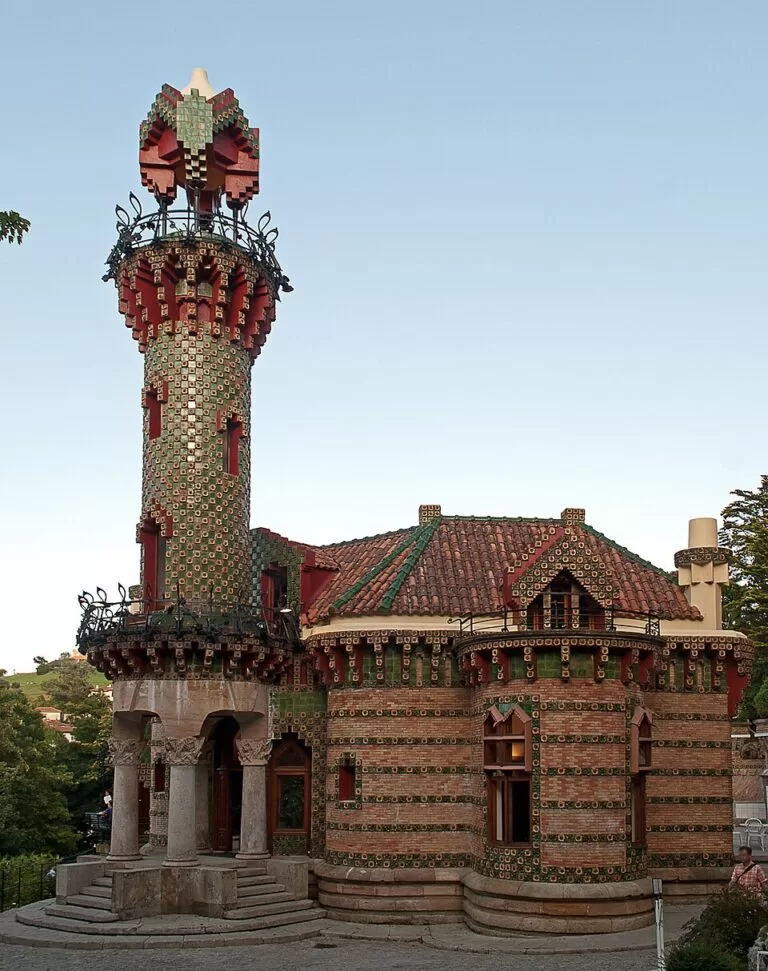
- El Capricho: a summer villa built in 1883–85 for Máximo Díaz de Quijano, who died a year before it was finished. Gaudí was in his early, orientalist phase: red brick, bands of green and yellow sunflower tiles and a slim tower often compared to a minaret. It was declared a national monument in 1969, became a restaurant in 1988 and has been a museum since 2009 (Wikipedia). There is a statue of Gaudí beside it.
- Palacio de Sobrellano: the marquis’s neo-Gothic palace by Joan Martorell, set in a green park next to the chapel-pantheon where the family is buried. Gaudí worked on it as Martorell’s assistant.
- Old Pontifical University: the big seminary buildings on the hill that dominate the town. The university moved to Madrid; the buildings and gardens have been a protected monument since 1985 and are now used by the University of Cantabria (Wikipedia, Spanish).
- Cemetery: built around the ruins of a late 15th-century church and remodelled from 1881 with work by Lluís Domènech i Montaner. On top stands Josep Llimona’s marble angel, El Ángel Exterminador.
- Old town: the Corro de Campíos square with its family houses, the 17th-century parish church of San Cristóbal, and the Fuente de los Tres Caños, a fountain by Domènech i Montaner.
- Port and Santa Lucía: a very small fishing port with a statue of the local poet Jesús Cancio, and above it the Santa Lucía chapel and viewpoint, where a bell once warned fishermen of whales and of bad weather.
Practical details
El Capricho: entry is paid. OpenStreetMap lists the opening hours as 10:30–17:30 from November to February, 10:30–20:00 in March to June and September to October, and 10:00–21:00 in July and August, closed on 24, 25 and 31 December and 1 and 6 January (checked November 2026). We could not open the museum’s own website from our research setup, so confirm hours and prices there before you go.
Sobrellano palace and chapel: run by the Cantabrian government’s culture network; OpenStreetMap lists visiting hours that change several times a year, longest from mid-June to mid-September. Check the regional culture website before you plan around them.
Other services: the tourist information office is in the centre next to the town hall. There are free public toilets with wheelchair access on the beach promenade, and a summer street market on Friday mornings from June to September (OpenStreetMap).
Accessibility and safety
The old town has cobbled streets and short, steep slopes between the centre, the palace hill and the port. OpenStreetMap tags El Capricho as having limited wheelchair access. The beach is an open Atlantic beach; we found no official 2026 information on lifeguard dates, so check the flags and the signs on the promenade before you swim.
Best time to visit
Summer is the busy season: Comillas became a royal summer resort in the late 19th century, when the court and the aristocracy came for sea bathing, and many of their descendants still spend the summer here (Wikipedia). For the buildings, spring and autumn are calmer and the museums keep long hours. Local festivals include bonfires on the beach on the night of 23 June and the town’s main fiesta, the Santo Cristo del Amparo, on 16 July (Wikipedia, Spanish).
Nearby alternatives
- Llanes Coastal Path, 37 km away: a cliff-top walk on the Asturian side of the border.
- Isla de Mouro (Santander), 44 km away: the lighthouse island at the mouth of Santander Bay.
- Ruta del Cares, 46 km away: the gorge walk in the Picos de Europa.
- Isla de Santa Marina (Ribamontán al Mar), 46 km away: a small island off the beaches east of Santander.
Distances are in a straight line from El Capricho. Closer still, the Oyambre natural area with its dunes and marsh starts about 3 km west of the town.
FAQ
Is El Capricho in Comillas really by Gaudí?
Yes. Antoni Gaudí designed it as a summer villa for Máximo Díaz de Quijano and it was built in 1883–85. It is one of the few Gaudí buildings outside Catalonia and has been a museum since 2009.
How far is Comillas from Santander?
About 50 km. You can drive or take a La Cantábrica bus, which stops in the centre by the Palacio de Sobrellano.
Is there parking in Comillas?
Yes. There are paid car parks at the edge of the centre and along the beach, and free car parks below the old university and on the Santa Lucía side of the beach.
Does Comillas have a beach?
Yes. Playa de Comillas is a sand beach of about 880 m below the town, next to the small fishing port. The larger Oyambre beaches lie a few kilometres west.
Is Comillas a good base?
For a quiet stay on the western Cantabrian coast, yes: the town is small, walkable and close to Oyambre, and Santander and the Ruta del Cares in the Picos de Europa both lie within about 50 km in a straight line.
Sources and freshness
Checked 6 November 2026 · 5 sources Show
Checked 6 November 2026. Official: Spain.info, Comillas (distance from Santander, main sights, Oyambre). Background: Wikipedia on Comillas, Comillas (Spanish) and El Capricho (history, dates, population, festivals, bus). Location, parking, toilets, opening hours as mapped and distances: OpenStreetMap. The town hall, El Capricho and Cantabria tourism websites could not be opened from our research setup, so opening hours and prices here are not confirmed by the operators.
How this page is made. CostaMap is written with an AI editorial system run by Ebizapple. This page is based on the sources listed above. Last updated 6 November 2026. Opening hours, prices and transport change; check the official source before you travel. How we work · Partner links and ads