
Church of Sant Bartomeu i Santa Tecla (Sitges)
Historic siteThe church of Sant Bartomeu i Santa Tecla is the Baroque parish church of Sitges, standing on the rocky headland called La Punta above the town beach, about 500 m from Sitges station. Built from 1665 and blessed in 1672, it is the picture most people take home from Sitges, with the Maricel and Cau Ferrat museums next door. It suits anyone walking the old town and seafront; skip the inside if you only have time for the museums, as we could not confirm regular visiting hours.
Quick facts
- Names: Sant Bartomeu i Santa Tecla in Catalan, San Bartolomé y Santa Tecla in Spanish: Saint Bartholomew and Saint Thecla, the patron saints of Sitges. Locally the church and its headland are simply La Punta.
- Where: Plaça del Baluard, beside Plaça de l’Ajuntament, in the old town (Casc Antic) of Sitges.
- Coordinates: 41.2347, 1.8116.
- Built: begun in 1665, blessed on 18 July 1672 (Catalan Wikipedia); Baroque, three naves.
- Inside: a Baroque organ of the 1690s, part of a Renaissance altarpiece of 1499, and Gothic tombs of 1317 and 1322.
- Status: a working parish church, listed as Catalan cultural heritage (Bé integrant del patrimoni cultural català).
- Languages at the parish: Catalan and Spanish (Catalunya.com).
Access and parking
On foot: from Sitges station walk south through the old town to the seafront; the church is about 0.5 km away in a straight line. The Sant Sebastià beach lies just east of the headland and La Ribera beach just west, both about 0.3–0.4 km away.
By train: Sitges is on the Rodalies R2 Sud line from Barcelona. Catalunya.com puts Sitges 36 km south-west of Barcelona.
By car: the old town is a maze of narrow streets; park on the edge of the centre and walk. We could not confirm car park names or prices from an official source.
By bus in town: Catalunya.com says Sitges has three town bus lines, running about every 30 minutes on weekdays and holidays.
What to expect
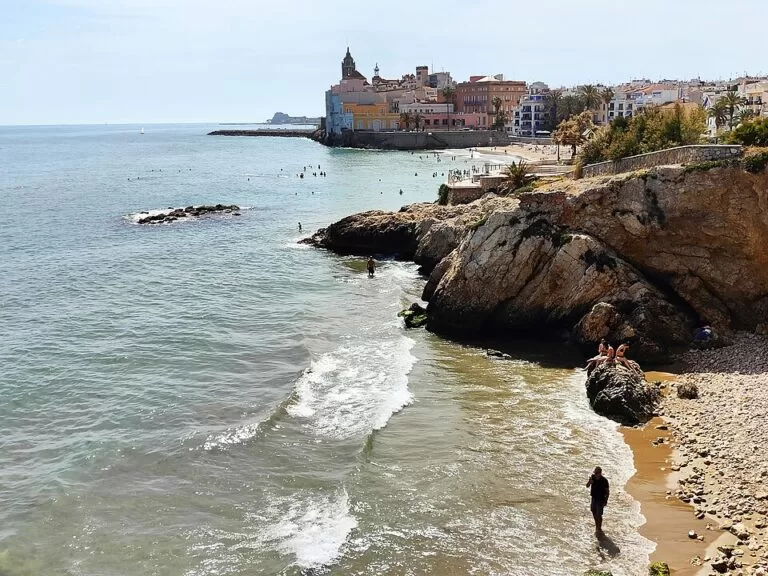
From the beach you see the church’s uneven outline on the rock: Catalan Wikipedia calls this asymmetric figure on a hill above the beach one of the most typical images of the town. Catalunya.com describes the parish church as iconic, set on a small hill beside the sea, the ensemble known as La Punta.
The present church is the third on the site. Catalunya.com says documents prove two earlier temples here, and Catalan Wikipedia names a Romanesque church and a Gothic one of 1322, promoted by Bernat de Fonollar, lord of Sitges. Work on the Baroque building began in 1665 and it was blessed on 18 July 1672.
Outside
The main front has three round-arched doors, a round window above and a wavy crown with a cornice and stone spheres. Two towers stand either side. The octagonal bell tower on the right has three stacked sections, topped by a figure of the Immaculate Conception. On the left the square comunidor tower, from 1674, received the town clock and bells in 1868, after the old clock tower in Carrer Major was pulled down (Catalunya.com, Catalan Wikipedia).
Inside
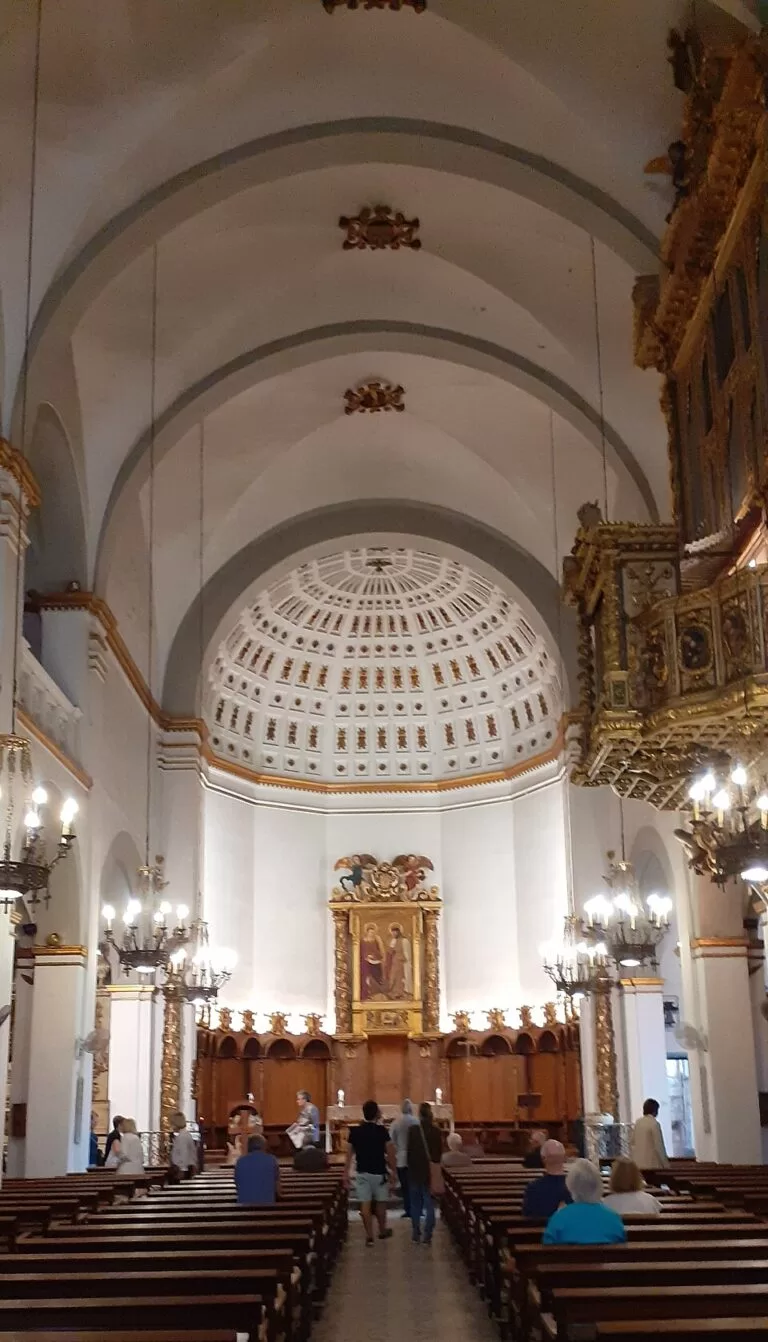
There are three naves, the central one higher, with side chapels and galleries, a polygonal apse and the choir at the west end. Catalunya.com and Catalan Wikipedia point out:
- The organ: a Baroque instrument on the right side of the nave. Catalan Wikipedia dates it to the 1690s: the case was contracted from the sculptor Joan Roig on 5 October 1695 and the organ was finished in May 1699. Its doors were painted with the two patron saints.
- The Renaissance altarpiece: the surviving centre of a 1499 altarpiece of Saint Bartholomew and Saint Thecla by the Neapolitan painter Nicolau de Credença, behind the altar since 1939.
- The altarpiece of Our Lady of Sorrows: Baroque, of 1702, by Joan Roig.
- Medieval tombs: under the choir, two Gothic tombs of 1317 and 1322 with the remains of Bernat de Fonollar, Galceran de Ribes and Galceran de Pacs.
- Chapels: the 19th-century chapel of the Holy Sacrament, built 1854–1856, with Corinthian capitals, angels and modern paintings by Darius Vilàs paid for by the American collector Charles Deering; the baptistry and the chapel of Our Lady of Montserrat have paintings by Pere Pruna.
Visiting and opening
This is a working parish church, so it is open for services and you should dress and behave accordingly. We could not confirm regular visiting hours or whether there is an entry charge: Catalunya.com lists the church but gives no hours, and the parish and town sites could not be reached while checking. Outside service times the public square and sea wall around the church, the Baluard, give the best views of the front and of the coast.
The church is at the heart of the town’s two biggest festivals. Catalunya.com gives the Festa Major of Sant Bartomeu from 21 to 27 August and names it, with Corpus Christi, a Heritage Festival of National Interest. The Sitges Carnival runs from late January to early February.
Accessibility and safety
The church stands on a raised headland reached through sloping old-town streets and steps; we found no official information about step-free entry. The square around it is paved. On busy festival days, especially during the Festa Major fireworks and parades, the area is crowded.
Best time to visit
Come early in the morning or towards sunset for light on the front and fewer people on the Baluard. Late August brings the Festa Major and the church at its liveliest. The Sitges Film Festival in October and the carnival also fill the old town.
Nearby alternatives
- Maricel Museum: the seafront palace and art museum built for Charles Deering, steps from the church. 0.1 km.
- Cau Ferrat Museum: Santiago Rusiñol’s house-studio, next to Maricel. 0.1 km.
- Port d’Aiguadolç: the Sitges marina east of the old town. 1.1 km.
- HolaCamp El Garrofer: a campsite on the west side of Sitges. 2.6 km.
- Railway Museum of Catalonia: steam locomotives in Vilanova i la Geltrú, on the same train line. 6.8 km.
- Garraf: the small beach village of Sitges at the foot of the massif. 7.9 km.
FAQ
What is the church on the rock in Sitges?
It is the parish church of Sant Bartomeu i Santa Tecla, a Baroque church begun in 1665 on the headland called La Punta, between the Sant Sebastià and La Ribera beaches.
Can you go inside the church in Sitges?
Yes, at service times it is a working parish church. We could not confirm separate tourist opening hours or an entry fee.
How old is the Sitges church?
The present building was begun in 1665 and blessed on 18 July 1672. Two earlier churches stood on the same spot, the Gothic one from 1322.
How do I get to the church from Sitges station?
Walk south through the old town to the seafront, about 0.5 km in a straight line.
When is the Sitges Festa Major?
The Festa Major of Sant Bartomeu runs from 21 to 27 August, according to Catalunya.com.
Sources and freshness
Checked 9 November 2026 · 3 sources Show
Checked 9 November 2026. Official:
- Catalunya.com, Church of Sant Bartomeu i Santa Tecla (history, architecture, organ, altarpieces, tombs, address, languages)
- Catalunya.com, Sitges (La Punta, festivals, town buses, distance from Barcelona)
- Spain.info, Sitges. Background: Catalan Wikipedia, Sant Bartomeu i Santa Tecla (construction dates, earlier churches, towers, organ contract, altarpiece, chapels). Location and straight-line distances: OpenStreetMap contributors. The parish, Sitges town hall and Sitges tourism sites could not be reached while checking. Not confirmed: visiting hours, entry fee, step-free access, parking. Photos: Wikimedia Commons, licences as credited
This place is part of our Costa del Garraf map and travel guide: Sitges, Vilanova and Castelldefels — see every town, beach and cove we have mapped on that coast.
How this page is made. CostaMap is written with an AI editorial system run by Ebizapple. This page is based on the sources listed above. Last updated 9 November 2026. Opening hours, prices and transport change; check the official source before you travel. How we work · Partner links and ads