
Víctor Balaguer Library-Museum (Vilanova i la Geltrú)
MuseumThe Víctor Balaguer Library-Museum (Biblioteca Museu Víctor Balaguer) is the art museum and historic library of Vilanova i la Geltrú, the capital of the Garraf comarca on the Costa del Garraf south-west of Barcelona. It stands on Avinguda de Víctor Balaguer, about 170 metres from Vilanova station and next to the Railway Museum of Catalonia, so you can walk straight in from the R2 Sud. Opened in 1884, it shows Catalan painting and sculpture of the 19th and 20th centuries, Baroque paintings lent by the Prado, and small Egyptian, Asian and pre-Columbian collections, including the mummy known as Nesi. It suits anyone interested in Catalan art or 19th-century buildings, and it pairs well with the Railway Museum on a rainy day; skip it if you only want the beach.

Quick facts
- Names: Biblioteca Museu Víctor Balaguer in Catalan, Biblioteca Museo Víctor Balaguer in Spanish; locally often just “el Museu Balaguer”.
- Where: Avinguda de Víctor Balaguer, Vilanova i la Geltrú (Garraf, Barcelona province), between the railway station and the Railway Museum.
- Coordinates: 41.2213, 1.7293 (OpenStreetMap).
- Opened: 26 October 1884, founded by the writer and politician Víctor Balaguer; building by Jeroni Granell i Mundet.
- Status: declared a Museum of National Interest by the Catalan government in October 2019; the library is a section of the National Library of Catalonia.
- Collections: Catalan art from Romanticism to the 20th century, a Prado deposit of Baroque painting, Egyptian, Philippine, East Asian and pre-Columbian pieces, decorative arts and a library of more than 100,000 documents.
- Hours and prices: not confirmed; check victorbalaguer.cat before you go.
Access and parking
By train: Vilanova i la Geltrú station is on the Rodalies R2 Sud and several regional lines (Catalunya.com). The museum is about 170 metres from the station in a straight line (OpenStreetMap), so this is the easiest way to arrive from Barcelona or Sitges. Check Rodalies de Catalunya for current times.
On foot in town: the Railway Museum of Catalonia is a few metres away, and Catalunya.com’s family day suggests doing both and then walking through Plaça de la Vila, the Mercat del Centre and the Rambla down to the seafront (Catalunya.com). Ribes Roges beach is about 1.2 km away.
By car: the town is reached by the C-32 and C-31. We could not confirm a car park for the museum itself; in the centre, plan to use public car parks or street parking near the station, and the train if you come from Barcelona.
What to expect
The building. Balaguer wanted a public “temple” of learning, and the building looks the part. Granell designed it in the eclectic style of the 1880s, with classical and Egyptian details: a portico with a pediment, columns with papyrus-leaf capitals and the motto Surge et ambula (“rise and walk”) above the door. Statues of Archbishop Francesc Armanyà and the poet Manuel de Cabanyes, two 19th-century figures from Vilanova, flank the steps, and eighteen sgraffito panels by Josep Mirabent decorate the facade. A 19th-century garden planted with acacias, palms, eucalyptus and roses surrounds it. The first stone was laid on 1 January 1882 on land next to the new railway, and the building was extended several times: the Saló Maria (1892), the Saló Isabel (1898) and the Sala Silvela (1919) (Viquipèdia).
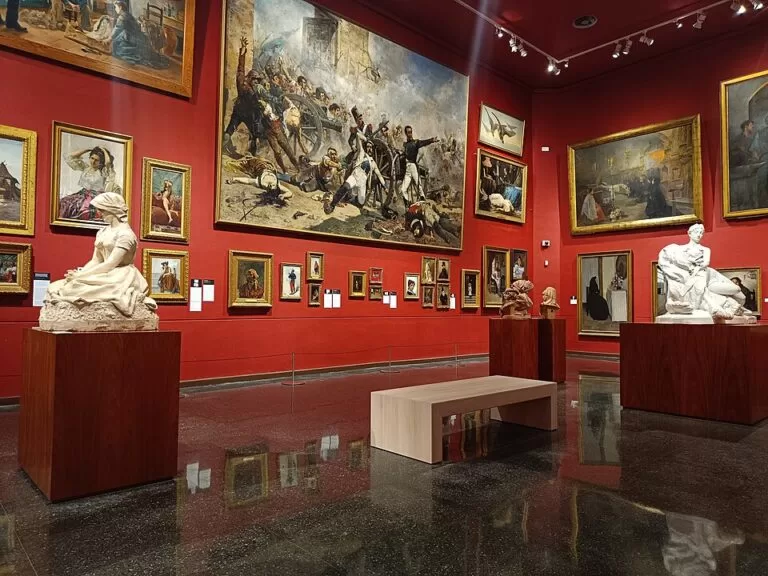
The art. Catalunya.com describes the museum as an important gallery of Catalan art from Romanticism and early Modernisme well into the 20th century, with painting and sculpture especially strong (Catalunya.com). Its family page names Rusiñol and Goya among the artists on show (Catalunya.com). The Goya belongs to a deposit from the Museo del Prado, one of the oldest documented Prado deposits, which Balaguer obtained through his political contacts in Madrid. It rotates and has included Castilian, Valencian and Andalusian paintings of the 16th to 18th centuries by artists such as El Greco, Goya and Ribera; since 2018 it hangs in the Sala Prado. The museum also keeps the town’s collection of 19th-century Catalan painting.
The world collections. The founder also gathered objects from far away. In 1886 Eduard Toda gave an Egyptian collection, the first shown in Catalonia; its best-known piece is the mummy of a child of about five, known as Nesi. Balaguer’s Philippine collection followed in 1887, Juan Mencarini’s East Asian collection in 1888 and a pre-Columbian collection in 1894. Catalunya.com lists ethnographic and anthropological pieces from the Philippines, the ancient East, Egypt and pre-Columbian America, plus decorative arts.
The library. Balaguer’s own library of about 25,000 books was the starting point. Today the catalogue passes 100,000 documents, including incunabula, manuscripts and first editions, and the reading service is in the Casa Castrofuerte just behind the historic building. Catalunya.com calls it one of the most important document collections in Catalonia.
A story worth knowing: on 30 January 1981 the art thief known as Erik el Belga stole 56 works from the museum; most were recovered in 1982 from Germany and the Netherlands.
Practical details
- Opening hours and tickets: we could not open the museum’s own website from our research setup, so we give no times or prices. Check victorbalaguer.cat before you travel.
- Time needed: no official figure. The building is compact; an hour or so covers the main rooms, more if a temporary exhibition is on.
- Activities: the museum runs temporary exhibitions, guided visits, school and family activities, talks and concerts, according to its Viquipèdia entry.
- Combine with: the Railway Museum of Catalonia next door, and the Museu Romàntic Can Papiol on Carrer Major, a 19th-century town house that shows how a well-off Romantic-era family lived (Catalunya.com).
Accessibility and safety
The main entrance is up a flight of steps between the two statues. We could not confirm step-free access or lifts from an official page, so wheelchair users should contact the museum first. The surroundings are flat, with the station and the Railway Museum a short walk away on level streets.
Best time to visit
It is an all-year visit and a good plan for a rainy or very hot day. Vilanova is busiest at Carnival in February, at the Tres Tombs festival on 17 January and at the Festa Major on the last weekend of July (Catalunya.com); check museum hours on those days.
Nearby alternatives
- Railway Museum of Catalonia, 0.2 km: steam locomotives in the old engine shed, next door.
- Vilanova Park, 3.3 km: the campsite on the edge of town.
- HolaCamp El Garrofer, 4.5 km: a campsite towards Sitges.
- Maricel Museum, 7.1 km: art and the Deering palace on the sea in Sitges.
- Cau Ferrat Museum, 7.1 km: Santiago Rusiñol’s house-studio in Sitges.
- Iberian Citadel of Calafell, 12.9 km: a rebuilt Iberian village on the Costa Dorada.
Distances are in a straight line from the museum.
FAQ
Where is the Víctor Balaguer Museum?
On Avinguda de Víctor Balaguer in the centre of Vilanova i la Geltrú, about 170 metres from the railway station and next to the Railway Museum of Catalonia.
How do I get there from Barcelona?
Take the Rodalies R2 Sud or a regional train to Vilanova i la Geltrú and walk across from the station.
What is there to see?
Nineteenth- and twentieth-century Catalan painting and sculpture, Baroque paintings on deposit from the Prado, Egyptian pieces including the child mummy Nesi, Asian and pre-Columbian objects, and the 1884 building itself.
Is it good for children?
Catalunya.com includes it in its family day in Vilanova together with the Railway Museum; the Egyptian room and the mummy tend to be the hook for children.
What are the opening hours?
We could not confirm them. Check the museum’s website, victorbalaguer.cat, before you go.
Sources and freshness
Checked 9 November 2026 · 7 sources Show
Checked 9 November 2026. Official: Catalunya.com (Catalan Tourist Board) on the Víctor Balaguer Library-Museum, Vilanova i la Geltrú, a family day out in Vilanova and Can Papiol; Spain.info on Vilanova i la Geltrú. History, building and collections: Viquipèdia (Catalan Wikipedia), background only. The museum’s own website could not be opened from our research setup, so hours and prices are not given. Location and distances: OpenStreetMap contributors (ODbL). Photos: Wikimedia Commons, licences as credited.
This place is part of our Costa del Garraf map and travel guide: Sitges, Vilanova and Castelldefels — see every town, beach and cove we have mapped on that coast.
How this page is made. CostaMap is written with an AI editorial system run by Ebizapple. This page is based on the sources listed above. Last updated 9 November 2026. Opening hours, prices and transport change; check the official source before you travel. How we work · Partner links and ads