
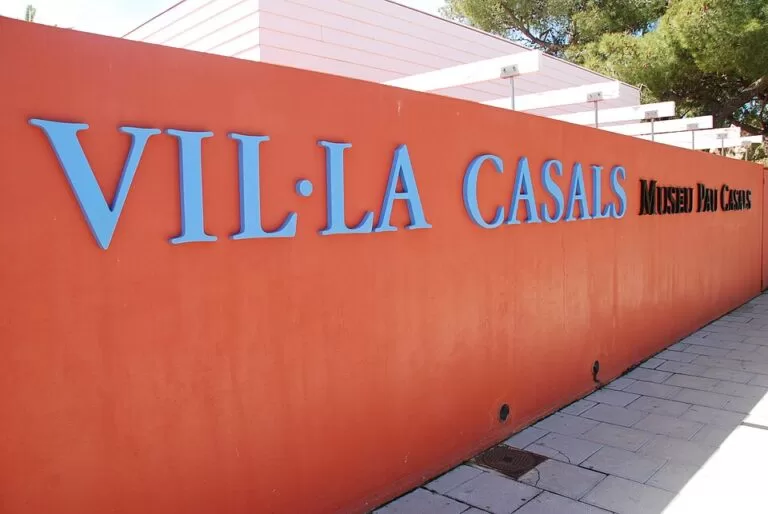
The Pau Casals Museum (Museu Pau Casals) is the seaside summer house of the cellist Pau Casals on the Sant Salvador beach in El Vendrell, on the northern Costa Dorada, about 1.4 km from Sant Vicenç de Calders station. Casals had Vil·la Casals built in 1909 and spent his summers here until his exile in 1939; today 17 rooms tell his life with personal objects, documents and audiovisuals, and the Pau Casals Auditorium stands opposite. It is closed on Mondays. It suits music lovers and anyone spending a beach day at Sant Salvador or Coma-ruga; skip it if museums about one person do not interest you.
Quick facts
- Names: Museu Pau Casals or Casa-Museu Pau Casals in Catalan; Vil·la Casals is the house itself. In Spanish, Museo Pau Casals. Casals is also known abroad as Pablo Casals.
- Where: Avinguda Palfuriana, Sant Salvador, El Vendrell (Baix Penedès, Tarragona), on the seafront.
- Coordinates: 41.1834, 1.5414 (OpenStreetMap).
- Built: 1909; refurbished in the early 1930s by the architect Antoni Puig, who designed the music room, the garden and the lookout over the beach (Catalunya.com).
- Visit: 17 rooms on Casals’s private and professional life.
- Closed: Mondays.
- Entry: paid; we could not confirm the 2026 price.
- Official site: paucasals.org.
Access and parking
By car: Catalunya.com’s Pau Casals route says to take the N-340 to El Vendrell and continue to Sant Salvador (Coma-ruga). El Vendrell is reached by the AP-7 (exit 31), the N-340 and the C-32 (exit 55), according to the Catalunya.com page on the town’s transport. The Sant Salvador beach has a pedestrian promenade, which makes it hard to park right by the sand (Catalunya.com), so expect to park in the streets behind.
By train: Sant Vicenç de Calders station, a junction of the coast and inland lines, is about 1.4 km in a straight line from the museum (OpenStreetMap). Calafell station is about 2.9 km away. Check Rodalies de Catalunya for current services.
On foot from Calafell or Coma-ruga: the GR 92 coastal path follows the seafront from Platja de Calafell to Sant Salvador and passes the museum before continuing to Coma-ruga (Catalunya.com).
What to expect
A seafront villa with a garden, not a large museum. Pau Casals (1876–1973), born in El Vendrell, is described by Catalunya.com as one of the greatest cellists and also a conductor and composer. Catalunya.com tells how he first had a cello at 12, studied in Barcelona and Madrid, went on to Brussels and Paris, and taught at the Liceu conservatory in Barcelona before his international career. In the years before the Civil War he came back to this house every summer to rest from his tours. After 1939 he never returned to El Vendrell: he lived in exile in Prada de Conflent, in French Catalonia, and then in San Juan, Puerto Rico, where he died. His remains were moved to the El Vendrell cemetery in 1979 (Catalunya.com, Pau Casals route).
The restored villa takes you through 17 rooms with objects from his private life and career and modern displays; audiovisuals guide the visit. Casals is remembered for his stand for peace as much as for his music: his performance of El cant dels ocells at the United Nations and his oratorio El Pessebre are the best-known examples.
The Pau Casals Auditorium was built in 1981 right in front of the villa. It holds concerts through the year, with cycles of young performers, jazz and classical music (Catalunya.com). The Pau Casals International Music Festival, founded in 1981, fills July and August, with the cello as its common thread.
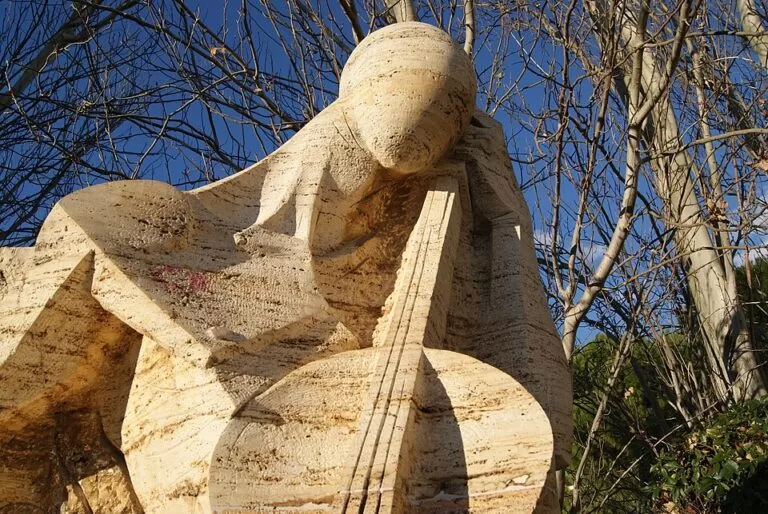
Nearby on the same route: the 11th-century hermitage of Sant Salvador, which Casals often visited, and a monument to him by Josep Maria Subirachs on Plaça Bach.
Prices and opening
Opening hours on Catalunya.com, checked November 2026:
- Summer: Tuesday to Saturday 10.00–14.00 and 17.00–21.00; Sundays and public holidays 10.00–14.00.
- 16 September to 14 June: Tuesday to Friday 10.00–14.00 and 16.00–18.00; Saturdays 10.00–14.00 and 16.00–19.00; Sundays and public holidays 10.00–14.00.
- Closed: Mondays.
OpenStreetMap gives slightly different summer afternoon hours and lists closures on 1, 5 and 6 January and 25 and 26 December, so check paucasals.org before you go. The museum charges entry; we could not open the official site to confirm the price.
Accessibility and safety
OpenStreetMap tags the museum as wheelchair accessible, but we could not confirm from the museum which rooms and garden areas are step-free. The building faces the beach promenade, which is pedestrian; take care with traffic in the streets behind it in summer.
Best time to visit
July and August, if you want to combine the house with a concert of the Pau Casals Festival across the road; book festival tickets early. Outside summer the museum is quieter and opens most afternoons from Tuesday to Saturday. A cool or windy beach day is a good moment for a visit.
The Pau Casals route in El Vendrell
Catalunya.com describes a 5.4 km, three-hour route through El Vendrell. It starts at the house where Casals was born on Carrer de Santa Anna, a museum since 29 December 1998, which shows the gourd cello and the gralla that began his career (Catalunya.com). It continues to the 18th-century Baroque church of El Salvador, whose 1777 organ he played as a child, and ends at the villa on the beach. Extras include his tomb in the cemetery and the statue of him by Josep Viladomat on Plaça Nova.
Nearby alternatives
- HolaCamp Sant Salvador, 0.5 km: a campsite in the same beach district.
- El Vendrell, about 4 km: the town centre with the Casals birth house, the parish church and the Deu Museum.
- Calafell, about 3 km: the family beach, the Iberian Citadel and Santa Creu castle.
- Arc de Berà, 6.2 km: the Roman arch on the N-340.
- Cunit, 7.9 km: breakwater beaches and a seafront promenade.
Distances are in a straight line from the museum.
FAQ
Where is the Pau Casals Museum?
On the seafront of the Sant Salvador beach, Avinguda Palfuriana, in El Vendrell (Tarragona), opposite the Pau Casals Auditorium.
Is the Pau Casals Museum open on Mondays?
No. It is closed on Mondays all year, according to Catalunya.com.
How long does a visit take?
The official pages give no visit time. The museum has 17 rooms, so allow time for the audiovisuals as well as the garden.
How do I get there by train?
Take a train to Sant Vicenç de Calders, about 1.4 km away in a straight line, and walk or take a taxi to Sant Salvador.
When is the Pau Casals Festival?
In July and August, at the Pau Casals Auditorium in front of the house. It has been held since 1981.
Sources and freshness
Checked 7 November 2026 · 9 sources Show
Checked 7 November 2026. Official: Catalunya.com (Catalan Tourist Board) on the Pau Casals House-Museum (history, rooms, hours, closing day), the Pau Casals route, Pau Casals: biography and legacy, the birth house, the Auditorium, the festival, Sant Salvador beach and getting to El Vendrell. The museum website (paucasals.org) could not be opened from our research setup, so prices are not given. Location, stations and distances: OpenStreetMap contributors (ODbL). Photos: Wikimedia Commons, licences as credited.
This place is part of our Costa Dorada map and travel guide: Roman Tarragona, Salou and the Ebro Delta — see every town, beach and cove we have mapped on that coast.
How this page is made. CostaMap is written with an AI editorial system run by Ebizapple. This page is based on the sources listed above. Last updated 6 November 2026. Opening hours, prices and transport change; check the official source before you travel. How we work · Partner links and ads