
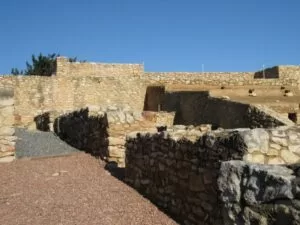
The Iberian Citadel of Calafell (Ciutadella Ibèrica de Calafell) is an Iberian village rebuilt on its original site on a low hill in Calafell, on the northern Costa Dorada, 500 m from Calafell railway station. Since 1992 its walls, tower and houses have been reconstructed with experimental archaeology, which Catalunya.com calls a first for an archaeological site on the Iberian Peninsula. You can walk its streets, go inside the houses and climb onto the wall. It suits families and anyone curious about pre-Roman Spain; skip it if you only want original ruins rather than reconstructions.
Quick facts
- Names: Ciutadella Ibèrica de Calafell in Catalan, Ciudadela Ibérica de Calafell in Spanish. The site is also called Alorda Park or Les Toixoneres.
- Where: beside the C-31 in the Alorda Parc district of Calafell (Baix Penedès, Tarragona), between Calafell station and the beach.
- Coordinates: 41.1906, 1.5812 (OpenStreetMap).
- People: a settlement of the Cessetani (Cossetans), the Iberian tribe of this coast.
- Date: the Iberian town is dated differently by official sources: 6th century BC (Catalunya.com, Calafell page), 6th–3rd centuries BC (Catalunya.com family route) and 5th–2nd centuries BC (Spain.info).
- Reconstruction: started in 1992, on the site itself.
- Networks: part of the Ruta dels Ibers, and a member of EXARC, the international network of open-air archaeological museums, since 2007.
- Closed: 1 and 6 January, 1 May, 25 and 26 December (Catalunya.com).
Access and parking
By train: Calafell station is about 500 m away in a straight line (OpenStreetMap). Trains on the Rodalies line from Barcelona stop there; check current times before you travel.
By car: Catalunya.com gives the address as the C-31 road in Calafell. The C-32 motorway and the AP-7 are the main roads into the town. We could not confirm a dedicated car park for visitors, so plan to use street parking in Calafell.
From the beach: the Platja de Calafell seafront lies south of the station, so the citadel is an easy walk from the beach district.
What to expect
A walled hilltop village rebuilt as it may have looked more than 2,000 years ago. Catalunya.com describes it as an architectural interpretation project based on scientific method: the houses, streets, wall and siege tower have been reconstructed on top of the excavated remains, using the techniques the Iberians used. The site faces the old coastal lagoons. Inside, you walk the streets, enter the houses and go up onto the wall by way of the tower, with educational displays explaining daily life. OpenStreetMap notes that the museum design comes from projects of the University of Barcelona.
Spain.info says the citadel was rebuilt and decorated to evoke the people who lived here twenty-five centuries ago, and the Calafell page on Catalunya.com calls it a fortress built more than 2,500 years ago and fully recreated to explain the daily life of the Iberians. The fortress fell when the Romans arrived; they left their own mark at Vilarenc, nearer the sea.
For children. Catalunya.com’s family route through the Baix Penedès starts here. It describes family treasure hunts (gimcanes) and children’s workshops in which you can dress as Iberians, make bread the Iberian way and watch demonstrations of ancient crafts. The tourist board has also published a children’s story about Imilke, an imagined Iberian girl of the citadel who became a priestess.
Terra Ibèrica. In summer the citadel hosts Terra Ibèrica, a festival of the Iberian world with family activities, talks and historical re-enactment (Catalunya.com). Check the dates for the year you visit.
Prices and opening
Catalunya.com says opening hours depend on the time of year and refers to the citadel’s website, which we could not open. OpenStreetMap, checked November 2026, lists an entry charge of 4 euros and these hours:
- Wednesday to Sunday 10.00–14.00 all year.
- Saturday afternoons as well: 16.00–18.00 in February, March and July to October, 16.00–19.00 from April to June.
- 1 July to 15 September: every day 10.00–14.00 and 17.30–20.30.
Treat these as a guide only and check with the Calafell tourist office or the museum before you go.
Accessibility and safety
The site is on a hill, with reconstructed streets and a climb up the siege tower onto the wall. We could not confirm step-free access or how much of the site a wheelchair user can reach. In summer bring water and a hat: the streets are open to the sun.
Best time to visit
Spring and autumn weekends, when it is cooler, or a summer morning, when the site opens every day. Come in summer during Terra Ibèrica for re-enactments and family activities. Families with children get the most from the workshop days.
Combine it with Calafell
The citadel fits into a half day in Calafell. Catalunya.com’s family route suggests going on to the hill of the Santa Creu castle in the old town, built at the end of the 10th or beginning of the 11th century, with a church with Romanesque wall paintings and a 17th-century comunidor from which the priest blessed the fields and warded off storms (Catalunya.com). On the seafront, La Confraria, the old fishermen’s guild building, is now the interpretation centre of Calafell’s fishing past.
Nearby alternatives
- Calafell, 0.5 km: the town guide, with the family beach, Santa Creu castle and the seafront museums.
- Pau Casals Museum, 3.4 km: the cellist’s summer villa on the Sant Salvador beach.
- HolaCamp Sant Salvador, 3.9 km: a campsite in El Vendrell’s beach district.
- Cunit, 4.5 km: breakwater beaches and the Iberian farm remains of Fondo del Roig.
- Arc de Berà, 9.6 km: the Roman arch on the Via Augusta.
Distances are in a straight line from the citadel.
FAQ
What is the Iberian Citadel of Calafell?
An Iberian village of the Cessetani, excavated and rebuilt on its original site since 1992 with experimental archaeology, so you can walk its streets and enter its houses.
Is the Iberian Citadel of Calafell good for children?
Yes. The tourist board’s family route starts here, with treasure hunts and workshops such as dressing as Iberians and making bread.
How much does the Iberian Citadel cost?
OpenStreetMap lists 4 euros. We could not confirm the price on the official site, so check before you go.
How do I get to the Iberian Citadel by train?
Take a train to Calafell station; the citadel is about 500 m away.
Is the citadel original?
The walls and houses you see are reconstructions built on the excavated remains, made with the techniques and materials the Iberians used.
Sources and freshness
Checked 7 November 2026 · 7 sources Show
Checked 7 November 2026. Official: Catalunya.com (Catalan Tourist Board) on the Iberian Citadel of Calafell (reconstruction, visit, Terra Ibèrica, EXARC, closing days), Calafell, the Baix Penedès family route, Imilke, the Iberian lady of Calafell and Santa Creu castle; Spain.info on Calafell. The citadel’s own website could not be opened from our research setup. Location, price and hours as mapped, station distance: OpenStreetMap contributors (ODbL). Photos: Wikimedia Commons, licences as credited.
This place is part of our Costa Dorada map and travel guide: Roman Tarragona, Salou and the Ebro Delta — see every town, beach and cove we have mapped on that coast.
How this page is made. CostaMap is written with an AI editorial system run by Ebizapple. This page is based on the sources listed above. Last updated 9 November 2026. Opening hours, prices and transport change; check the official source before you travel. How we work · Partner links and ads