
Santillana del Mar (Cantabria)
VillageSantillana del Mar is a medieval village in Cantabria, about 25 km west of Santander, built around the 12th-century Romanesque Collegiate Church of Santa Juliana. Its cobbled streets of stone towers and noble houses, mostly from the 14th to 18th centuries, make it one of the best-preserved historic sites in Cantabria, and the Altamira Museum, with its replica of the painted cave, is 2 km away. It suits anyone interested in Romanesque art, old villages and prehistory; skip the middle of a summer day if you dislike crowds.
Quick facts
- Name: Santillana del Mar. The name comes from Santa Juliana (Santa Illana), whose relics the collegiate church keeps. The old joke calls it the village of three lies: not holy (santa), not flat (llana) and not on the sea (mar).
- Where: Santillana del Mar, Cantabria, inland from the coast; about 25 km west of Santander in a straight line.
- Coordinates: 43.3923, -4.1060 (Collegiate Church of Santa Juliana).
- Status: spain.info describes the village centre as a declared National Monument.
- Main sight: Collegiate Church of Santa Juliana, Plaza del Abad Francisco Navarro.
- Route: on the northern route (Camino del Norte) of the Camino de Santiago.
- Tourist information: turismosantillana@cantur.com, +34 942 818 812 (spain.info listing).
Access and parking
By car: the old village is for walking. OpenStreetMap maps several surface car parks on its edge: free ones about 340 m and 710 m from the collegiate church, a larger free gravel car park of about 115 spaces about 780 m away, and paid car parks about 300–560 m away, including Plaza del Rey. In summer the closest ones fill early.
By bus: OpenStreetMap shows bus stops about 550 m from the church, one of them served by the La Cantábrica company. We could not confirm current routes or timetables.
From Santander: the village is about 25 km away in a straight line. Santander has an airport, a railway station and a ferry port.
What to expect
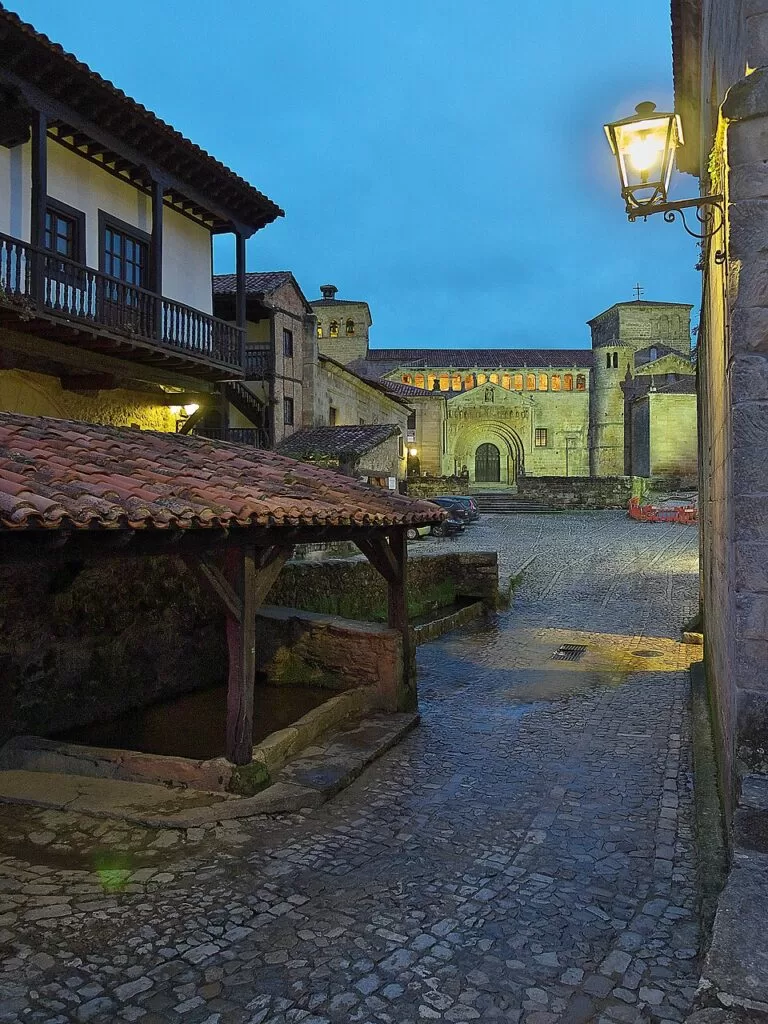
You enter the historic quarter along Calle de Santo Domingo, the main street. The cobbled streets are lined with stately buildings, most of them built between the 14th and 18th centuries (spain.info). The Torre del Merino (14th century) and the Torre de Don Borja (15th century) are the oldest civil buildings. There are Renaissance palaces such as that of the Velarde family and Baroque mansions of the Valdivieso and Villa families. Despite the mix of styles, the village looks remarkably uniform.
The main square holds the House of the Eagle and the Vine, the town hall and the 17th-century Barreda-Bracho palace, which became a Parador in the mid-1940s (the Parador Gil Blas). The hero of the novel Gil Blas was “born” in Santillana, and Jean-Paul Sartre called it the prettiest village in Spain in La Nausée (Wikipedia).
The Collegiate Church of Santa Juliana grew out of a monastery dating from 870. It became a collegiate church in the 11th century, but the building you see is from the 12th century, one of the greatest examples of Romanesque architecture in Cantabria. It has three naves, three semicircular apses and a tower. Look for the carved capitals of the cloister, the Byzantine-style Christ in majesty (pantocrator) over the main door, medieval tombs, a 17th-century embossed silver altar front and an early 16th-century altarpiece by a Burgos master (spain.info, collegiate church).
Altamira: 2 km from the village is the Altamira National Museum and Research Centre. Its Neocave is a careful replica of the cave as it looked 35,000 to 13,000 years ago. The real cave, discovered in 1879 and a World Heritage Site, is closed to normal visits: only five people a week enter, from a waiting list that is closed to new requests (spain.info, Altamira museum).
Practical details
- Collegiate church: Plaza del Abad Francisco Navarro s/n, 39330 Santillana del Mar. We could not confirm current opening hours or the entry price from an official page; ask at the tourist office.
- Altamira Museum: Avenida Marcelino Sanz de Sautuola s/n; tickets are sold through the Ministry of Culture’s booking page; phone +34 942 818 005.
- Food: local specialities include cocido montañés (bean, meat and cabbage stew), Cantabrian cheeses, the Santillana sponge cake and sobaos pasiegos.
- Toilets: OpenStreetMap marks free public toilets about 370 m from the church, near the town tourist office.
- Events: a nativity play and Three Kings parade on 5 January.
Accessibility and safety
The streets are cobbled and uneven, and some slope; wear flat shoes and take care when the stones are wet, which is often in Cantabria. Wheelchairs and pushchairs will find the cobbles hard going. OpenStreetMap marks the town tourist office as wheelchair accessible; we could not confirm step-free access inside the collegiate church or its cloister.
Best time to visit
Santillana draws thousands of visitors a year, and the middle of the day in summer is the busiest time. Go early in the morning or in the evening, or stay overnight to see the streets quiet. Spring and autumn are calmer than July and August. Combine the visit with the Altamira Museum, 2 km away, and check ticket availability ahead in high season.
Nearby alternatives
- Camping Santillana del Mar, 0.6 km: the campsite on the edge of the village.
- Santander, 25.5 km: Cantabria’s capital on its bay, with the Magdalena palace and El Sardinero beaches.
- Isla de Mouro, 30 km: the lighthouse islet at the mouth of Santander bay.
- Llanes Coastal Path, 52 km: the cliff-top walk on the Asturian coast.
- Ruta del Cares, 61 km: the gorge walk in the Picos de Europa.
Distances are in a straight line from the collegiate church.
FAQ
Why is Santillana del Mar called the village of three lies?
Because, the saying goes, it is neither holy (santa), nor flat (llana), nor on the sea (mar). The name actually comes from Santa Juliana, whose relics are kept in the collegiate church.
How far is Altamira from Santillana del Mar?
About 2 km. The Altamira Museum has a replica of the cave, the Neocave; the original cave is closed to normal visits.
Is there parking in Santillana del Mar?
Yes, on the edge of the old village. OpenStreetMap shows free car parks 340–780 m from the collegiate church, the largest with about 115 spaces, plus paid car parks closer in.
Can you visit the real Altamira cave?
Almost no one can. Only five people a week enter, from a waiting list that is currently closed to new applications.
How far is Santillana del Mar from the sea?
Despite its name it is not on the coast. spain.info points to the beach of Santa Justa at Ubiarco, in the same municipality, and to Suances and Cóbreces a few kilometres away.
Sources and freshness
Checked 6 November 2026 · 5 sources Show
Checked 6 November 2026. Official: spain.info (Turespaña) on Santillana del Mar (history, buildings, Parador, food, Camino, Santa Justa), the Collegiate Church (history, interior, address, contact) and the Altamira Museum (Neocave, cave access). The Cantabria tourist board site could not be reached. Background: Wikipedia, Santillana del Mar (name, Gil Blas, Sartre). Location, parking, bus stops, toilets and distances: OpenStreetMap.
How this page is made. CostaMap is written with an AI editorial system run by Ebizapple. This page is based on the sources listed above. Last updated 6 November 2026. Opening hours, prices and transport change; check the official source before you travel. How we work · Partner links and ads