
Valldigna Monastery (Simat de la Valldigna)
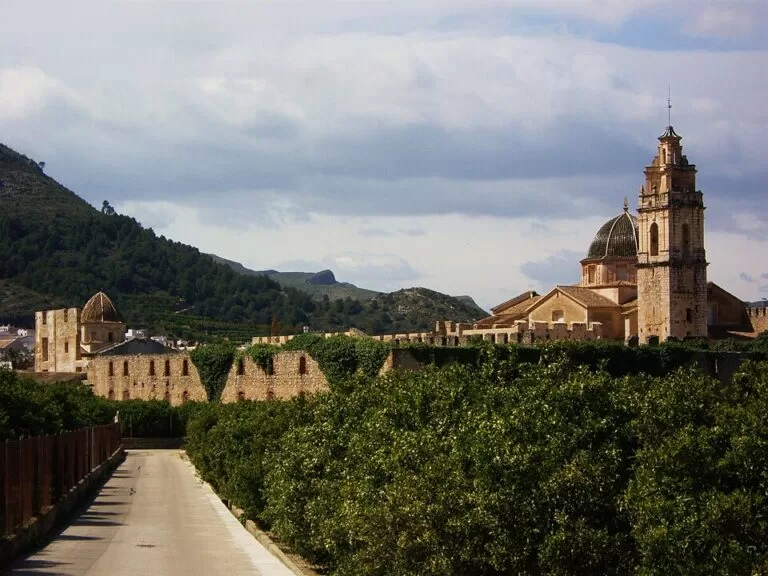
Historic siteThe Valldigna Monastery (Reial Monestir de Santa Maria de la Valldigna) is a Cistercian monastery founded in 1298 by King James II of Aragon at the edge of Simat de la Valldigna, in the valley behind Tavernes de la Valldigna, about 14 km north-west of Gandia. Its Baroque church, the Gothic remains of the cloister and the abbot’s palace are open to the public, and the regional tourist board says free guided tours run on Saturday and Sunday mornings. It suits anyone interested in history or Valencian Gothic, and makes a half-day out from the beaches of La Safor; it is a partly ruined and still-restored site, so do not expect a complete monastery.
Quick facts
- Names: Reial Monestir de Santa Maria de la Valldigna in Valencian, Real Monasterio de Santa María de la Valldigna in Spanish; often just “el Monestir” or the Valldigna Monastery.
- Where: Plaça del Monestir, Simat de la Valldigna (Valencia), on the eastern side of the village.
- Coordinates: 39.0430, -0.3056.
- Founded: 15 March 1298 by James II “the Just”, King of the Crown of Aragon, for monks from the Cistercian abbey of Santes Creus (Spanish Wikipedia).
- Style: Valencian Gothic of the 14th century around a cloister, rebuilt after earthquakes in 1396 and 1644; the present church is Baroque.
- Visits: free guided tours for individuals on Saturday and Sunday mornings (Comunitat Valenciana tourism, checked November 2026).
- Distances: about 4.6 km from Tavernes de la Valldigna town and 13.8 km from the Ducal Palace in Gandia, in a straight line.
Access and parking
By car: from the coast, turn inland at Tavernes de la Valldigna and follow the valley road west towards Simat and Benifairó de la Valldigna. The monastery is on the Tavernes side of Simat, so you reach it before the village centre. OpenStreetMap shows a free surface car park about 240 m from the monastery and a motorhome area about 265 m away (OpenStreetMap).
By public transport: Cercanías line C1 from València to Gandia stops at Tavernes de la Valldigna station, about 8 km from the monastery. We could not confirm a bus from Tavernes to Simat, so plan on a taxi or a car.
On foot from the village: Simat’s tourist office is about 240 m from the monastery, and the old mosque of La Xara, now the chapel of Santa Anna, about 530 m away.
What to expect
This is a large complex of separate buildings, some restored and some still in ruins, in a valley of orange groves. The regional tourist board picks out three parts above all (Comunitat Valenciana tourism):
- The church of Santa María: the best-preserved building of the complex, with Baroque decoration. Spanish Wikipedia describes high vaults with painted decoration and a polychrome ceiling with flowers and angels.
- The chapter house (Sala Capitular): designed by Pere Compte, with a cross vault rebuilt in recent years and the symbols of the four evangelists: the lion, the bull, the eagle and the angel.
- The abbot’s palace and cloister: a Gothic piece built between the 14th and 16th centuries.
The old olive oil mill has been restored and is now a multi-purpose hall. You also enter through the Portal Nou, the “new gate”, carved with the arms of the Crown of Aragon and of the abbot (Comunitat Valenciana tourism; Spanish Wikipedia).
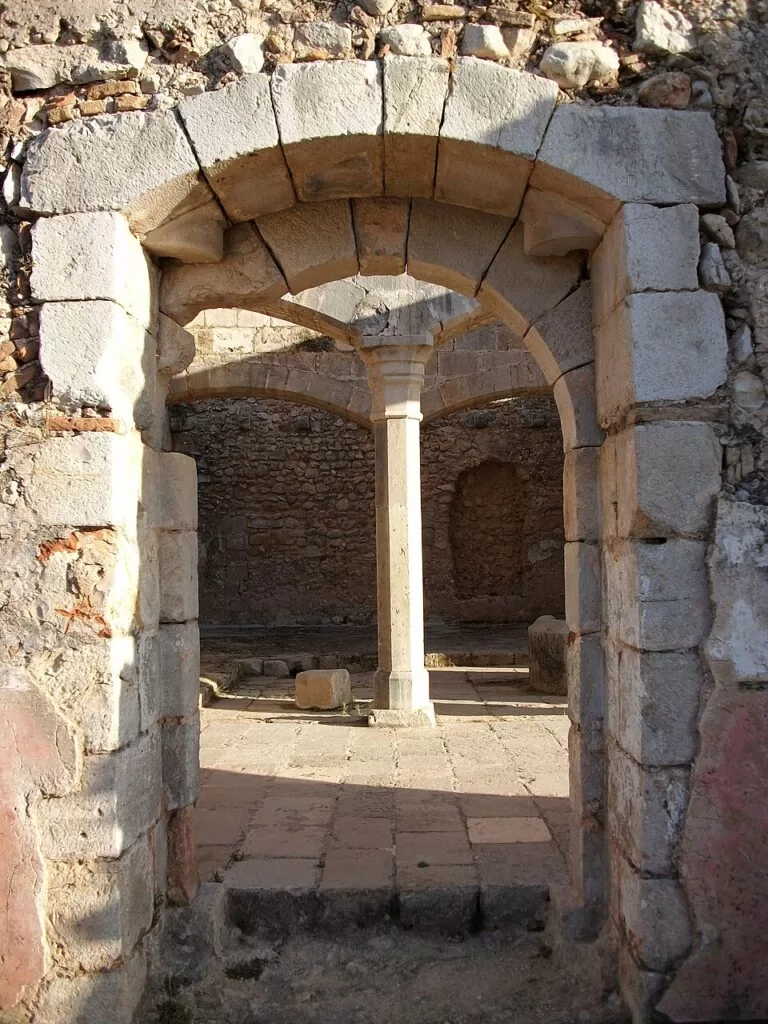
A short history. The story goes that James II, riding back from war in Alicante and Murcia, was so struck by the valley, then called Alfàndec, that he told the abbot of Santes Creus it was a “vall digna”, a valley worthy of a monastery of his order; the abbot answered “Vall digna!”, and the name stuck. The first Gothic monastery took shape in the 14th century around the cloister. Earthquakes in 1396 and 1644 forced two big rebuildings, the second in Baroque style, to which the present church and the chapel of the Virgen de Gracia belong. After the state confiscated church property in 1835 the monks left, and the monastery was sold to private owners, used as a farm and largely pulled down; its stone was sold as building material. Between 1920 and 1926 the Gothic arches of the upper cloister of the abbot’s palace were taken to a mansion in Torrelodones, near Madrid. The Generalitat Valenciana bought them back in 2003 and returned them in 2006 (Spanish Wikipedia). The restoration is managed by the Fundación Jaume II el Just. The regional tourist board calls it one of the finest examples of the Region of Valencia’s heritage.
Practical details
- Guided tours: free, for individuals, on Saturday and Sunday mornings, according to the regional tourist board. We could not confirm start times, weekday opening or whether you need to book; the monastery website (monestirvalldigna.gva.es) and the Simat tourism site could not be reached from our research setup, so check there before you go.
- Events: the monastery also runs living-history tours, food tastings, concerts and talks, many aimed at families.
- Time needed: about an hour for the monastery (our estimate), longer if you add the village of Simat.
- Food: Simat is known for brines, mushrooms, coques and rice dishes (Comunitat Valenciana tourism); there is a bakery-café in the village a few hundred metres from the monastery.
Accessibility and safety
We could not confirm step-free access. Parts of the complex are ruins, with uneven ground, and restoration work may close some areas. Phone the Simat tourist office before you travel if you use a wheelchair. Bring water and a hat on summer visits.
Best time to visit
A weekend morning, to join the free guided tour. Spring and autumn are the most comfortable seasons for combining the visit with a walk: Simat’s Font del Cirer picnic area has a viewpoint, and the “Camí dels Burros” walk ends at the arches of an 18th-century aqueduct the monks built from that spring (Comunitat Valenciana tourism). On a weekday, if the monastery is closed, the Sant Jeroni de Cotalba monastery near Alfauir, about 8 km from Gandia, is the other big monastery of La Safor (Comunitat Valenciana tourism).
Nearby alternatives
- Camping & Bungalows San Vicente, 9.6 km away: a campsite by the beach of Xeraco.
- L’Ahuir beach, 10.9 km away: the dune beach between Xeraco and Gandia.
- Ducal Palace of the Borgias, 13.8 km away: the Gothic palace of the Dukes of Gandia.
- Collegiate Basilica of Gandia, 13.7 km away: the Gothic Seu de Gandia.
- Cullera, 14.0 km away: castle hill, lighthouse and beaches at the mouth of the Júcar.
- Xàtiva, 19.4 km away: the two-part castle and the birthplace of two Borgia popes.
Distances are in a straight line from the monastery.
FAQ
Is the Valldigna Monastery free to visit?
The regional tourist board says it organises free guided tours for individuals on Saturday and Sunday mornings. Check the monastery website for times.
Where is the Monastery of Santa María de la Valldigna?
At the edge of Simat de la Valldigna, in La Safor (Valencia province), about 4.6 km west of Tavernes de la Valldigna and 14 km from Gandia.
Who founded the Valldigna Monastery?
King James II of Aragon, on 15 March 1298, for Cistercian monks from Santes Creus. The name comes from his words “vall digna”, a worthy valley.
Is there parking at the monastery?
Yes. OpenStreetMap shows a free car park about 240 m away and a motorhome area nearby.
Can I get to the Valldigna Monastery by train?
Not directly. The nearest station is Tavernes de la Valldigna on Cercanías line C1, about 8 km away; continue by taxi or car.
Sources and freshness
Checked 7 November 2026 · 7 sources Show
Checked 7 November 2026. Official: Comunitat Valenciana tourism on the Real Monasterio de Santa María de la Valldigna (founding, buildings, free weekend tours), its feature on the monastery (chapter house, church, abbot’s cloister, activities), Simat de la Valldigna and Sant Jeroni de Cotalba; spain.info on Gandia and La Safor. History and architecture: Spanish Wikipedia. Location, car park and distances: OpenStreetMap contributors (ODbL). The monastery website and the Simat tourism website could not be reached from here. Photos: Wikimedia Commons, licences as credited.
This place is part of our Costa Valenciana Map: Valencia, Gandia and the Albufera — see every town, beach and cove we have mapped on that coast.
How this page is made. CostaMap is written with an AI editorial system run by Ebizapple. This page is based on the sources listed above. Last updated 6 November 2026. Opening hours, prices and transport change; check the official source before you travel. How we work · Partner links and ads