
Alcázar of Jerez de la Frontera
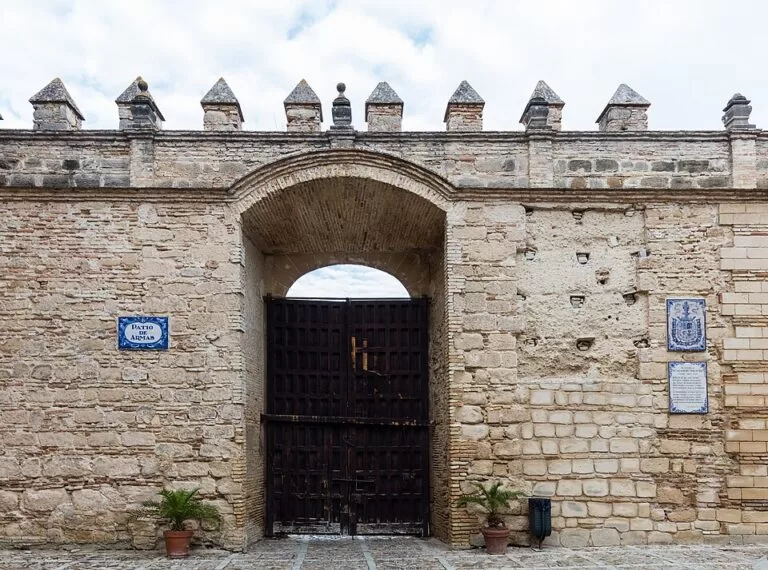
Historic siteThe Alcázar of Jerez de la Frontera is the walled Almohad fortress-palace in the centre of Jerez, on the Alameda Vieja, a few minutes’ walk from the cathedral. One ticket (5 € standard, checked November 2026) covers the town’s only surviving mosque, the Arab baths, the gardens, the parade ground and the Baroque Villavicencio Palace; the Camera Obscura in the palace tower is a separate part of the visit. It suits anyone with an interest in Moorish Spain and fits easily into a sherry-bodega day; skip it if you have already seen the larger alcázares of Seville or Córdoba and want something new.
Quick facts
- Names: Alcázar de Jerez; the official name of the visit is the Conjunto Monumental del Alcázar de Jerez y Cámara Oscura.
- Where: Alameda Vieja s/n, 11408 Jerez de la Frontera (Cádiz), at the south-west corner of the old city walls.
- Coordinates: 36.6808, -6.1399.
- Built: a first fortress in the 11th century; most of the Islamic buildings are Almohad work of the 12th century. The Villavicencio Palace was begun in 1664.
- Protection: Bien de Interés Cultural (monument) since 1931.
- Standard ticket: 5 € (Andalusia tourism board, checked November 2026). Free on Monday afternoons at set times, without the Camera Obscura.
- Contact: +34 956 149 955, info.visitas.alcazar@aytojerez.es.
Access and parking
On foot: the Alcázar is in the historic centre. The cathedral is about 200 m to the north-west and the municipal tourist office about 170 m to the north-east, according to OpenStreetMap. The González Byass bodega is about 250 m away, so the two combine well.
By train or bus: Jerez railway station is about 1.1 km east in a straight line, a walk of 15–20 minutes. The city bus stop called “Alcázar” (operator COMUJESA) is about 90 m from the walls.
Parking: the underground Parking Alameda Vieja sits right beside the Alcázar; it is a paid car park. Other paid options within about 250 m are the underground car park under Plaza del Arenal and the surface car park at Plaza de Silos (all from OpenStreetMap). Driving inside the old town is slow, so park at the first of these you reach.
What to expect
This is a compact walled complex rather than one big castle. The Andalusia tourism board describes it as one of the few examples of Almohad architecture on the peninsula. From the outside you see the Octagonal Tower, which the board calls the tallest in the city, the Almohad tower and the Ponce de León tower. Inside, the main points are:
- The City Gate, in the 12th century the only way into the fortress from the town.
- The mosque, the only one left in Jerez of the eighteen the town had in Islamic times (Spanish Wikipedia). It keeps its minaret, ablutions courtyard, prayer hall and mihrab. After the Castilian conquest it became the chapel of Santa María del Alcázar.
- The Arab baths, with the classic cold, warm and hot rooms under brick domes pierced by star-shaped skylights.
- The gardens and the Patio de Armas, the largest open space, where the Almohad governor once mustered his troops.
- The Villavicencio Palace, a Baroque residence begun in 1664 on Arab remains. It holds the fittings of the old municipal pharmacy.
- The Camera Obscura, in the palace tower: a system of lenses and mirrors that projects live views of the streets and rooftops of Jerez. The board says the visit includes two exhibitions, one on camera obscuras around the world and one on Jerez, explained by a guide.
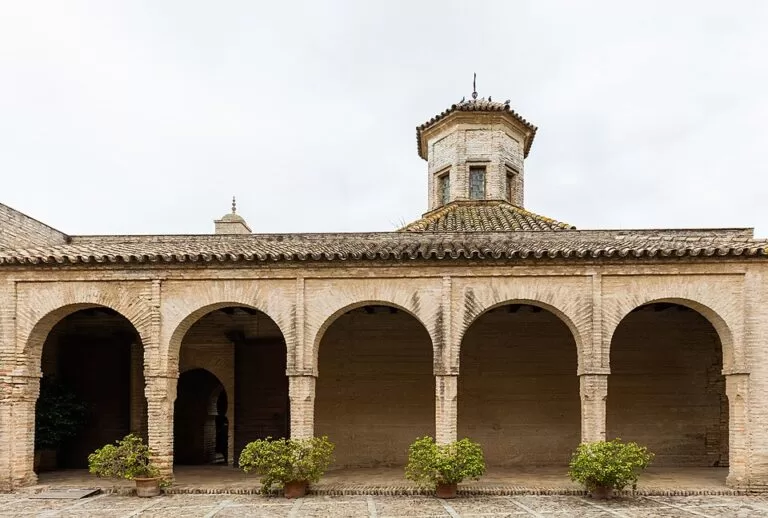
A short history. The hill has been lived on since the Copper Age. The first remains of a fortress date from the 11th century, when Jerez belonged to the taifa of Arcos; most of what you see was built under the Almohads in the 12th century. Castile took the fortress in the 13th century, under Nuño González de Lara; the Muslims of Jerez retook it in a revolt in 1264, and Alfonso X then besieged the town for five months. The Alcázar fell into ruin in the 16th and 17th centuries until the Villavicencio family built their palace. In 1926 the Díez family bought it after the town hall planned to knock it down for a park (Spanish Wikipedia).
Prices and opening
From the Andalusia tourism board listing, checked November 2026:
- January–June and October–December: every day 08:30–14:30.
- July–September: Monday to Friday 08:30–17:30; Saturday, Sunday and public holidays 08:30–14:30.
- Tickets: standard 5 €; groups 4 €; reduced 1.80 € for pensioners, students and Jerez residents. Groups can only be guided by Alcázar staff or accredited official guides.
- Free entry: on Mondays, 13:30–14:30 in the winter season and 16:30–17:30 in summer. Free entry does not include the Camera Obscura.
The listing does not mark the Alcázar as open on Christmas Day or New Year’s Day. Ask the tourist office or check the town hall website before a holiday visit.
Accessibility and safety
The complex mixes level gardens and courtyards with old buildings, towers and steps, and we could not confirm step-free access to the baths, the mosque or the Camera Obscura tower; neither the tourism board listing nor OpenStreetMap gives wheelchair information for the site. Phone ahead (+34 956 149 955) if you need it. In July and August Jerez gets very hot, and the morning-only hours on summer weekends mean the visit is best done early.
Best time to visit
Come at opening time, 08:30, before tour groups and the midday heat. Allow about an hour and a half for the whole complex; add time for the Camera Obscura session. If you are on a budget, the free Monday hour covers everything except the Camera Obscura. The Alcázar is also used for events and concerts, and the tourism board says some spaces can be booked through the town’s tourism department, so parts may occasionally be closed.
Nearby alternatives
- Jerez de la Frontera, 1.3 km away: the town guide, with the sherry bodegas, the cathedral and the flamenco quarter.
- El Puerto de Santa María, 12.7 km away: sherry town on the bay, with its own castle and beaches.
- Puerto Sherry, 15.1 km away: the marina at El Puerto, for boat trips and waterfront restaurants.
- Bahía de Cádiz Natural Park, 20.7 km away: salt pans, marshes and birdwatching around the bay.
- Cádiz, 21.6 km away: the old port city at the end of the bay.
- Sanlúcar de Barrameda, 21.9 km away: manzanilla bodegas and the mouth of the Guadalquivir.
Distances are in a straight line from the Alcázar.
FAQ
How much does it cost to visit the Alcázar of Jerez?
The standard ticket is 5 €, with a reduced rate of 1.80 € for pensioners, students and Jerez residents (Andalusia tourism board, checked November 2026). Entry is free on Mondays for one hour, without the Camera Obscura.
What are the opening hours of the Alcázar of Jerez?
Every day 08:30–14:30 from October to June. From July to September it stays open until 17:30 on weekdays, and closes at 14:30 at weekends and on holidays.
Is there parking near the Alcázar of Jerez?
Yes. The paid underground Parking Alameda Vieja is right beside it, and there are more paid car parks at Plaza del Arenal and Plaza de Silos within about 250 m.
How long does a visit take?
Plan on about an hour and a half for the mosque, baths, gardens and palace, plus the Camera Obscura session if you include it.
Can I walk to the Alcázar from Jerez station?
Yes. The station is about 1.1 km east in a straight line, roughly a 15–20 minute walk through the centre.
Sources and freshness
Checked 6 November 2026 · 5 sources Show
Checked 6 November 2026. Official: Andalusia tourism board listing for the Conjunto Monumental del Alcázar de Jerez y Cámara Oscura (description, hours, prices, address, contact); spain.info (overview). The Jerez town hall website could not be reached from our research setup. Background and history: Spanish Wikipedia and English Wikipedia. Location, parking, bus stop and distances: OpenStreetMap contributors (ODbL). Photos: Wikimedia Commons, licences as credited.
This place is part of our Costa de la Luz, Spain: beaches, towns, sherry and map — see every town, beach and cove we have mapped on that coast.
How this page is made. CostaMap is written with an AI editorial system run by Ebizapple. This page is based on the sources listed above. Last updated 6 November 2026. Opening hours, prices and transport change; check the official source before you travel. How we work · Partner links and ads