
Jerez Archaeological Museum (Museo Arqueológico de Jerez)
MuseumThe Jerez Archaeological Museum (Museo Arqueológico de Jerez) is the city’s municipal archaeology museum, on the Plaza del Mercado in the old San Mateo quarter, 1.7 km from Jerez railway station. Its best-known piece is a Greek Corinthian bronze helmet of the 7th century BC found in the river Guadalete, shown with finds from the Stone Age to the late Middle Ages in nine rooms. It suits anyone curious about the long history behind the sherry town; skip it if you have time for only one sight and want the Alcázar or a bodega instead.
Quick facts
- Names: Museo Arqueológico de Jerez, officially Museo Arqueológico Municipal de Jerez de la Frontera; in English, the Jerez Archaeological Museum.
- Where: Plaza del Mercado s/n, Jerez de la Frontera (Cádiz), beside the Palacio Riquelme, the Pinacoteca Rivero and the church of San Mateo.
- Coordinates: 36.6851, -6.1446.
- Star piece: a Greek Corinthian helmet of the 7th century BC, found near the Charterhouse (La Cartuja) in the Guadalete; Wikipedia calls it extremely rare in Spain.
- Layout: nine rooms in chronological order over three floors.
- Building: a late 18th-century town palace built around patios; protected as a Bien de Interés Cultural.
- Phone: +34 956 149 560; groups +34 956 149 561 (Andalusia tourist board).
Access and parking
On foot: the museum is in the north-west of the historic centre. Jerez railway station is 1.7 km away in a straight line, and the cathedral about 0.4 km south.
By city bus: OpenStreetMap shows urban bus stops (operator COMUJESA) at Muro, about 150 m away, and at Nueva Medina, about 200 m away.
Parking: the streets around the Plaza del Mercado are narrow and mostly pedestrian or “living streets” on OpenStreetMap, and we found no public car park right beside the museum. Park in one of the central car parks and walk.
What to expect
Most of the collection comes from sites inside Jerez’s own municipality, which is the second largest in Spain by area and takes in the city, the banks of the Guadalete and a series of Neolithic, Phoenician and Roman sites (Andalusia tourist board).
- Ground floor: the Palaeolithic and Neolithic.
- First floor: collections from the Copper Age on, with the Greek helmet as the highlight, then the Roman and Visigothic period and the coin collection.
- Second floor: the Islamic world and the late Middle Ages.
The helmet. It is a bronze Corinthian helmet, found near the city’s Charterhouse by the river Guadalete (Wikipedia). Other notable pieces listed by Wikipedia include spear and arrowheads from about 2000 BC found at Torre Melgarejo, Roman pottery, and some 300 lithographic printing plates from the early sherry industry of the late 19th and early 20th centuries.
A long history. The museum’s roots go back to a “deposit of antiquities” begun in 1753, when the town’s magistrate ordered stones and statues to be gathered at the town hall. A municipal archaeological deposit was set up in the old town hall (Cabildo Viejo) in 1873. From 1931 Manuel Esteve Guerrero put the collection in order, and it opened to the public in 1935. It closed in 1972 because the building was in poor condition, and in 1983 the council decided to move it to the Plaza del Mercado; it reopened there in 1992. It closed again in April 2005 for refurbishment and extension, and reopened on 23 November 2012 (Wikipedia, Spanish).
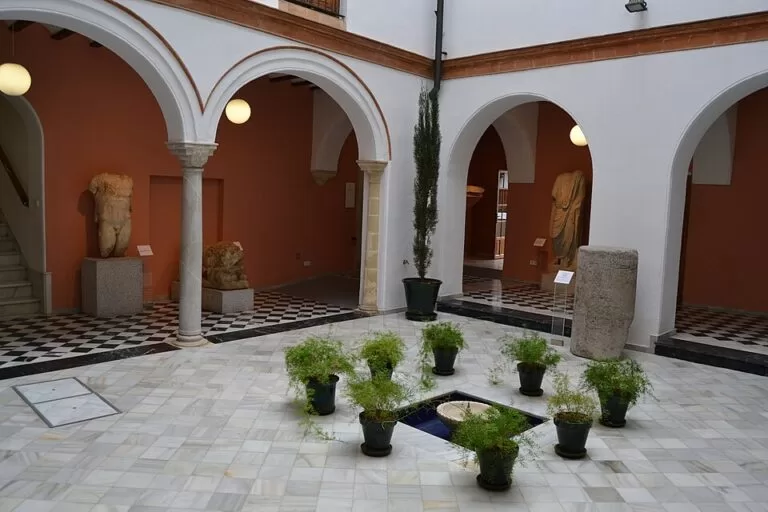
The building. The main exhibition is in a late 18th-century palace laid out as a patio house around three courtyards. From 1838 it was a school, later the provincial secondary school, and it stayed in teaching use until the early 1970s (Wikipedia, Spanish).
Practical details
- Facilities: a permanent exhibition, a temporary exhibition room, an auditorium, an audiovisual room, a library, an education department and a research and restoration department (Andalusia tourist board).
- Audio guides: available in English, French and German through QR codes you scan with your phone, so bring headphones and a charged phone.
- Groups: book on +34 956 149 561.
- Opening hours and tickets: we could not confirm 2026 hours or prices; the council’s museum website could not be reached when we checked. The tourist board lists the museum as open all year. Check before you go, especially on Mondays and public holidays.
- Time needed: about an hour for the nine rooms.
Accessibility and safety
The tourist board lists ramps for wheelchair users and a lift, and marks the museum as accessible. The surrounding streets of the San Mateo quarter are cobbled in places and narrow, with cars passing on shared “living streets”. Indoors the rooms are spread over three floors.
Best time to visit
Any time of year: it is an indoor visit and a good choice for a hot afternoon or a rainy day. Combine it with the Pinacoteca Rivero on the same square, or with a walk to the cathedral and Alcázar.
Nearby alternatives
- Jerez de la Frontera, 1.6 km away: our guide to the town, its old centre and its sherry bodegas.
- Alcázar of Jerez, 0.7 km away: the Moorish fortress at the southern edge of the old town.
- El Puerto de Santa María, 13 km away: the sherry port on the Bay of Cádiz.
- Sanlúcar de Barrameda, 21 km away: the manzanilla town at the mouth of the Guadalquivir.
- Museum of Cádiz, 21.5 km away: the provincial museum, with Phoenician sarcophagi and Zurbarán paintings from the Jerez Charterhouse.
- Cádiz Cathedral, 22 km away: the cathedral on Cádiz’s seafront.
Distances are in a straight line from the museum.
FAQ
Where is the Jerez Archaeological Museum?
On the Plaza del Mercado in the San Mateo quarter of Jerez’s old town, next to the Palacio Riquelme and the Pinacoteca Rivero. Coordinates: 36.6851, -6.1446.
What is the most famous object in the museum?
A Greek Corinthian bronze helmet of the 7th century BC, found in the river Guadalete near the Charterhouse of Jerez. It is shown on the first floor.
Is there parking at the museum?
Not beside it: the surrounding streets are narrow. Use a central car park and walk, or take a city bus to the Muro stop about 150 m away.
Is the museum wheelchair accessible?
Yes, according to the Andalusia tourist board, which lists ramps and a lift.
Are there audio guides in English?
Yes. Audio guides in English, French and German are available by QR code on your phone.
Sources and freshness
Checked 6 November 2026 · 4 sources Show
Checked 6 November 2026. Official: Andalusia tourist board, Museo Arqueológico de Jerez (address, collections, layout, facilities, audio guides, accessibility, phones). Background: Wikipedia, English (helmet, 1935 opening) and Spanish (history, closures, building, notable pieces). The council’s museum site (jerez.es) could not be reached for hours and prices. Location, bus stops, streets and distances: OpenStreetMap contributors (ODbL). Photos: Wikimedia Commons, licences as credited.
This place is part of our Costa de la Luz, Spain: beaches, towns, sherry and map — see every town, beach and cove we have mapped on that coast.
How this page is made. CostaMap is written with an AI editorial system run by Ebizapple. This page is based on the sources listed above. Last updated 6 November 2026. Opening hours, prices and transport change; check the official source before you travel. How we work · Partner links and ads