
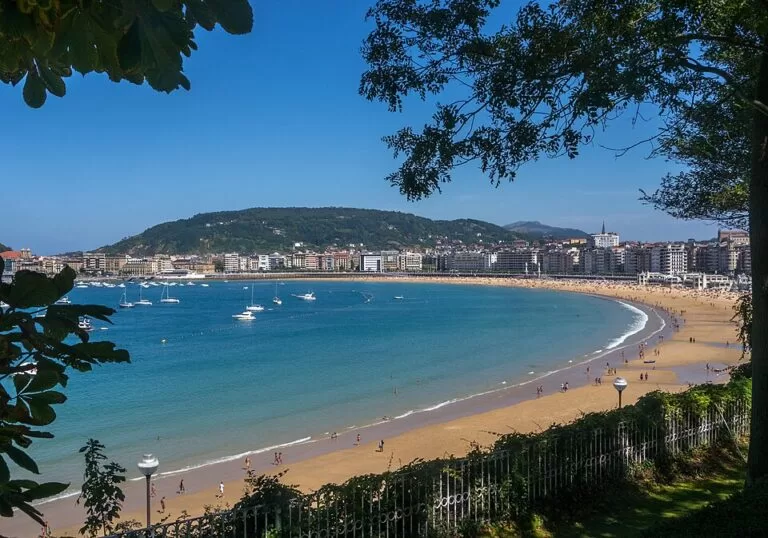
San Sebastián (Donostia in Basque) is the coastal capital of Gipuzkoa in the Basque Country, spread around the sandy Bay of La Concha between Mount Urgull and Mount Igeldo. Trains and long-distance buses arrive at stations under 1 km from La Concha beach, and the centre is easy to cover on foot or by city bus. Spain’s official tourism portal lists three city beaches: La Concha (1,350 m), Ondarreta (600 m) and the surf beach of Zurriola (800 m). It suits food lovers, city-break walkers and beach days in one trip; skip it if you want cheap, quiet summer weeks, because festivals fill the city.
Quick facts
- Names: San Sebastián in Spanish, Donostia in Basque; the official name is Donostia / San Sebastián. La Concha beach is Kontxa hondartza in Basque.
- Where: capital of Gipuzkoa province, Basque Country, on the Bay of Biscay.
- Coordinates: 43.3177, -1.9864 (La Concha beach, in the centre).
- Beaches: La Concha, 1,350 m long and 40 m wide; Ondarreta, 600 m by 100 m; Zurriola, 800 m by 110 m (spain.info).
- Landmarks: the Old Town (Parte Vieja), Mount Urgull, Mount Igeldo, the Peine del Viento sculptures, the Miramar Palace, the Kursaal and the San Telmo Museum.
- Events: the San Sebastián International Film Festival every September (turismo.euskadi.eus), the Tamborrada, the Semana Grande with its trainera rowing regattas, and a jazz festival (spain.info).
- Getting around: on foot, city buses and the San Sebastián Tourist Card for public transport and discounts (turismo.euskadi.eus).
Getting there and around
By train: OpenStreetMap maps the Adif main-line station Donostia / San Sebastián on the east bank of the Urumea, about 800 m from La Concha beach, and the Euskotren station Amara-Donostia about 700 m from the beach. spain.info notes that the María Cristina bridge, with four street lamps by the sculptor Mariano Benlliure, leads to the railway station.
By bus: the city bus station (Estación de Autobuses de San Sebastián), tagged as wheelchair accessible, sits next to the railway station, about 700 m from the beach.
In the city: the Basque tourism site calls San Sebastián an easy city to walk around or to cover by public transport. It recommends the San Sebastián Tourist Card, which includes public transport and gives discounts, and the Donostiatransport.eus app for city buses, car parks and taxi ranks (turismo.euskadi.eus). We could not confirm car park prices; the app lists the car parks.
What to see
The bay and the promenade. According to spain.info, the city spreads along a bay of white sand between Urgull and Igeldo. At the Igeldo end, at Punta Torrepea, stands the Peine del Viento (Wind Comb), a group of sculptures by Eduardo Chillida; turismo.euskadi.eus credits it to Chillida and the architect Peña Ganchegui. Ondarreta beach starts there. The small Pico del Loro cape separates it from La Concha, and above it Queen Maria Cristina built the Miramar Palace as her summer residence in the 19th century. A promenade with its well-known railings and lamp posts runs along La Concha, where the La Perla spa, a former royal bathhouse, stands on the sand.
The Old Town. Between the sea, the Urumea river and Mount Urgull lies the Parte Vieja, rebuilt after the fire of 1813 (turismo.euskadi.eus). It holds the Gothic church of San Vicente, the Renaissance-baroque basilica of Santa María del Coro, the San Telmo Museum in a former Dominican convent, and the Plaza de la Constitución, whose numbered balconies recall its past as a bullring (spain.info). Its streets are packed with pintxo bars.
Urgull and Igeldo. Mount Urgull is topped by the Castillo de la Mota and a statue of the Sacred Heart; one path climbs to the top and another, the Paseo Nuevo, runs round the mountain by the sea. Mount Igeldo, at the other end of the bay, is described by spain.info as an unbeatable viewpoint over the city.
Gros and the Kursaal. Across the river, the Gros district has Zurriola beach and the Kursaal congress centre designed by Rafael Moneo. Further south is the neo-Gothic Buen Pastor cathedral.
Beaches
- La Concha: 1,350 m of golden sand with moderate waves and high occupancy. spain.info lists sunshade and sunbed hire, water-craft rental, toilets, showers and a yacht club. turismo.euskadi.eus says the beach invites a dip or a stroll even in winter; the bay is framed by Igeldo and the island of Santa Clara.
- Ondarreta: 600 m by 100 m at the foot of Igeldo, moderate waves (spain.info).
- Zurriola: 800 m by 110 m in Gros, with strong waves and wind (spain.info); it is the surfers’ beach (turismo.euskadi.eus).
OpenStreetMap tags La Concha with a lifeguard service and no dogs.
Food and drink
Both official portals single out food. spain.info says some of Spain’s best-known restaurants are in San Sebastián and suggests local garden produce, fish and seafood with a txakoli wine from Getaria, which has its own Designation of Origin. turismo.euskadi.eus calls the city a world capital for food, particularly pintxos, small bar snacks served on the counters of the Old Town.
Accessibility and safety
La Concha is the most sheltered beach; Zurriola has strong waves and wind (spain.info), so swim only between the flags there. The Adif and Euskotren stations and the bus station are tagged as wheelchair accessible on OpenStreetMap. Urgull and Igeldo are hills, so expect climbs on foot. Book accommodation early for the festivals: spain.info advises reserving in advance.
Best time to visit
For beach weather, July and August are warmest but busiest, and festivals such as the Semana Grande fill the city. September brings the International Film Festival and very full hotels. Spring and autumn are good for walking and eating; pack a rain layer, as on all of this coast. Even in winter, La Concha is pleasant for a walk along the promenade.
Nearby alternatives
- Isla de Santa Clara, 1.1 km away: the island in the middle of the bay.
- Monte Igueldo, 1.9 km away: the viewpoint at the west end of the bay.
- Pasaia to San Sebastián walk, 5.3 km away: the GR 121 cliff path over Monte Ulia.
- Getaria, 17.6 km away: the fishing village known for txakoli.
- Flysch Route: Zumaia to Deba, 22.3 km away: the coastal walk past layered cliffs.
Distances are in a straight line from La Concha beach.
FAQ
Is La Concha safe for swimming?
It is the most sheltered of the city’s beaches, with moderate waves (spain.info) and a lifeguard service tagged on OpenStreetMap. Zurriola has strong waves and suits surfers.
How do I get to San Sebastián by train?
Main-line trains stop at Donostia / San Sebastián station (Adif), and Euskotren trains at Amara-Donostia; both are under 1 km from La Concha.
What are pintxos?
Small snacks served on bar counters, the city’s best-known food. The Old Town is full of pintxo bars.
When is the San Sebastián Film Festival?
Every September (turismo.euskadi.eus). Book accommodation early.
Is San Sebastián walkable?
Yes. The Basque tourism site calls it an easy city to walk around; the Tourist Card covers public transport.
Sources and freshness
Checked 6 November 2026 · 7 sources Show
Checked 6 November 2026. Official: spain.info, Donostia-San Sebastián (layout, landmarks, festivals, food), spain.info beach pages for La Concha, Ondarreta and Zurriola (sizes, waves, services); Basque tourism on San Sebastián and the Old Town (1813 fire, film festival, Tourist Card, pintxos). Stations, bus station, lifeguard tag and distances: OpenStreetMap contributors (ODbL). The city tourism site (sansebastianturismoa.eus) could not be reached from our research tools. Photos: Wikimedia Commons, licences as credited.
How this page is made. CostaMap is written with an AI editorial system run by Ebizapple. This page is based on the sources listed above. Last updated 6 November 2026. Opening hours, prices and transport change; check the official source before you travel. How we work · Partner links and ads