
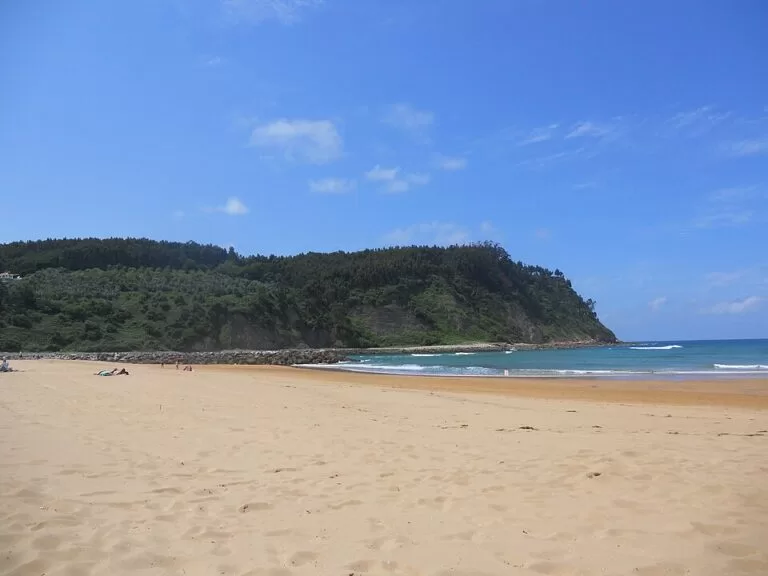
Playa de Rodiles is a beach of golden sand more than one kilometre long at the mouth of the Villaviciosa estuary in Asturias, about 7 km in a straight line north-east of Villaviciosa town. You reach it by car on the VV-6 road to the beach, which ends at the car parks behind a pine and eucalyptus wood; Turismo Asturias says the beach is also served by public transport. It suits surfers, families who want a long walk on the sand and anyone who likes woodland behind a beach. Skip it on a calm-sea swimming day with small children: the official page calls it a very open area with strong waves.
Quick facts
- Names: Playa de Rodiles (Spanish), Rodiles beach. It lies in the parish of Selorio (Seloriu) in the municipality of Villaviciosa.
- Where: the east side of the mouth of the Ría de Villaviciosa, opposite the beach of El Puntal; Tazones is about 2 km away in a straight line across the estuary.
- Coordinates: 43.5338, -5.3797 (beach, OpenStreetMap).
- Size: more than 1 km long and 300 m wide, though both vary a lot with the tides (Turismo Asturias).
- Sand and sea: golden sand, a very open beach with strong waves.
- Protection: part of the Ría de Villaviciosa Partial Nature Reserve.
- Lifeguards: every day from 20 June to 20 September (checked November 2026).
- Dogs: not allowed on the beach from 1 June to 30 September.
Access and parking
By car: the last stretch is the VV-6, signed as the road to Rodiles beach (OpenStreetMap). Villaviciosa town is about 7 km away in a straight line, Gijón about 23 km and Oviedo about 42 km; road distances are longer.
Parking: Turismo Asturias mentions a controlled (paid) car park. OpenStreetMap shows several car parks behind the wood: a “Parking oeste” tagged as paid, about 500 m from the middle of the beach, an “Aparcamiento este” tagged as free, about 550 m away on the east side, and a few small free car parks of around eight spaces each near the beach access. We could not confirm prices or opening times.
By bus: Turismo Asturias says the beach has public transport. We could not confirm the line or how often it runs, so check the Asturias transport consortium (CTA) timetables before you rely on it.
On foot: from the car parks you walk through the eucalyptus wood to the sand. A wooden promenade runs along the bank of the estuary.
What to expect
Rodiles is one of the largest and busiest beaches in Asturias. The sand runs along the mouth of the estuary, and behind it is a large wood of pine and eucalyptus trees, which OpenStreetMap names the Eucaliptal de Rodiles. Turismo Asturias says the wood and the wooden promenade along the estuary make it a unique stretch of sand.
The open sea side has strong waves. Villaviciosa’s municipal page calls Rodiles “a surfing icon”, and Turismo Asturias says surfers and anglers use it. OpenStreetMap shows a surf school by the car parks. The nature reserve page lists windsurfing, canoeing, sailing and boat trips along the estuary as activities in the area.
The estuary is the main reason to come outside summer. The Ría de Villaviciosa is the largest estuary in Asturias and, after the Eo estuary, the second most important wintering and resting area for migrating waterbirds in the region. Almost a hundred waterbird species have been recorded there, and the Spanish Ornithological Society rates it a Wetland of National Importance (Turismo Asturias). Rodiles is in the mouth zone of the reserve, with sandbanks and mudflats further up the estuary.
At the east end, OpenStreetMap marks the Mirador de Punta de Rodiles, a viewpoint about 650 m from the middle of the beach, with a view along the coast and over the estuary mouth towards Tazones.
Practical details
- Toilets: OpenStreetMap shows public toilets near the beach access and two free toilets by the west car park.
- Food and drink: several bars and restaurants are mapped by the car parks, and there are cider bars near the beach. Tazones, across the estuary, has fish restaurants by its harbour.
- Campsites: Turismo Asturias notes campsites around the beach; OpenStreetMap maps three about 600–700 m from the sand.
Accessibility and safety
An amphibious wheelchair and adapted crutches are available from 21 June to 21 September; ask the lifeguard service at the beach access walkway. There is a defibrillator at the lifeguard station (Turismo Asturias, checked November 2026).
The waves can be strong and the tide changes the width of the beach a lot. Swim only when the lifeguards are on duty, between 20 June and 20 September. In an emergency call 112.
The reserve rules say dogs must be on a lead shorter than one metre, and unleashed dogs are not allowed on the beaches. On the promenades near the beach access, dogs are allowed on a fixed lead of no more than one metre all year.
Best time to visit
For swimming on a lifeguarded beach, come between 20 June and 20 September; as one of the busiest beaches in Asturias, it is at its fullest on sunny summer days. For birds, the reserve page says the autumn migration brings the most species, and many waterbirds spend the winter on the estuary.
Nearby alternatives
- Lastres, 9 km away: a fishing village stacked above its harbour, further east.
- Mirador del Fitu, 18 km away: a viewpoint over the coast and the Picos de Europa.
- Gijón, 23 km away: the city beach of San Lorenzo and the old fishing quarter of Cimadevilla.
- Luanco, 34 km away: a fishing village with the Asturias Maritime Museum.
- Cabo de Peñas, 40 km away: the northernmost point of Asturias.
Distances are in a straight line from Rodiles. Tazones, 2 km away across the estuary, has no CostaMap page yet: it is the port where Emperor Charles V first landed in Spain in September 1517, according to Turismo Asturias.
FAQ
Is there parking at Rodiles beach?
Yes. Turismo Asturias mentions a paid car park, and OpenStreetMap shows a paid west car park, a free east car park and several small free car parks behind the wood, 200–550 m from the sand.
Can you swim at Rodiles?
Yes, but it is an open beach with strong waves. Lifeguards are on duty every day from 20 June to 20 September.
Is Rodiles good for surfing?
Yes. Turismo Asturias lists surfing among its main uses, and Villaviciosa calls it a surfing icon. A surf school is mapped by the car parks.
Are dogs allowed on Rodiles beach?
Not from 1 June to 30 September. On the promenades near the beach access, dogs are allowed all year on a lead of no more than one metre.
How far is Rodiles from Villaviciosa?
About 7 km in a straight line north-east of the town, along the estuary; the last part of the road is the VV-6.
Sources and freshness
Checked 6 November 2026 · 6 sources Show
Checked 6 November 2026. Official: Turismo Asturias pages on Rodiles beach (size, waves, parking, public transport, lifeguards, accessibility, dogs; also the Spanish version), the Ría de Villaviciosa Nature Reserve (zones, birds, activities, dog rules), the municipality of Villaviciosa and Tazones. Location, road, car parks, toilets, campsites, viewpoint and distances: OpenStreetMap contributors (ODbL). Photo: Wikimedia Commons, licence as credited.
How this page is made. CostaMap is written with an AI editorial system run by Ebizapple. This page is based on the sources listed above. Last updated 6 November 2026. Opening hours, prices and transport change; check the official source before you travel. How we work · Partner links and ads