
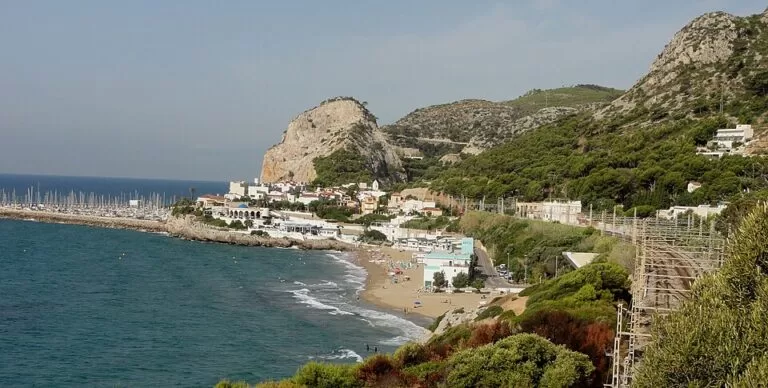
Garraf is the small seaside village of Sitges at the foot of the Garraf massif, about 8 km east of Sitges town and 27 km from central Barcelona in a straight line. Its 380 m pebble beach, lined with low beach houses, sits between a sports harbour and the rocky hills of the Garraf Natural Park, and the R2 Sud train stops in the village, so you can come without a car. It suits a beach day or a lunch stop on the coast road; skip it if you want a long sandy beach or quiet in July and August.
Quick facts
- Names: Garraf, sometimes called Garraf Poble (Garraf village) to tell it from the massif and the comarca of the same name. The beach is the Platja de Garraf, the harbour the Port de Garraf.
- Where: municipality of Sitges, Garraf comarca, Barcelona province; on the coast between Port Ginesta (Les Botigues de Sitges) and Vallcarca. Postcode 08871.
- Coordinates: 41.2527, 1.9025.
- People: 514 inhabitants in 2025 (Catalan Wikipedia, from Idescat).
- Beach: 380 m long and 28 m wide, pebbles and rock, calm water, high occupancy (spain.info).
- Train: Garraf station on the Rodalies R2 Sud line, opened in 1881; the present station building dates from 1912.
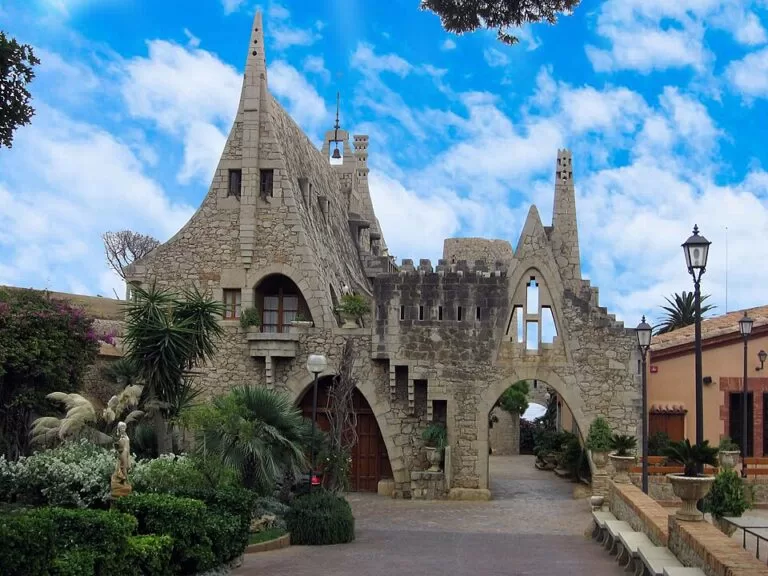
- Landmark: the Celler Güell, a modernista wine cellar of about 1901 commissioned by Eusebi Güell, today a restaurant.
- Entry: the beach is free.
Access and parking
By train: Garraf station lies about 150 m from the beach. It is on the R2 Sud, the line along the Garraf coast between Barcelona and Sitges, Vilanova and beyond; Catalan Wikipedia gives fare zone 2A and about 56,000 passengers a year. Sitges station is 8 km west in a straight line. Check times with Rodalies de Catalunya before you travel.
By car: the coast road between Castelldefels and Sitges runs through the village along the cliffs; Catalan Wikipedia calls it the C-31, while spain.info names the C-246. Spain.info lists the beach as easy to reach on foot and by car.
Parking: we could not confirm the size, price or rules of parking in the village. The beach is busy in summer, so arrive early or take the train.
On foot or by bike: Port Ginesta, the large marina at Les Botigues de Sitges, is about 1.9 km east in a straight line.
What to expect
Spain.info describes a beach surrounded by the hills of the Serra de Coma Roja, named after the stretch of coast known as the Costa de Garraf, with low houses at the same level as the sand. Catalan Wikipedia calls it a small cove with picturesque casetes, the row of little beach houses that contrasts with the rocky massif, and notes that it has been used for several television adverts. It is a busy summer resort beach, not a wild cove.
Garraf was a small fishing village. Its harbour was built in 1902 to ship stone from a quarry used for one of the extensions of the port of Barcelona, and it is now used only for leisure boats (Catalan Wikipedia). Catalunya.com lists Garraf as one of the three harbours of Sitges, with Port Ginesta and Aiguadolç, where you find sailing courses, boat rental and diving. The village also has a small church, Santa Maria Estrella del Mar.
The name is old: Catalan Wikipedia says “Garraf” is recorded in 1011, and Alfonso II founded a priory here, Sant Vicenç de Garraf, in 1163. The area, the old Quadra de Garraf, became part of Sitges between 1832 and 1841. Catalan Wikipedia lists two films linked to the village: The Last Days of Pompeii (1959), credited there to Sergio Leone, and Cesc Gay’s Krámpack (2000).
The Celler Güell
Above the coast road at the village stands the Celler Güell (Bodegas Güell), a group of buildings for Eusebi Güell: a wine cellar, a residence and a chapel. Güell bought the old Garraf farmhouse and its land in 1871 for a hunting pavilion; Antoni Gaudí drew one in 1882, but it was never built, and later Güell ordered a cellar with a house instead. Who designed it is disputed: some historians credit Francesc Berenguer, while the Gaudí expert Joan Bassegoda made Gaudí a co-author. Look for the parabolic arches, wrought iron, bare brick and the way wall and roof merge into one triangular shape. It is listed as cultural heritage and now houses a restaurant (Catalan Wikipedia), so you see the outside from the road unless you eat there.
Practical details
- Beach services listed by spain.info: sunshade and lounger rental, water-sports rental, toilets, showers, bins and cleaning, a sports area and a children’s play area.
- Surface: pebbles and rock, so bring water shoes and something to lie on.
- Food: the Celler Güell restaurant and bars by the harbour; hours and prices not checked.
- Natural park: the Garraf Natural Park office on the road from Ratpenat to Plana Novella (km 3.5, Sitges) is open Monday to Friday 9:00–15:00 according to Catalunya.com, checked November 2026.
Accessibility and safety
The station is close to the beach, but the beach itself is pebbles and rock, which is hard going with a wheelchair or a pushchair; we found no official information about adapted access or a bathing chair at Garraf. Spain.info gives calm swimming conditions. The coast road is narrow and winding along the cliffs, so take care walking along it. The hills behind are dry scrub and limestone: in summer, carry water and check any fire-risk restrictions before walking into the park.
Best time to visit
Spain.info rates occupancy as high. In July and August expect a full beach and little parking: come early, on a weekday or by train. In spring and autumn the beach is quiet and the walks in the Garraf hills are cooler. Catalunya.com notes that the Garraf range shelters Sitges and gives it a mild climate, with an average of about 15 °C in winter.
Nearby alternatives
- Port Ginesta: the big marina at Les Botigues de Sitges, with restaurants and the long Les Botigues beach next to it. 1.9 km.
- Garraf Massif and Natural Park: the limestone hills behind the village, with caves, fan palms and marked walks. 4.9 km to the park centre point.
- Castelldefels Castle: a hilltop castle above Castelldefels, near the R2 Sud station. 7.2 km.
- Port d’Aiguadolç: Sitges’ marina, east of the old town, with a small beach. 6.9 km.
- Sitges: the town, with its old quarter, town beaches and museums. About 8 km.
- Cau Ferrat Museum: Santiago Rusiñol’s house-studio on the Sitges seafront. 7.8 km.
FAQ
How do I get to Garraf from Barcelona?
Take the Rodalies R2 Sud train towards Sitges and get off at Garraf; the station is a few minutes’ walk from the beach. By car, follow the coast road (C-31) from Castelldefels towards Sitges.
Is Garraf beach sandy?
No. Spain.info lists it as pebbles and rock, 380 m long and 28 m wide, with calm water. For sand, try Les Botigues beach by Port Ginesta or the town beaches of Sitges.
Can you visit the Celler Güell?
The building now houses a restaurant, so you can see the outside from the coast road and the inside if you eat there. We could not confirm any separate guided visits.
What are the little houses on Garraf beach?
They are the casetes, a row of small beach houses at the level of the sand that give the bay its look. They are private.
Is there parking in Garraf?
We could not confirm how much parking there is or what it costs. In summer the train is the easier choice.
Sources and freshness
Checked 9 November 2026 · 3 sources Show
Checked 9 November 2026. Official:
- Spain.info, Beach: Garraf (size, surface, services, access)
- Catalunya.com, Sitges (the three harbours of Sitges, climate)
- Catalunya.com, Garraf Natural Park (park office address and hours). Background: Catalan Wikipedia on Garraf (Sitges) (population, history, harbour, films), the Celler Güell and Garraf station. Location and straight-line distances: OpenStreetMap contributors. The Sitges town hall and Sitges tourism sites could not be reached while checking. Not confirmed: parking, train frequency, restaurant hours, harbour operators. Photos: Wikimedia Commons, licences as credited
This place is part of our Costa del Garraf map and travel guide: Sitges, Vilanova and Castelldefels — see every town, beach and cove we have mapped on that coast.
How this page is made. CostaMap is written with an AI editorial system run by Ebizapple. This page is based on the sources listed above. Last updated 9 November 2026. Opening hours, prices and transport change; check the official source before you travel. How we work · Partner links and ads