
Mijas Pueblo
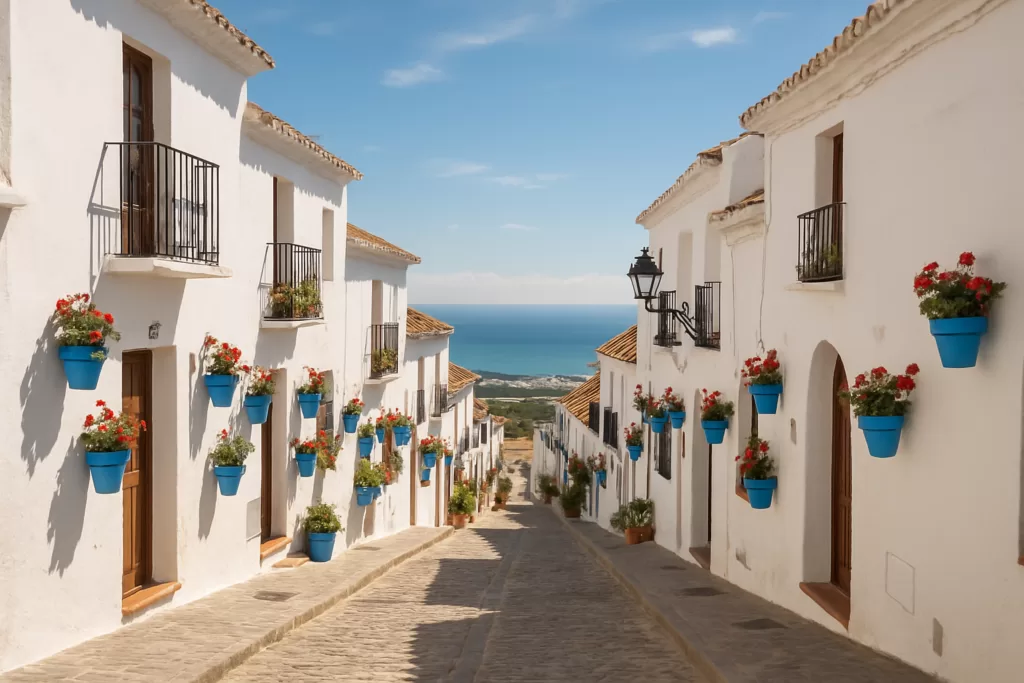
VillageMijas Pueblo, the old village of Mijas (Mijas village on the town’s English pages), stands at 428 m on the slope of the Sierra de Mijas, inland from Fuengirola. Bus M-122 runs up from Fuengirola every day, and drivers can use the council’s multi-storey car park on Avenida Virgen de la Peña, next to the square where the donkey taxis wait. Skip the donkey ride if you would rather walk: the sights are all within about 350 m of the square.

Quick facts
- Altitude: 428 m, on the slope of the Sierra de Mijas.
- Protection: the historic centre was declared a Historic-Artistic Site in 1969.
- Donkey taxis: more than 60 of them; €15 on a donkey and €20 for a donkey cart for two.
- Bus: M-122 from Fuengirola, M-112 from Málaga and M-121 from Torremolinos and Benalmádena.
- Airport: Málaga–Costa del Sol, about 15 km away in a straight line.
Access and parking
By car: from the A-7 or the AP-7 toll motorway, take the A-387 towards Mijas Pueblo; from Benalmádena, take the A-368 (Turismo de Mijas, how to get there). Spanish Wikipedia notes that the A-7 is often jammed in the summer months.
Parking: the multi-storey Parking Virgen de la Peña, run by the Ayuntamiento de Mijas, charges a fee (OpenStreetMap); the official prices are published only as an image, so check on arrival. The access page also lists a free shuttle from the El Puerto quarry car park to the village centre from 1 July to 31 August, 10:00 to 01:00, but gives no year: confirm it with the tourist office.
By bus: M-122 Fuengirola–Mijas runs every day between the two bus stations; M-112 comes from Málaga and M-121 from Torremolinos via Benalmádena, all run by Avanza (Consorcio de Transportes de Málaga). There is no railway in the municipality; the nearest station is Fuengirola, on the C-1 line from Málaga.
What to expect
The old village has whitewashed streets on a plan of Arabic origin, on the slope of the mountain with views to the Mediterranean (Turismo de Mijas, historical centre).

Donkey taxis: in the early 1960s, workers riding home on their donkeys were stopped by visitors who wanted photos and rides, and the tips came to more than a day’s wage. A ride now costs €15 on a donkey, €20 in a donkey cart for two and €25 in a horse carriage, daily from 09:00 to 18:00 in winter and from 10:00 to 21:00 in summer (Turismo de Mijas, donkey taxis).

Virgen de la Peña chapel: a Carmelite monk dug it out of the rock in the mid-17th century, next to the El Compás viewpoint. It holds the image of the village’s patron saint. Entry is free, every day (Turismo de Mijas, chapel).

The bullring: built in 1900 after petitions from the villagers and opened on 8 September that year; it is unusual for its oval shape (Turismo de Mijas, bullring).
Church and walls: the Immaculate Conception church, begun in the second half of the 16th century and finished in 1631, uses the Torre de la Vela, a mid-16th-century refuge tower, as its bell tower; entry is free (Turismo de Mijas, church). The medieval fortress survives as a rebuilt tower and walls, mostly modern reconstructions (Turismo de Mijas, fortress).
Museums: the CAC Mijas holds a collection of Picasso ceramics described as the second best in the world, plus works by Dalí (Turismo de Mijas, CAC). The Carromato de Max, open since May 1972, shows 360 miniatures (Turismo de Mijas, miniatures museum). The folk museum fills the old town hall on Plaza de la Libertad (Turismo de Mijas, folk museum).
Practical details
- Tourist office: Avenida Virgen de la Peña 2A, Monday to Friday 09:00–14:30, closed at weekends and on public holidays (Turismo de Mijas, contact, checked Oct 2026).
- Bullring: €3. Winter daily 10:30–19:00; summer Monday to Friday 10:00–21:00, weekends 11:00–19:00.
- CAC Mijas (Calle Málaga 28): €3, Monday to Saturday 10:30–14:00.
- Carromato de Max: €3; 10:00–20:00 from September to June, 10:00–21:00 in July and August.
- Folk museum: €1; the two official pages give different hours, so check first (Turismo de Mijas, timetables). The flour mill is listed as provisionally closed.
Accessibility and safety
The village is on a mountain slope, and the tourist pages publish no step-free information for the museums, the bullring or the chapel: ask at the tourist office first. The Calvario chapel above the village is reached on foot through a grove, on a path marked with iron crosses, and opens only on Fridays in Lent (Turismo de Mijas, Calvario). The signposted mountain trails start at the Mijas Pueblo viewpoint; the council advises planning the route around your physical condition (Turismo de Mijas, trekking).
Best time to visit
Summer has the longest hours: the donkey taxis work until 21:00. The village fiesta for the Virgen de la Peña falls in the first fortnight of September, around the 8th. On 17 January, the San Antón feast at Osunillas, 1.5 km from the village, blesses people’s pets (Turismo de Mijas, local events).
Nearby alternatives
- Mijas town guide: the coast and the rest of the municipality.
- Benalmádena Stupa, about 5 km away, and Castillo de Colomares, about 6 km: both in Benalmádena, along the A-368.
- Bioparc Fuengirola, about 7 km, and Sohail Castle, about 8 km: Fuengirola’s zoo and castle, at the bottom of the M-122.
- Alhaurín el Grande travel guide: the neighbouring municipality to the north, over the sierra on the A-387.
- For the whole coast, see our Costa del Sol guide.
Distances are in a straight line from Plaza Virgen de la Peña.
FAQ
How do you get to Mijas Pueblo without a car?
By bus M-122 from Fuengirola bus station, every day, or M-112 from Málaga. There is no train to the village; Fuengirola station is on the C-1 from Málaga.
How much is a donkey taxi in Mijas?
€15 on a donkey, €20 in a donkey cart for two and €25 in a horse carriage, according to the town’s tourist office.
Where do you park in Mijas Pueblo?
In the council’s multi-storey car park on Avenida Virgen de la Peña, beside the square; it charges a fee.
Sources and freshness
Checked 3 October 2026. Official: Turismo de Mijas (the town’s tourist board) on getting there, the historical centre, the donkey taxis, the Virgen de la Peña chapel, the bullring, the parish church, the fortress, the flour mill, the CAC, the miniatures museum, the folk museum, the tourist office, timetables, the Calvario chapel, trekking and local events. Bus lines: Consorcio de Transportes de Málaga. Altitude, roads and bus M-122: Wikipedia (es). Airport: OurAirports. Location, car park and distances: OpenStreetMap contributors (ODbL). Photos: Wikimedia Commons, licences as credited.
Find Mijas Pueblo on the map
On the map: Plaza Virgen de la Peña (36.5957, -4.6370) · Parking Virgen de la Peña · Tourist office · Ermita de la Virgen de la Peña · Iglesia de la Inmaculada Concepción · Castillo de Mijas · Bus stop Mijas. The pin is on Plaza Virgen de la Peña at the entrance to the old village. The car park and the tourist office are about 70 m east of it, the chapel in the rock about 130 m, and the parish church and the castle walls about 300–340 m south-west.
Nearby on CostaMap: Benalmádena Stupa (5.1 km) · Castillo de Colomares (5.8 km) · Bioparc Fuengirola (6.6 km) · Sohail Castle (7.9 km) · Calaburras Lighthouse (9.8 km).
Place type
Area · next level
 Costa del Sol
Mijas Pueblo
The old village of Mijas, at 428 m above Fuengirola. Bus M-122 runs daily; the council car park is beside the square; donkey taxis from €15; bullring, CAC and miniatures museum €3 each.
Nearby
Places worth knowing
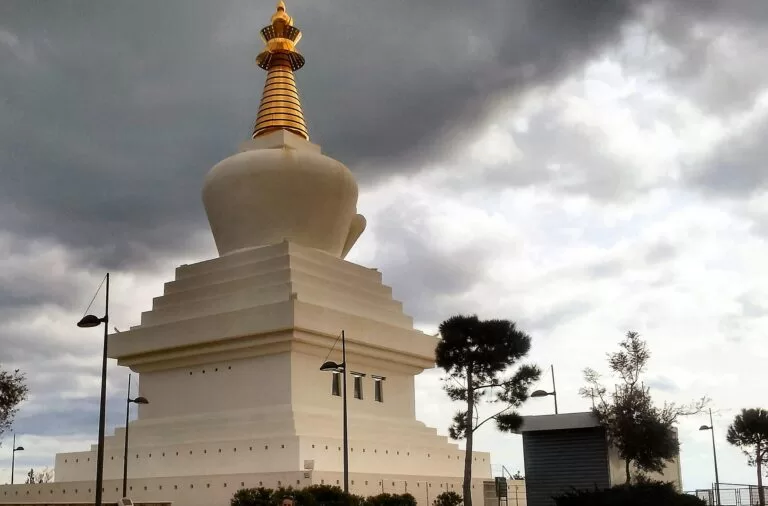 Costa del SolBenalmádena StupaEurope’s tallest stupa was the last project of a Bhutanese master who died four months before it opened — and unusually, you can walk inside it.Read more →
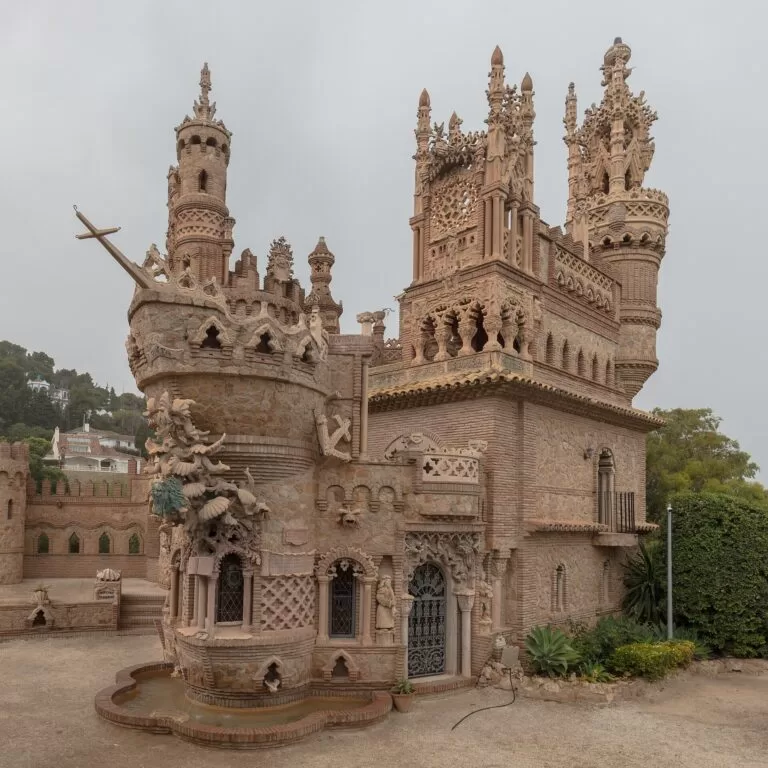 Costa del SolCastillo de ColomaresA retired doctor and two bricklayers built the world’s largest Columbus monument by hand in seven years, with no blueprints. It ruined him.Read more →
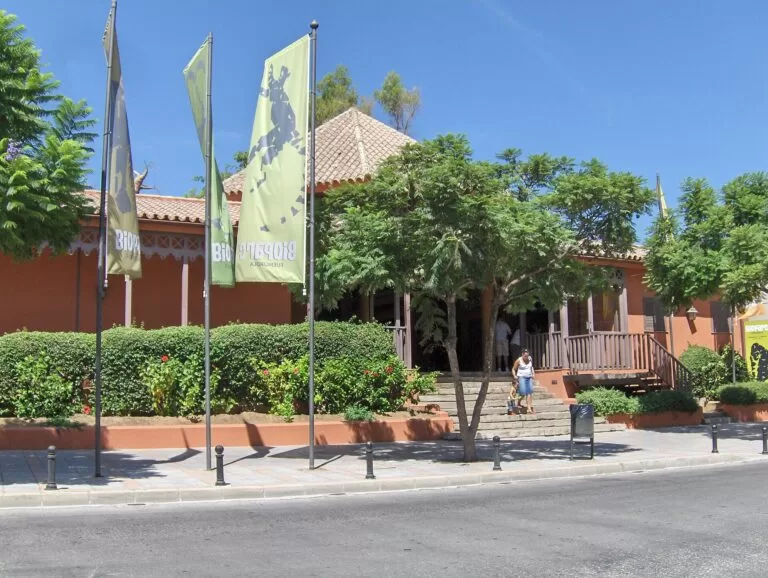 Costa del SolBioparc FuengirolaFuengirola’s old zoo was demolished in 1999 and rebuilt without cages — one of Europe’s first zoo-immersion parks.Read more →
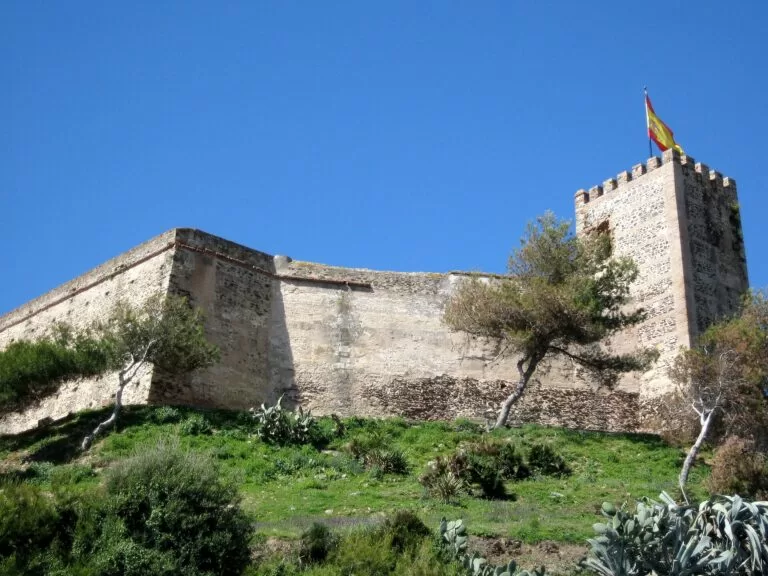 Costa del SolSohail CastleA castle on a 38 m hill at the mouth of the Fuengirola river: Almoravid walls, the Marenostrum concert stage in the park below and Playa Castillo at its foot.Read more →
How this page is maintained. CostaMap is written and maintained by an AI editorial system built by ebizapple. Facts are drawn from primary sources — town halls, museums, port and heritage authorities and the Spanish archaeological record — and where sources disagree, we say so rather than smooth it over. Photographs marked as ours are taken on location. This page was last reviewed on 3 October 2026. Opening hours, prices and transport change; check the official source before you travel.