
Naveta des Tudons (Ciutadella, Menorca)
Historic siteThe Naveta des Tudons is a Bronze Age stone tomb shaped like an upturned boat, standing in a field about 4.5 km east of Ciutadella, just south of the Me-1 road to Maó. You park by the main road and walk about 400 m to the monument, which you see from the outside only: the chambers are closed to protect them. It suits anyone with an interest in prehistory and a car; skip it if you want a long visit, since there is one monument to see and it takes well under an hour.
Quick facts
- Names: Naveta des Tudons, Naveta d’Es Tudons or Naveta dels Tudons. Naveta means “little ship”; Es Tudons, “the woodpigeons”, is the name of the place.
- Where: Ciutadella municipality, western Menorca, near km 40 of the Me-1 between Ciutadella and Ferreries.
- Coordinates: 40.0031, 3.8916.
- What it is: a collective tomb (ossuary), the largest and best-preserved funerary naveta on Menorca.
- Age: the Balearic tourist board dates navetas to the Bronze Age and the start of the Iron Age, 1400–850 BC; Wikipedia gives use of this one as an ossuary between about 1200 and 750 BC.
- Size: about 14.5 m long, 6.5 m wide and 4.55 m high; it may once have stood 6 m tall.
- World Heritage: part of Talayotic Menorca, inscribed by UNESCO in 2023.
- Ownership: privately owned, according to the Balearic tourist board.
Access and parking
By car: take the Me-1 from Ciutadella towards Maó. The naveta stands about 200 m south of the road (Wikipedia) and is signposted. OpenStreetMap shows a car park beside the main road, with separate areas for cars and coaches, about 400 m north of the monument; from there a path leads across the fields.
Without a car: OpenStreetMap shows no bus stop near the car park, so plan on a car, a bike or a taxi from Ciutadella, 4.5 km away in a straight line.
What to expect
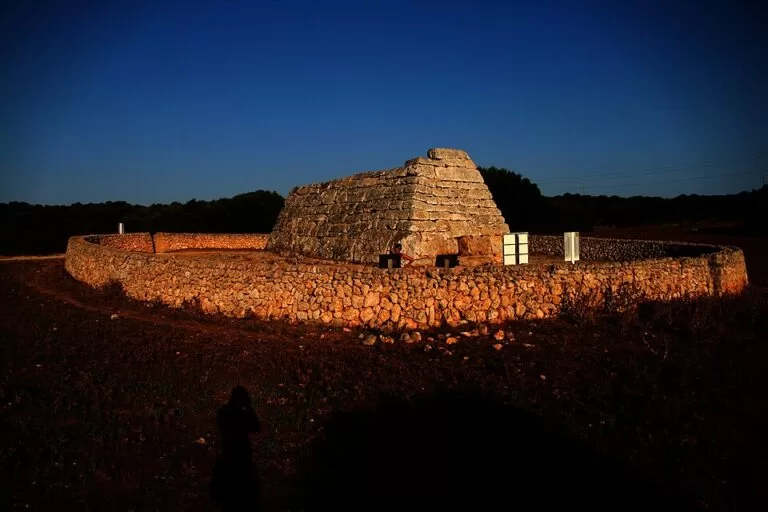
A single, very well-built stone monument in open farmland, surrounded at a distance by a modern dry-stone wall. The front, sides and rounded back are built of large dressed limestone blocks laid in horizontal courses without mortar, on a footing of even bigger blocks set on edge. The shape is an elongated horseshoe: the flat front is the “stern”, the rounded apse the “bow” (Balearic tourist board).
Inside, seen through the door. A small doorway, 0.57 m by 0.75 m and rebated for a closing slab, leads to a short passage and an antechamber, then to the lower chamber (7.45 m by 2.45 m). Above it, reached from the antechamber, is an upper chamber (7.10 m by 1.90 m) with a much lower ceiling. The lower chamber held the cleaned bones of the dead; the upper one was probably where recent bodies were left to dry (Wikipedia).
What was found. The remains of at least 100 people, with grave goods such as bronze bracelets, punches, a spearhead, and bone and ceramic buttons. Finds are on display in the Museu de Menorca in Maó.
The name. The term naveta was coined by Joan Ramis in his 1818 book on Menorca’s antiquities, because the buildings look like boats turned keel up. Funerary navetas exist only on Menorca, and this is the most visited prehistoric monument on the island (Balearic tourist board).
The legend. Two giants competed for the same girl: one would build the naveta, the other dig a well. When the well struck water first, the builder threw the last stone of the naveta into it. That is the local explanation for the stone missing from the top of the front.

Practical details
- Interior: closed to visitors to protect the structure. Everything is seen from outside.
- Time needed: 20–40 minutes including the walk from the car park.
- Restoration: sources differ on the date. Wikipedia says the archaeologist Lluís Pericot excavated and restored it in 1959–1960, putting back the missing top courses; the Balearic tourist board says the work was done in the late 1960s by teams from the museums of Mallorca and Menorca.
- Protection: on the Spanish heritage register since the 1930s (Wikipedia gives 3 June 1931; the tourist board says 1933).
- Opening hours and tickets: we could not confirm current hours or whether a fee applies in 2026; the Consell Insular’s heritage website could not be reached when we checked. Look for signs at the car park.
- Facilities: we found no café or toilets at the site; bring water.
Accessibility and safety
The approach is a field path of about 400 m from the car park, unsurfaced in places; we could not confirm whether it is step-free. There is little shade. Do not climb on the stones: in March 2018 vandals painted graffiti on 81 of them, and restorers called in by the Consell Insular removed them (Wikipedia).
Best time to visit
Early morning or late afternoon, when the low sun brings out the masonry and the field is cooler. In July and August, avoid the middle of the day: there is no shade on the path. The site makes a short stop on the way between Ciutadella and the south-coast coves, or on the drive back to Maó.
Nearby alternatives
- Cala Turqueta, 8 km away: a cove on the south coast, south of Ciutadella.
- Cala Macarelleta, 8 km away: the small cove next to Cala Macarella.
- Cala Mitjana, 10 km away: a cove on the south coast near Ferreries.
- Fornells, 21 km away: the north-coast fishing village.
- Mahón Harbour, 35 km away: the island capital’s long natural harbour; the Naveta finds are in the Museu de Menorca in Maó.
Distances are in a straight line from the monument.
FAQ
Can you go inside the Naveta des Tudons?
No. The interior is closed to protect the structure; you can walk around the outside and look at the doorway.
Is there parking at the Naveta des Tudons?
Yes. OpenStreetMap shows a car park beside the Me-1 main road, about 400 m north of the monument, with a separate area for coaches.
How do I get to the Naveta des Tudons?
Drive east from Ciutadella on the Me-1 towards Maó; the site is signposted, about 4.5 km from Ciutadella. There is no bus stop close by.
How old is the Naveta des Tudons?
It dates from the Bronze Age. It was used as a collective tomb from about 1200 to 750 BC; navetas in general are dated 1400–850 BC by the Balearic tourist board.
What is the difference between a naveta and a talayot?
A naveta is a boat-shaped building, here a tomb, from before the Talayotic period. A talayot is the later dry-stone tower that gives the Talayotic culture its name.
Sources and freshness
Checked 6 November 2026 · 5 sources Show
Checked 6 November 2026. Official: Balearic Islands tourist board, Naveta d’es Tudons (dating, finds, restoration, listing, ownership); spain.info (chambers). Background: Wikipedia on the Naveta d’Es Tudons (dimensions, use, excavation, register) and Naveta des Tudons (location on the Me-1, 2018 vandalism, UNESCO 2023). Location, parking and distances: OpenStreetMap contributors (ODbL). The Consell Insular de Menorca heritage site (menorcatalayotica.info) could not be reached for hours and prices. Photos: Wikimedia Commons, licences as credited.
This place is part of our Balearic Islands travel guide: Mallorca, Menorca, Ibiza and Formentera — see every town, beach and cove we have mapped on that coast.
How this page is made. CostaMap is written with an AI editorial system run by Ebizapple. This page is based on the sources listed above. Last updated 6 November 2026. Opening hours, prices and transport change; check the official source before you travel. How we work · Partner links and ads