
Ses Salines Natural Park (Sant Josep, Ibiza)
Natural parkSes Salines Natural Park is the protected area of salt pans, beaches, dunes and sea at the southern tip of Ibiza, in Sant Josep de sa Talaia, about 8 km south of Ibiza town and 4 km from the airport in a straight line. From Ibiza town you follow the airport road, then the ring road towards Sant Jordi and the PM-802 towards Sa Canal, Es Cavallet and Ses Salines; buses 11 and 11B also run there. The park, managed by the Balearic Government, is open every day, all day, and its official page mentions no entry fee. It suits beachgoers, birdwatchers (flamingos almost all year) and anyone curious about the salt works; skip it in high summer if you want a quiet beach.
Quick facts
- Names: Parc Natural de ses Salines d’Eivissa i Formentera in Catalan, Parque Natural de ses Salines de Ibiza y Formentera in Spanish. “Ses Salines” means “the salt pans”.
- Where: the south of Ibiza and the north of Formentera, with the strait between them, in the municipalities of Sant Josep de sa Talaia and Formentera.
- Coordinates: 38.8411, 1.3909 (Platja de ses Salines, the main beach on the Ibiza side; OpenStreetMap).
- Size: about 2,750 ha of land and 14,000 ha of sea; the sea is about 85% of the park.
- Protected since: partly an ANEI (Natural Area of Special Interest) from 1991, a Nature Reserve under state law in 1995, and a Natural Park under Balearic law in 2001.
- UNESCO: its Posidonia seagrass meadows are part of the World Heritage site declared in 1999.
- Open: every day of the year, 24 hours; the official page mentions no entry fee.
- Visitor centre on Ibiza: the Sant Francesc interpretation centre, beside the church of Sant Francesc de s’Estany.
Facts above are from the park pages of the Balearic Government, checked November 2026.
Access and parking
By car: the park’s directions from Ibiza town are to take the Avinguda de Sant Josep towards the airport, then the ring road towards Sant Jordi, and follow the PM-802 towards Sa Canal, Es Cavallet and Ses Salines. The interpretation centre is on the same road, beside the church of Sant Francesc de s’Estany, about 3 km before the beach.
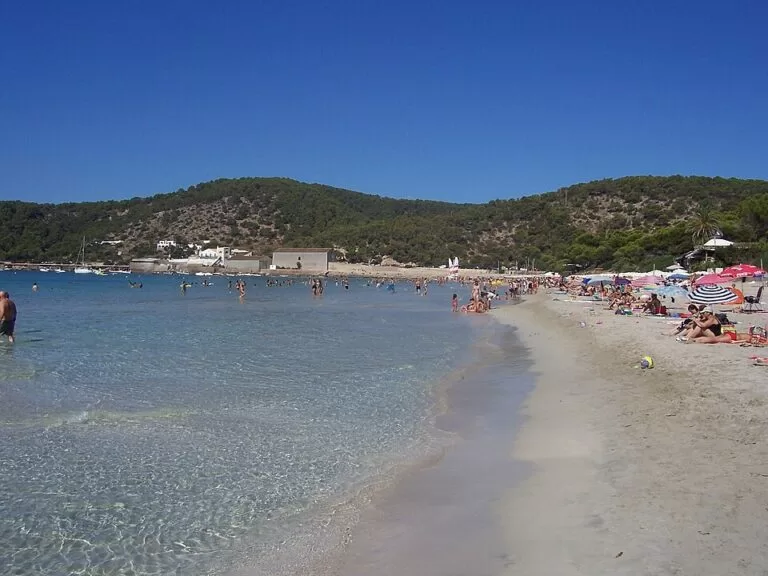
Parking: OpenStreetMap shows several surface car parks behind Platja de ses Salines, between 200 m and 350 m from the sand; the two nearest the middle of the beach are marked as paid, with no caravans or motorhomes. A further unpaved car park sits behind Es Cavallet.
By bus: the park lists Ibiza Bus lines 11 and 11B from Ibiza town (Balearic Government). OpenStreetMap shows a sheltered bus stop at the western end of the beach, about 600 m from the middle, and another stop beside the church at Sant Francesc. Check the current timetable before you go.
By boat: anchoring is allowed only on sandy bottoms where the rules permit it, never on the Posidonia. Landing on the islets between Ibiza and Formentera is not allowed, with one exception: Espalmador.
What to expect
The Ibiza side of the park is a flat landscape of salt pans and marsh, pine woods and coastal juniper, with two beaches at the southern tip. Spain.info describes the salt pans and maritime marshes extending across the south of Ibiza and the north of Formentera, and lists the beach of Ses Salines among those with beach clubs (Spain.info). On the east side of the headland, Platja des Cavallet has a nudist area and water sports such as windsurfing, kayaking and diving, with sunbed hire, toilets and showers (Spain.info). At the far end, OpenStreetMap marks the Torre de ses Portes, an old defence tower on the point, about 1.6 km from the middle of Ses Salines beach.
The salt works are still in operation, which the park calls a rare feature for a protected area. Much of the salt still goes to northern Europe to cure cod. The Sant Francesc interpretation centre has an exhibition on salt with old tools and modern images, explains how the work was done by hand for generations, and ends with an audiovisual on the park, including the sea bed.
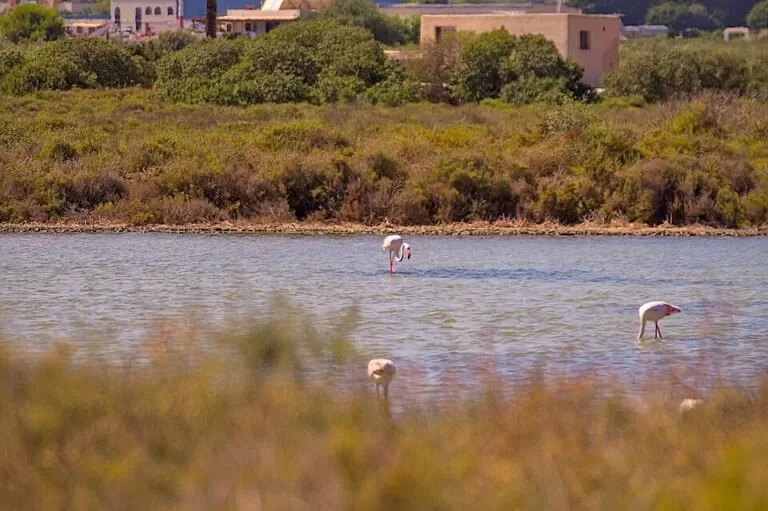
About 210 bird species have been recorded. The park names the flamingo, the black-winged stilt, the shelduck and the Kentish plover among the water birds, and Audouin’s gull and the Balearic shearwater among the seabirds. The Pityusic wall lizard, found only on these islands, lives here, and 178 plant species grow in the park: pine woods, coastal juniper, salt-marsh plants, dunes and cliff plants.
Practical details
- Open: every day, 24 hours.
- Restricted areas: the salt ponds, the dune systems, the islets, anywhere off the authorised paths and, from 1 March to 31 July during the nesting season, Cap des Falcó.
- No camping: camping and overnight stays are not allowed anywhere in the park, including in tents, caravans and motorhomes.
- Dogs: not allowed outside the urban areas, and always on a lead there.
- Fishing and diving: recreational fishing only in the permitted forms and with a licence; spearfishing is banned. Scuba diving needs a permit from the Balearic Government.
- Plants: do not pick protected plants or fungi.
- Guided visits: the park runs guided visits and activities for small groups of 20–25 people; you must sign up in advance. The park’s information line is 971 17 76 88.
Rules and phone number are from the park’s official page, checked November 2026. The page gives no opening hours for the Sant Francesc centre; call before you go.
Accessibility and safety
The park lends a Joëlette, an all-terrain chair carried by volunteers, free of charge to people who cannot reach the natural areas on their own. Book at least three weeks ahead through the park information centre (971 17 76 88) or the Red Cross volunteer service (971 29 50 00); visits go ahead when volunteers are available. OpenStreetMap shows three lifeguard towers along Ses Salines beach; outside the summer season, assume the beaches are unsupervised. There is little shade on the sand: bring water and sun protection.
Best time to visit
For birds, the park says flamingos can be seen on the salt ponds almost all year, best at the end of summer and in autumn. For a beach day in July or August, arrive early in the day, when parking is easier to find and the heat is lower. The park is open all year, so a winter walk round the salt pans is possible too.
Nearby alternatives
- Dalt Vila, 8.3 km: the walled old town of Ibiza town, part of the same World Heritage site.
- Marina Ibiza, 9.4 km: the marina in Ibiza town, facing Dalt Vila.
- Espalmador, 6.7 km: the islet in the park between Ibiza and Formentera, the only one where landing is allowed.
- Ses Illetes, 10.4 km: the Formentera beaches inside the same park, by ferry from Ibiza.
- Cala d’Hort, 15.4 km: the beach facing Es Vedrà on the south-west coast.
Distances are in a straight line from Platja de ses Salines.
FAQ
How do I get to Ses Salines beach in Ibiza?
By car from Ibiza town, take the airport road, then the ring road towards Sant Jordi and the PM-802 towards Ses Salines; there are car parks behind the beach. By bus, the park lists Ibiza Bus lines 11 and 11B from Ibiza town.
Is there parking at Ses Salines?
Yes. OpenStreetMap shows several car parks 200–350 m behind the beach, two of them marked as paid.
Do you have to pay to enter Ses Salines Natural Park?
The park’s official page lists it as open every day, 24 hours, and mentions no entry fee. Some car parks behind the beach are marked as paid on OpenStreetMap, and sunbeds and beach services are paid.
Where can you see flamingos in Ibiza?
On the salt ponds of Ses Salines. The park says they are there almost all year, and best seen at the end of summer and in autumn. Stay on the paths: the ponds themselves are closed to visitors.
Is Es Cavallet a nudist beach?
Spain.info notes nudism on Es Cavallet, the beach on the east side of the Ses Salines headland, about 1 km from Ses Salines beach.
Sources and freshness
Checked 7 November 2026 · 1 source Show
Checked 7 November 2026.
- Balearic Government: Parque Natural de ses Salines de Ibiza y Formentera (size, protection, directions, buses, rules, birds, interpretation centre, accessibility)
- Spain.info: Ibiza island
- Spain.info: Es Cavallet
- OpenStreetMap: Platja de ses Salines, with car parks, bus stops, lifeguard towers and the Torre de ses Portes
- Photos: Wikimedia Commons, Wikimedia Commons
The island council’s and Sant Josep town hall’s tourism sites could not be opened from our research setup, so bus times and parking prices are not given here.
How this page is made. CostaMap is written with an AI editorial system run by Ebizapple. This page is based on the sources listed above. Last updated 9 November 2026. Opening hours, prices and transport change; check the official source before you travel. How we work · Partner links and ads