
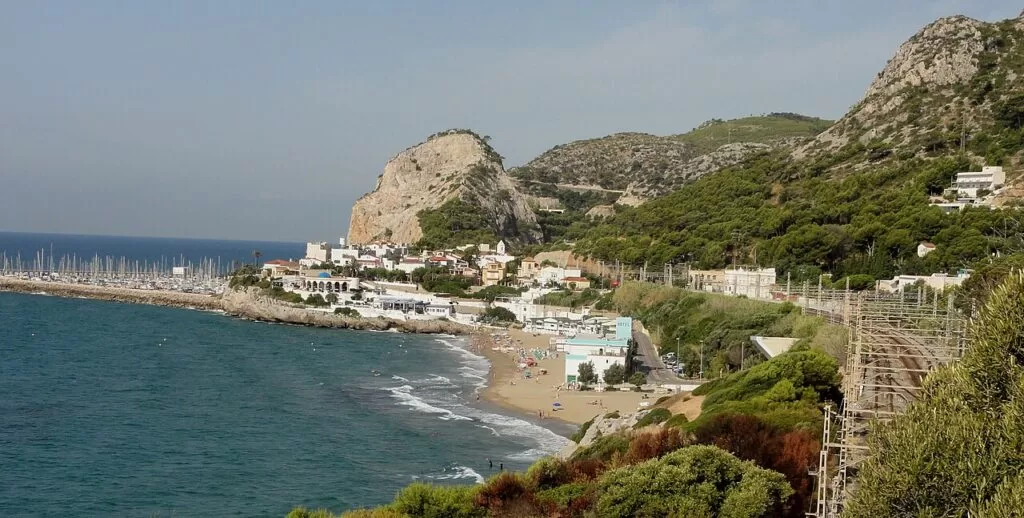
Costa del Garraf · Middle
Garraf and Sitges travel guide: the massif coast, beaches and old town
Where the limestone hills of the Garraf drop into the sea: the beach houses of Garraf village, the empty works village of Vallcarca, then Sitges with seventeen beaches, its church on the rock and its museums.
Garraf beach · Photo: Isidro Jabato, CC BY-SA 3.0
Part of the Costa del Garraf guide · Middle: Garraf and Sitges
The Garraf and Sitges stretch is the middle of the Costa del Garraf, south-west of Barcelona: about 15 km of coast, in a straight line, from Les Botigues de Sitges and Port Ginesta, past the village of Garraf and the cliffs of the Garraf massif, to the town of Sitges and its western beaches at Terramar. Almost all of it lies in the municipality of Sitges, which Catalunya.com places 36 km south-west of Barcelona, with a rugged northern half inside the Garraf park and a gentler southern half of sandy beaches.
At a glance
- Where the Garraf comarca, Barcelona province: from Les Botigues de Sitges on the Castelldefels border, through Garraf and Vallcarca, to Sitges and Terramar, with Sant Pere de Ribes just inland.
- Towns Sitges (32,086 inhabitants, Catalunya.com) with its districts, the village of Garraf, the abandoned works village of Vallcarca, and Sant Pere de Ribes with Les Roquetes.
- Best for town beaches with all services, the old town and museums of Sitges, its festivals, and walks in the Garraf Natural Park.
- Getting there the Rodalies R2 Sud train stops at Garraf and Sitges; Barcelona airport is about 23 km from Sitges station in a straight line. By road, the C-32 motorway and the C-31 coast road.
- On CostaMap guides to Sitges, Garraf village, the Maricel and Cau Ferrat museums, two marinas and the Garraf Massif.
Map of Garraf and Sitges
The map shows the places on this stretch that have a CostaMap page. Tick a place type to filter, and click a marker to see the place in the panel.
Place type
Area · next level
 Area map
Garraf and Sitges
Click a marker to see the place here. The middle Costa del Garraf, from Les Botigues and Garraf village to Sitges and Terramar.
Towns and districtsTowns and districts
From north-east to south-west, the way the train runs from Barcelona. Sitges is one municipality, but its districts differ, so each has its own section. Facts are from Catalunya.com and spain.info, the official tourism sites of Catalonia and Spain, and Catalan Wikipedia.
Les Botigues de Sitges and Port Ginesta
The first part of Sitges you reach from Barcelona is Les Botigues de Sitges, a residential area on the boundary with Castelldefels. Catalunya.com notes its closeness to the sea, its beach and Port Ginesta, a marina opened in 1986 that became the largest in Catalonia in 2007. Spain.info describes Les Botigues beach as a long, quiet sandy beach, 1,415 m long and 100 m wide, with parking, beach bars and apartment blocks behind it; it is by far the longest beach of this stretch. See our Port Ginesta guide.
Garraf
Garraf is a village of Sitges with 514 inhabitants (2025), at the foot of the massif and surrounded by the natural park. Its 380 m pebble beach is lined with the casetes, small beach houses at the level of the sand, next to a harbour built in 1902 to ship quarry stone for the port of Barcelona and now used only by leisure boats (Catalan Wikipedia, spain.info). Above the coast road stands the Celler Güell, a modernista cellar built for Eusebi Güell around 1901, attributed to Francesc Berenguer and possibly Gaudí, now a restaurant. Garraf has its own R2 Sud station. Read our Garraf village guide.
Vallcarca
Between Garraf and Sitges the road and railway pass Vallcarca, a works village that is now empty: Catalan Wikipedia records no inhabitants in 2025. It grew up around the Fradera cement factory, founded in 1903, and its quarries; a small port was built in 1913 to ship the cement, which went into the Susqueda and Sau dams and many University of Barcelona buildings. A cement works and two large quarries are still active inside the natural park, and the old station is abandoned. It explains the scarred hillsides you see from the train.
Sitges: the town
Sitges has 32,086 inhabitants on 44 km², according to Catalunya.com. It counts seventeen fine-sand beaches, three harbours (Port Ginesta, Garraf and Aiguadolç), a fishermen’s guild that still works in a fully artisanal way and can be visited by booking, and an open-air market every Thursday held since the Middle Ages. Catalunya.com says that in 1883, 27% of the Catalans trading with America came from Sitges. Our Sitges town guide covers where to stay, and the Sitges destination page sits on the map.
Sitges old town and La Punta
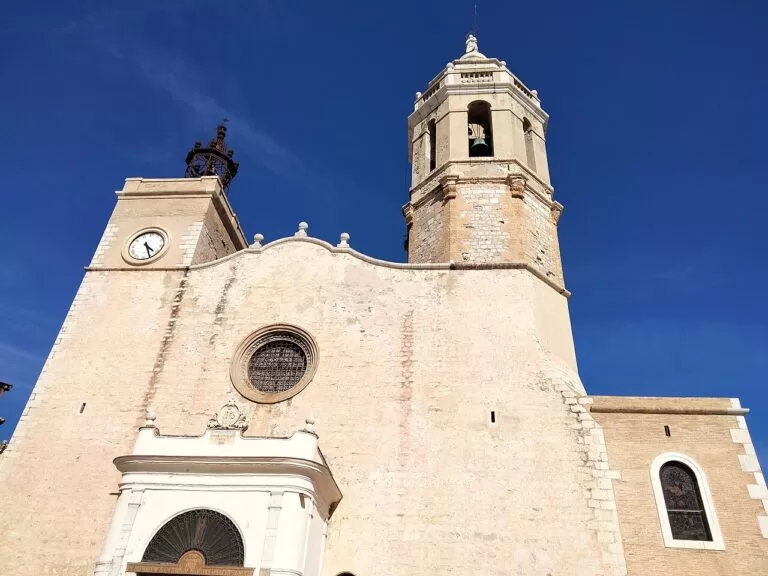
The old town is a grid of white, cobbled streets on and behind the headland of La Punta, with old fishermen’s houses marked with Sitges blue tiles and the corner called the Racó de la Calma (Catalunya.com). On the rock stand the Baroque church of Sant Bartomeu i Santa Tecla, begun in 1665, and the town hall; next door are the Maricel Museum, in the palace built for the American collector Charles Deering, and the Cau Ferrat Museum, Santiago Rusiñol’s house and studio on remains of the old castle. The Romantic Museum Can Llopis is closed with no reopening date (Catalunya.com). Two guided routes, the Ruta Modernista and the Ruta dels Americanos, cover the houses built by returning indianos.
Sant Sebastià and Aiguadolç
East of La Punta, Sant Sebastià beach lies in the middle of the town with views of the old quarter; spain.info gives it 205 m of golden sand and all services. Further east, past the headland, the marina of Aiguadolç sits within the town, its Capitania tower one of its symbols (Catalunya.com). The small Aiguadolç beach next to it is 145 m of pebbles and rock with a grassy esplanade used as a car park, according to spain.info. See our Port d’Aiguadolç guide.
La Ribera and the seafront
West of the church runs the Passeig de la Ribera, the palm-lined promenade that most photos of Sitges show. Spain.info lists La Ribera beach at 260 m, with a promenade continuing to Les Anquines, and the small La Fragata beach beside it, 85 m long and 35 m wide, with a sailing club and a beach volleyball area. On the promenade stands a monument to El Greco by Josep Reynés, from 1898 (Catalunya.com). Further west come La Bassa Rodona (285 m) and L’Estanyol (365 m), separated by small stone breakwaters.
Terramar and the western beaches
Terramar beach is one of the largest in the area, at 395 m (spain.info), and Les Anquines, held between two piers that keep out the waves, is the one spain.info recommends for small children. Behind them lies the Club de Golf Terramar, opened in 1922 and one of the oldest in Spain, with 18 holes, par 72 (Catalunya.com). Further west, Catalunya.com says two beaches are harder to reach and more sheltered; on OpenStreetMap the westernmost are Les Coves and L’Home Mort. The HolaCamp El Garrofer campsite is about 2.6 km west of the old town.
Sant Pere de Ribes and Les Roquetes
Just inland, Sant Pere de Ribes has 32,705 inhabitants on 40.8 km² (Catalan Wikipedia), almost as many as Sitges, but only 658 m of coast. Its two main centres are Ribes and Les Roquetes del Garraf (12,915 inhabitants). The name Ribes first appears in a charter of 6 May 990 that mentions its castle. Ribes is about 4 km from Sitges station in a straight line. Our Sant Pere de Ribes guide has more.
Beaches and coves
Lengths, surfaces and services below are from spain.info’s beach pages. All the town beaches of Sitges are sand with calm water and high occupancy; Garraf and Aiguadolç are pebbles and rock.
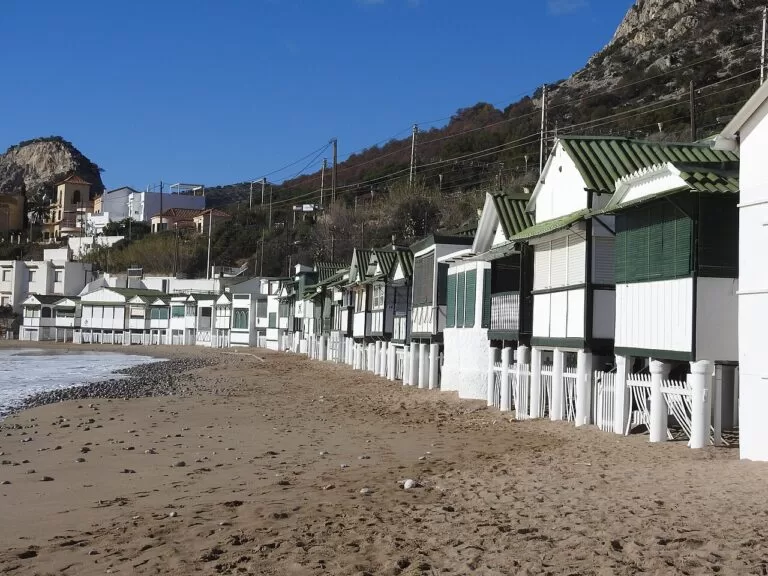
Platja de Garraf
380 m of pebbles and rock between the harbour and the hills, with low beach houses on the sand, lounger and sunshade hire, toilets, showers and a children’s play area (spain.info).
See the Garraf guide →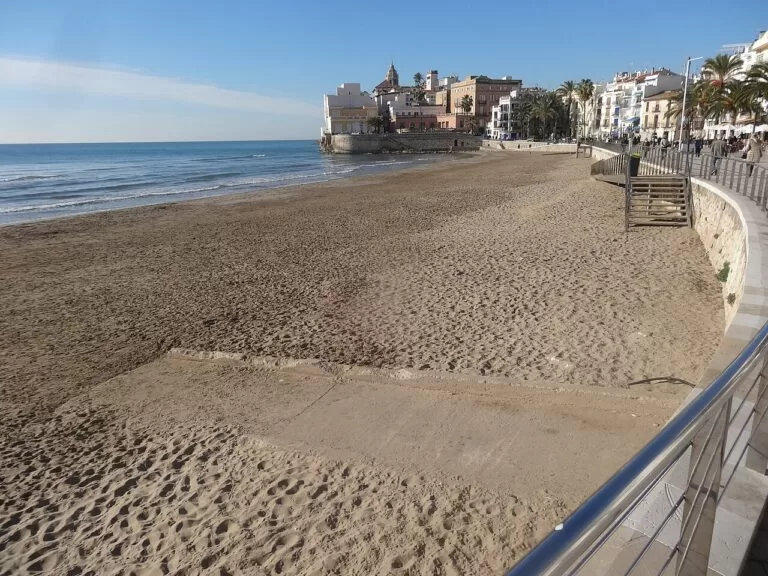
Sant Sebastià
205 m of golden sand just east of the church, with hotels, restaurants, showers and lounger hire along it (spain.info).
See the church guide →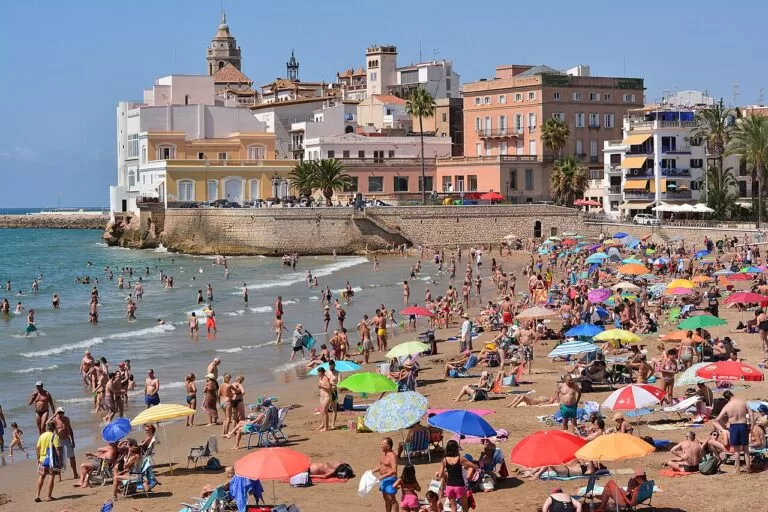
La Ribera and La Fragata
The main town beaches below the promenade: La Ribera, 260 m, with a tourist office and play area, and the small La Fragata, 85 m, with a sailing club (spain.info, spain.info).
See the Sitges guide →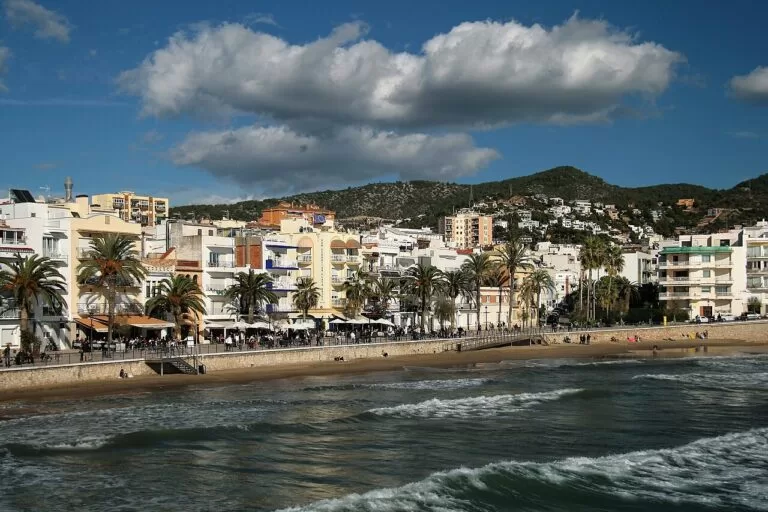
Les Anquines and Terramar
Les Anquines, 160 m between two piers, is calm and good for small children; Terramar next to it is 395 m with lifeguards (spain.info, spain.info).
Camp nearby →Also on spain.info: Les Botigues (1,415 m of sand) by Port Ginesta, Aiguadolç (145 m, pebbles), and Les Coves (500 m), an isolated beach in the west. Spain.info says some Sitges beaches are nudist, without naming them.
Things to do
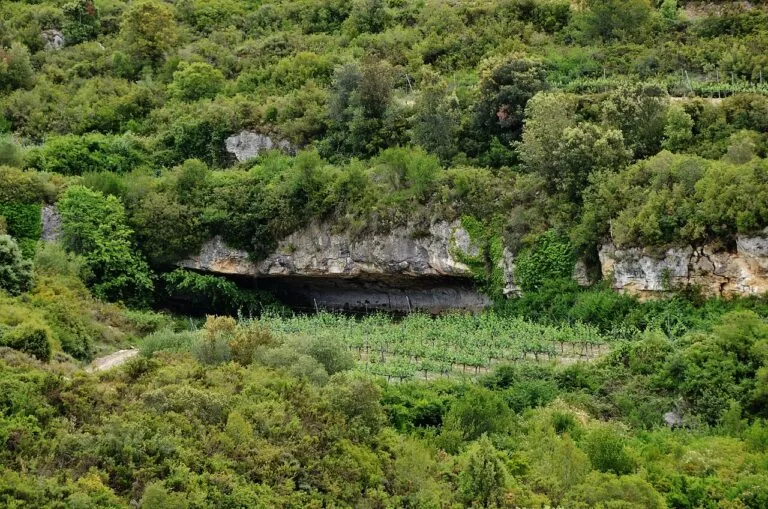
Nature: the Garraf Natural Park
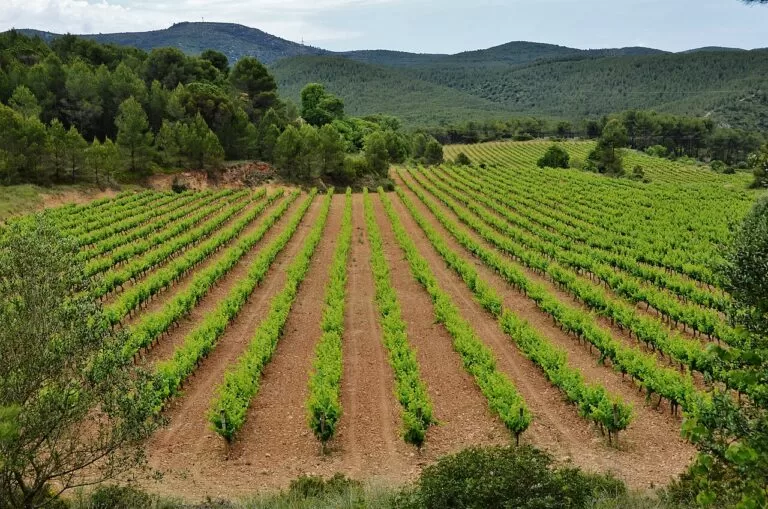
Behind the whole stretch rises the Garraf massif, protected since 1986 as the Garraf park: more than 12,000 ha across nine municipalities, white limestone with vineyards and dry-stone walls in the valleys, and scrub with fan palms (Catalunya.com). Bonelli’s eagle and peregrine falcon live here, and the caves shelter greater horseshoe bats. Marked routes include the GR 92 and GR 5 long-distance paths and a botanical trail at La Pleta, in Sitges. The park office, on the road from Ratpenat to Plana Novella, is open Monday to Friday 9:00–15:00 (Catalunya.com, checked November 2026). See our Garraf Massif guide.
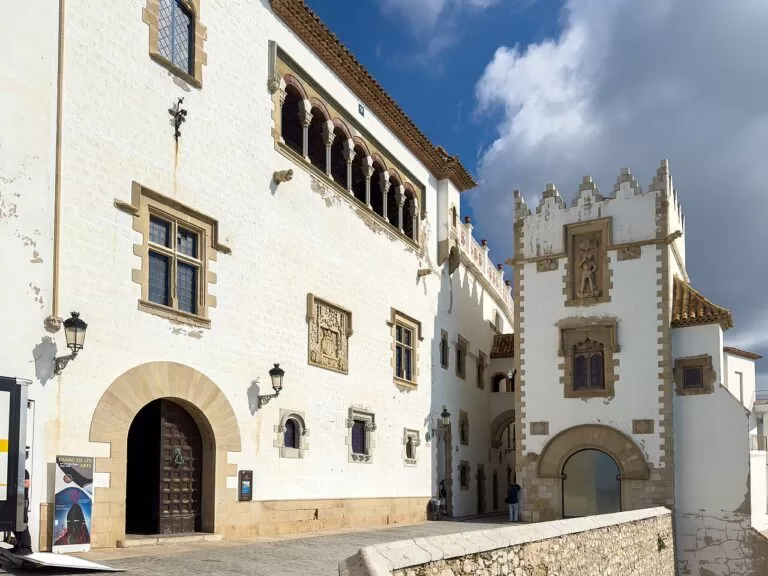
History and art: museums, churches and indianos
Sitges’ museums are run by the Consorci del Patrimoni. Cau Ferrat holds paintings and drawings by Rusiñol and other modernistes; Maricel combines medieval art given by Dr Pérez Rosales, modern Catalan sculpture and murals by Josep Maria Sert, in rooms reshaped by Miquel Utrillo (Catalunya.com). Inside the church of Sant Bartomeu i Santa Tecla are a Baroque organ of the 1690s and Gothic tombs of 1317 and 1322. The Ruta dels Americanos passes indianos’ houses such as those of Pere Jacas (1821) and Bartomeu Bascós (1847).
Food and wine: xató and malvasia
The local dish is xató, a salad of curly endive, salt cod, tuna, anchovies and olives with a romesco-style sauce of roasted peppers, almonds, garlic and olive oil (spain.info). Sitges claims to be its birthplace (Catalunya.com). The sweet Malvasia de Sitges wine was once exported to America; the Centre d’Interpretació de la Malvasia explains it.
Festivals
Catalunya.com lists the Sitges Carnival from late January to early February, the Barcelona–Sitges International Vintage Car Rally in March, Corpus Christi with its flower carpets, the Festa Major of Sant Bartomeu from 21 to 27 August, and the Sitges International Fantastic Film Festival of Catalonia in October, held since 1968. The Festa Major and Corpus are both Heritage Festivals of National Interest.
Where to stay by town
We do not name hotels. These are the bases we would choose, from busiest to quietest.
Sitges centre
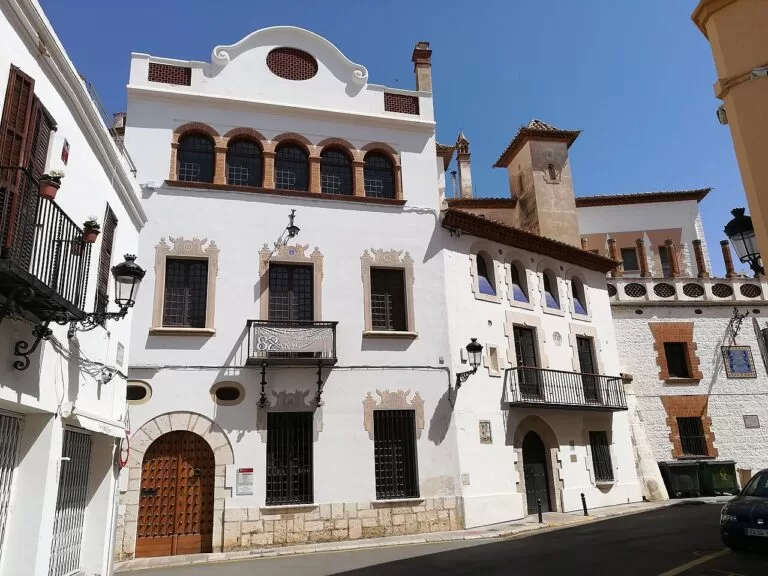
The old town, Sant Sebastià and La Ribera: the station, the museums and the town beaches are all on foot, and Catalunya.com notes that shops and restaurants open seven days a week all year. Lively and busy in summer and at festival time.
A first visit, no car, nightlife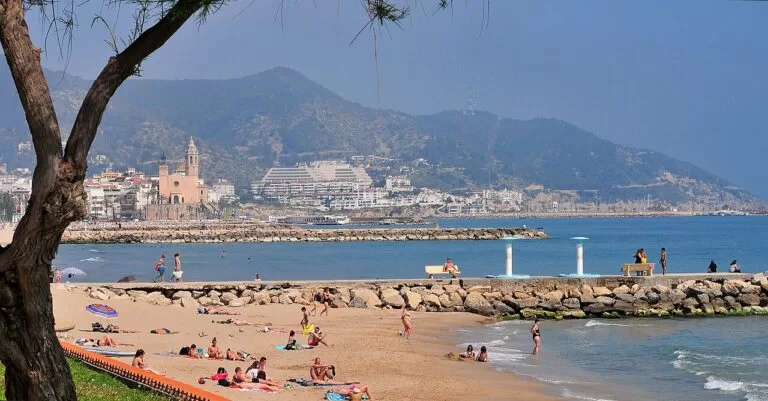
Sitges west: Terramar
Residential streets behind calmer beaches such as Les Anquines and Terramar, near the golf club and the campsites. A longer walk to the station.
Families, golfers, campers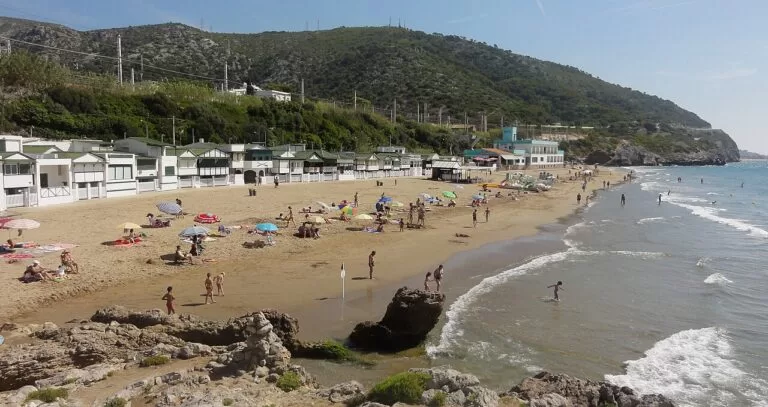
Garraf and Les Botigues
A small village and a residential beach area between the hills and the sea, with a marina each and a train station at Garraf. Little in the evenings, but close to the park and to Barcelona airport.
Quiet, boats, walkersGetting there and around
By air
Barcelona airport (BCN) is about 23 km from Sitges station and 16 km from Garraf in a straight line (OpenStreetMap). Road distances are longer.
By train
The Rodalies R2 Sud runs along the coast from Barcelona and stops at Garraf and Sitges. Sitges station, opened in 1881, handles about 1.86 million passengers a year; Garraf station is far quieter, with about 56,000 (Catalan Wikipedia). Check timetables with Rodalies de Catalunya.
By car
Two roads serve the stretch: the C-32 motorway and the C-31, which Catalan Wikipedia describes as the road along the Garraf coast through the village of Garraf. Spain.info lists the C-32, C-31 and C-246 as access roads to the Sitges beaches. We could not confirm parking capacity or prices in Sitges or Garraf.
In town
Sitges has three town bus lines, running about every 30 minutes on weekdays and holidays (Catalunya.com). The old town, the seafront and the station are close enough to walk.
A two-day route
By train from Barcelona, with a night in Sitges.
Day 1
Sitges old town, museums and seafront
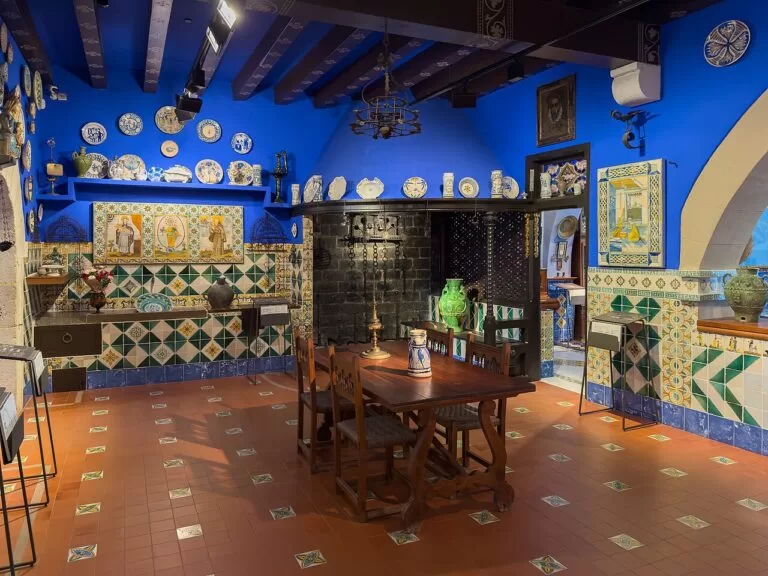
Walk from the station to La Punta and the church of Sant Bartomeu i Santa Tecla, then spend the morning in the Cau Ferrat and Maricel museums next door. After a lunch of xató, walk west along the Passeig de la Ribera to Les Anquines or Terramar for a swim, and come back for sunset over the church.
Day 2
Garraf village and the Garraf hills
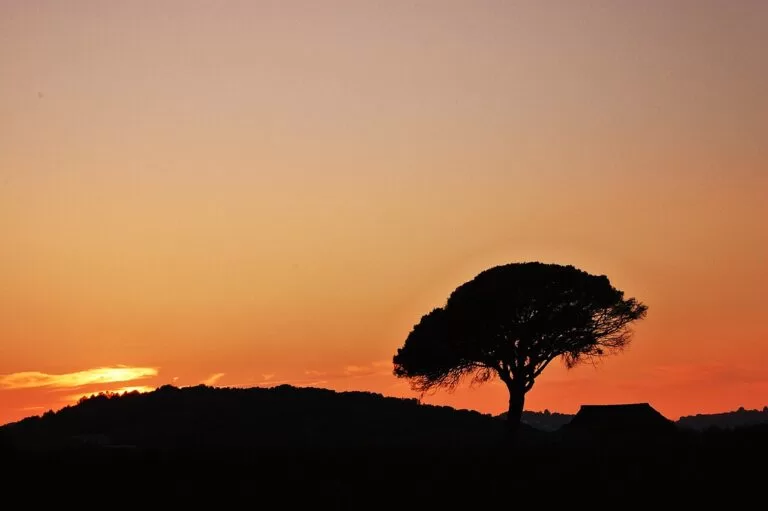
Take the R2 Sud one stop towards Barcelona to Garraf. See the beach houses, the harbour and the Celler Güell, then walk into the hills of the Garraf park, carrying water. In the afternoon swim at Garraf or walk on to Port Ginesta and Les Botigues beach before taking the train back.
FAQ
How far is Sitges from Barcelona?
Catalunya.com puts Sitges 36 km south-west of Barcelona. The R2 Sud train runs direct from Barcelona along the coast, and the C-32 motorway is the fastest road.
What is the difference between Garraf and Sitges?
Garraf is a small village inside the municipality of Sitges, about 8 km east of the town, with a pebble beach, a harbour and the Celler Güell. Garraf is also the name of the massif, the park and the comarca.
Which Sitges beach is best for children?
Spain.info recommends Les Anquines for small children: two piers keep the water calm and the sand is fine. La Ribera has a children’s play area.
When are the Sitges carnival and film festival?
The carnival runs from late January to early February and the Sitges Film Festival is in October, according to Catalunya.com. The Festa Major is from 21 to 27 August.
Can you walk from Garraf to Sitges?
The GR 92 long-distance path crosses the Garraf park (Catalunya.com), but we could not confirm a safe walking route along the coast road between Garraf and Sitges, which runs past the Vallcarca quarries. The train between the two takes one stop.
Other areas of the Costa del Garraf
Costa del Garraf
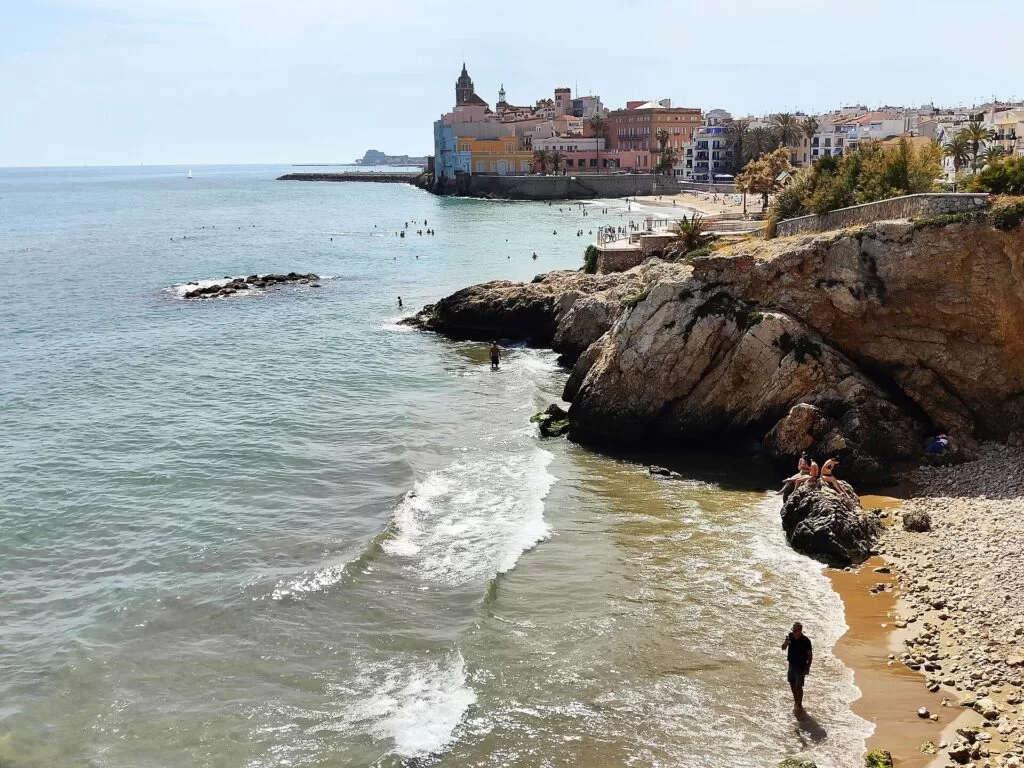
The whole coast from Castelldefels to Cubelles, with the map, the three areas and Penedès day trips inland.
Costa del Garraf guide →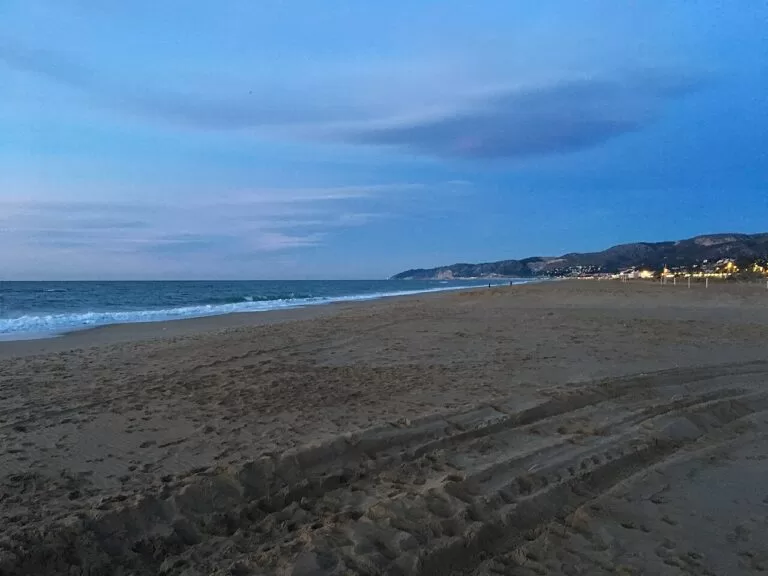
Castelldefels and Gavà
The long sandy beaches nearest Barcelona and its airport, between the Llobregat delta and the first hills of the Garraf.
Castelldefels and Gavà guide →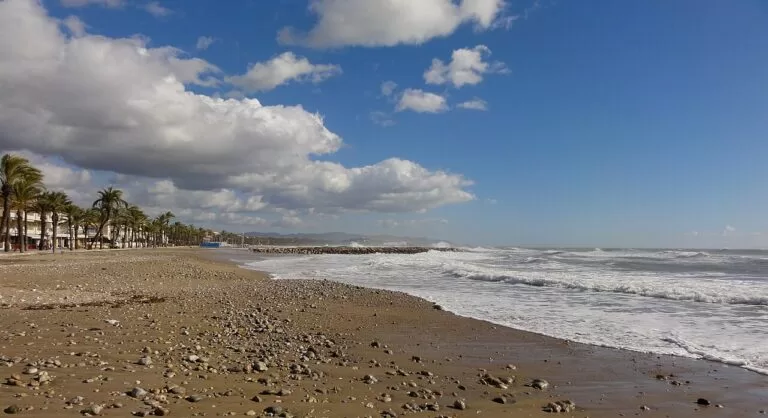
Vilanova i la Geltrú and Cubelles
The capital of the Garraf comarca, with its fishing port and railway museum, and Cubelles at the mouth of the Foix.
Vilanova and Cubelles guide →North-east of Garraf, Castelldefels Castle is about 7 km away and the Gavà Mines about 10 km. South-west of Sitges, the Railway Museum of Catalonia in Vilanova i la Geltrú is about 7 km away on the same train line, and the Vilanova Park campsite about 10 km.
Sources and freshness
Checked 9 November 2026. Catalunya.com (Catalan Tourist Board) on Sitges (population, beaches, harbours, museums, festivals, buses, history), the Garraf Natural Park, the church of Sant Bartomeu i Santa Tecla, the Club de Golf Terramar and the Museu Romàntic Can Llopis. Spain.info (Turespaña) on Sitges (food, Casa de la Vila) and the beaches of Les Botigues, Garraf, Aiguadolç, Sant Sebastià, La Fragata, La Ribera, La Bassa Rodona, L’Estanyol, Les Anquines, Terramar and Les Coves. Background: Catalan Wikipedia on Garraf, the Celler Güell, Vallcarca, Sant Pere de Ribes, Sant Bartomeu i Santa Tecla and the stations of Sitges and Garraf. Location and straight-line distances: OpenStreetMap contributors. The Sitges town hall, Sitges tourism, Diputació de Barcelona parks and Rodalies sites could not be reached while checking. Not confirmed: train frequencies, parking, beach names of the nudist beaches, the walking route between Garraf and Sitges. Photos: Wikimedia Commons, credited on the hero and in the linked guides.