
Poio Monastery (Mosteiro de San Xoán de Poio)
Historic sitePoio Monastery (Mosteiro de San Xoán de Poio) is a former Benedictine monastery on a raised terrace above the Ría de Pontevedra, 3.7 km west of Pontevedra old town and 2.4 km from Combarro. Mercedarian friars have lived in it since 1890; you can visit its church, two cloisters with a 200 m² mosaic of the Way of St James, a small museum and, in the gardens, the largest hórreo (granary) in Galicia by surface area. There is free parking; allow about an hour. It suits anyone touring Pontevedra and Combarro who likes churches, cloisters and quiet gardens; skip it if you only want the sea, or if you are passing on a Sunday morning, when the museum is closed.
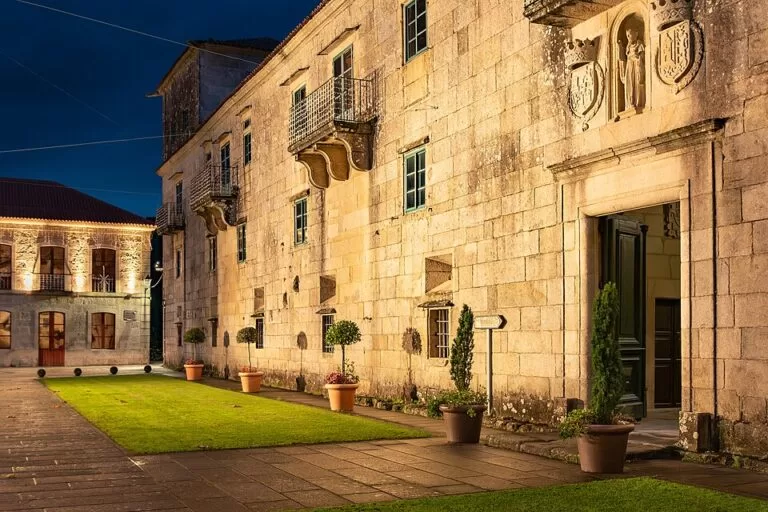
Quick facts
- Names: Mosteiro de San Xoán de Poio in Galician, Monasterio de San Juan de Poio in Spanish; locally often just “o convento”.
- Where: parish of San Xoán de Poio, municipality of Poio, north shore of the Ría de Pontevedra (Pontevedra province), between the city of Pontevedra and Combarro.
- Coordinates: 42.4465, -8.6847 (church and cloisters, OpenStreetMap).
- Founded: as a Benedictine house; the provincial tourist board dates the oldest written record of the monastery to the year 942.
- Today: home to a community of Mercedarian friars since 1890, with a museum and a guest house (Hospedería) in part of the building.
- Protection: National Monument since 13 August 1971; now listed as a Bien de Interés Cultural.
- Museum hours 2026: Monday to Saturday 10:00–13:00 and 16:30–19:30, Sunday 16:30–19:30 (Rías Baixas tourist board, checked November 2026).
- Entry: the museum visit is paid; we could not confirm the current price.
- Parking: free, according to the tourist board.
Access and parking
By car: the monastery stands just inland from the north shore of the ría, across the Lérez river from Pontevedra. OpenStreetMap shows the provincial road EP-0606 (Rúa do Convento) running past it; from Pontevedra follow the signs for Poio and Combarro. The provincial tourist board lists free parking at the monastery, and OpenStreetMap marks a car park about 70 m west of the church.
From Combarro: the monastery is 2.4 km east of the hórreos of Combarro in a straight line, so the two fit easily into one half-day.
By bus or taxi: local buses run along the north shore between Pontevedra, Combarro and Sanxenxo, but we could not confirm which stops serve the monastery or their timetables. The tourist board places the nearest taxi rank, Radio Taxi Pontevedra, about 7 km away by road; a taxi from Pontevedra is the simple option without a car.
What to expect
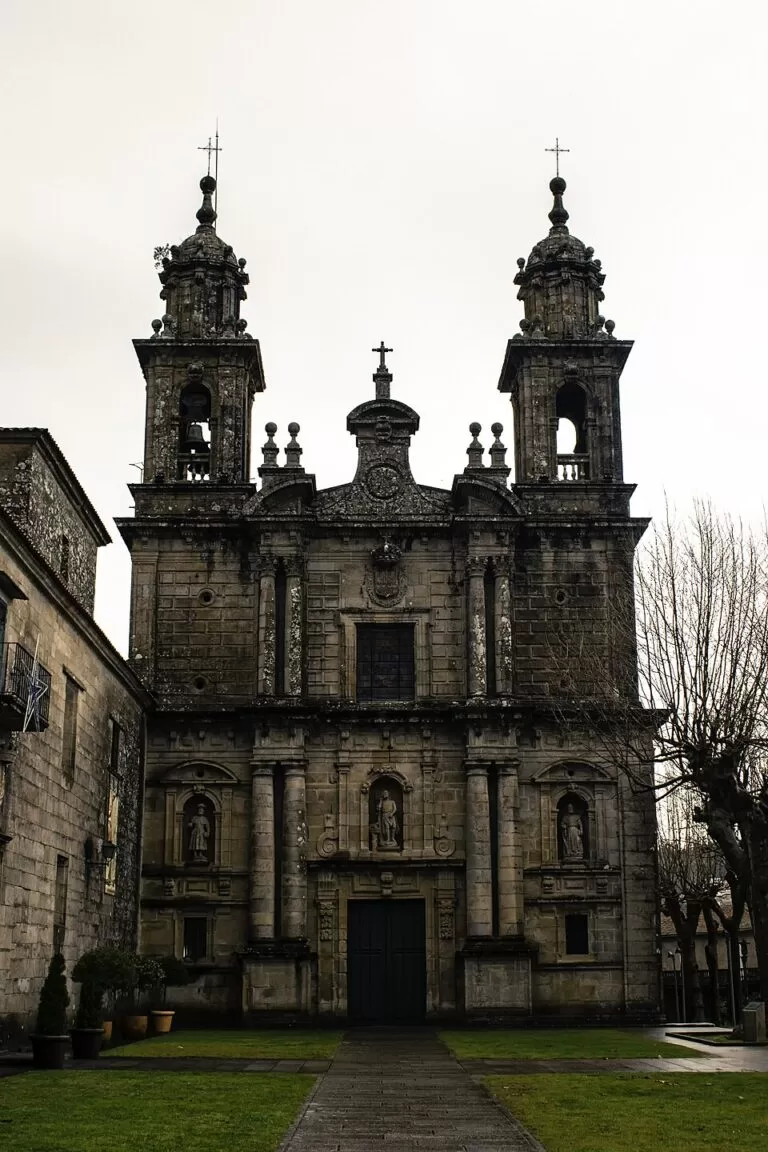
The Rías Baixas tourist board describes the site as a kind of poyo, a raised flat, above the Ría de Pontevedra, which is where the name comes from. The Benedictines left in the 1830s and the building stood abandoned until 1890, when the Mercedarians moved in, reopened classes, recovered the library and restored the church. Work on a new wing began on 24 September 1959; it was meant as a seminary but became the guest house.
- The church: a Baroque façade in three sections between two slender towers, and inside a single wide nave under a great barrel vault finished in 1708. The main altarpiece is Baroque, with twisted (Solomonic) columns and images of saints, among them Our Lady of Mercy and St John the Baptist.
- The tomb of Santa Trahamunda: in the Chapel of Christ (Capela do Cristo) is her sarcophagus, which the tourist board dates to the 6th century.
- The cloisters: the Cloister of the Processions is the older, built in the 16th century with star-ribbed vaults. The Cloister of the Cruceiro, or of the Orange Trees, holds the mosaic of the Way of St James designed by the Czech artist Antoine Machourek (1913–1991): 80 m long and 2.5 m high, about 200 m².
- The library: the tourist board calls it a jewel that no other monastery in Galicia has.
- The museum: four rooms. The former refectory shows mosaics and sculptures in stone and plaster; a second room explains the Mercedarian Order; a third holds temporary exhibitions; the last, in the old stables, has paintings and a collection of miniature books. Panels tell the history of the monastery along the way.
- The hórreo: in the gardens stands the largest hórreo in Galicia by surface area, raised on 51 stone feet.
Poio’s highest hill is Monte Castrove, 667 m (English Wikipedia). In the 18th century Father Sarmiento wrote, after climbing it, that in all his travels along the coast from Ferrol to A Guarda and Tui he found no finer view, a line the tourist board still quotes.
Practical details
- Time needed: about an hour for the church, cloisters, museum and hórreo; more if you add Combarro.
- Language: the tourist board lists the museum information in Spanish.
- Services: shop and public toilets, according to the tourist board.
- Staying here: the Hospedería Monasterio de Poio, at Praza do Convento 2, is a one-star hotel inside the monastery buildings (Rías Baixas tourist board).
- Respect: it is a living friary and the church is in use; keep quiet during services.
Accessibility and safety
The tourist board lists adapted infrastructure and adapted public toilets. We could not confirm step-free access to every room or both cloister levels; ask on arrival.
Best time to visit
Any time of year: this is an indoor and garden visit, good on a rainy day in the Rías Baixas. Come on a weekday or a Saturday if you want the morning session; on Sundays the museum opens only in the afternoon. Hours can change, so check the tourist board listing or ask in Pontevedra before you go.
Nearby alternatives
- Combarro, 2.4 km: the fishing village with more than sixty hórreos, about thirty of them on the waterfront.
- Pontevedra Old Town, 3.7 km: car-free granite squares, the Pilgrim’s church and the free Museum of Pontevedra.
- Sanxenxo and Praia de Silgar, 11.7 km: the busiest beach town of the ría, with a calm town beach.
- Cambados, 13.3 km: the Albariño wine town on the Ría de Arousa.
- A Lanzada Beach, 15.7 km: the long open Atlantic beach on the O Grove isthmus.
Also in Poio, the island of Tambo in the middle of the ría was handed over by the Ministry of Defence to the Concello de Poio in 2022 and can now be visited on controlled trips with boat companies (Rías Baixas tourist board). Distances are in a straight line from the monastery.
FAQ
Can you visit Poio Monastery?
Yes. The tourist board lists the monastery museum as open Monday to Saturday 10:00–13:00 and 16:30–19:30 and on Sunday 16:30–19:30 (2026 hours from the Rías Baixas tourist board). The museum visit is paid.
Is there parking at Poio Monastery?
Yes. The tourist board lists free parking, and OpenStreetMap shows a car park beside the church.
How far is Poio Monastery from Pontevedra?
About 3.7 km in a straight line from the old town, across the Lérez river. By car it is a few minutes; Combarro is 2.4 km further west.
What is special about Poio Monastery?
Its 80 m mosaic of the Way of St James by Antoine Machourek, the 6th-century sarcophagus of Santa Trahamunda, its library and the largest hórreo in Galicia by surface area, on 51 feet.
Can you stay at Poio Monastery?
Yes. The Hospedería Monasterio de Poio is a one-star hotel in the monastery buildings.
Sources and freshness
Checked 9 November 2026 · 9 sources Show
Checked 9 November 2026. Official: Rías Baixas tourist board (Deputación de Pontevedra), Route of the monasteries (history, church, sarcophagus, library, mosaic, 1971 status), Museo do Mosteiro de Poio and Spanish listing (rooms, hours, parking, services), Combarro: stroll among hórreos by the sea (the 51-foot hórreo), Hospedería Monasterio de Poio and Isla de Tambo. Background: Galician Wikipedia (cloisters, towers) and English Wikipedia (Monte Castrove). Location, roads, car park and distances: OpenStreetMap contributors (ODbL). Photos: Wikimedia Commons, licences as credited.
How this page is made. CostaMap is written with an AI editorial system run by Ebizapple. This page is based on the sources listed above. Last updated 9 November 2026. Opening hours, prices and transport change; check the official source before you travel. How we work · Partner links and ads