
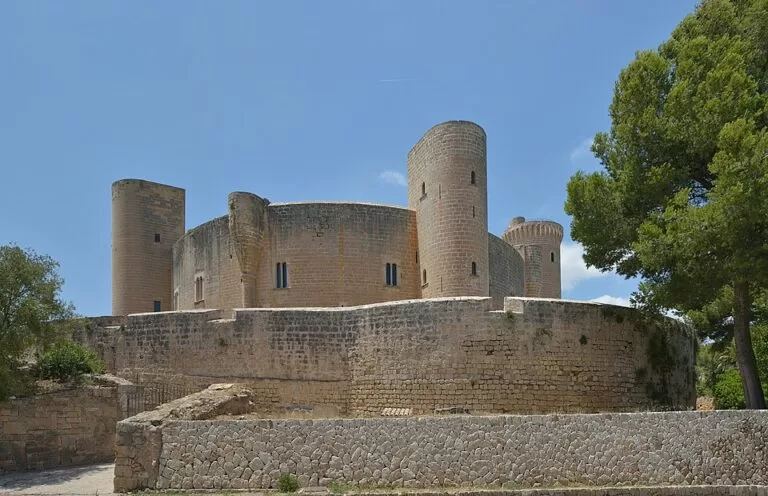
Bellver Castle is the round Gothic castle on a wooded hill about 2.5 to 3 km west of the centre of Palma, Mallorca’s capital. You can drive up to a free car park next to it, take the Palma sightseeing bus (line 50 on OpenStreetMap), or walk up through the Bellver forest from the El Terreno district. Built for King James II of Mallorca in the early 14th century, it is one of very few circular castles in Europe and now holds the city’s history museum. It suits anyone with two hours in Palma who likes history or a view over the bay; skip it if you cannot manage steps or a steep climb on foot.
Quick facts
- Names: Bellver Castle; Castell de Bellver in Catalan, Castillo de Bellver in Spanish. The name comes from medieval Catalan “bell veer”, a fine view (Catalan Wikipedia).
- Where: on the hill of Bellver, about 112 m high, above the El Terreno district in the west of Palma; address carrer de Camilo José Cela.
- Coordinates: 39.5638, 2.6195.
- Built: between about 1300 and 1311 for King James II of Mallorca; architect Pere Salvà, who also worked on the Almudaina palace (English Wikipedia).
- Today: owned by the city of Palma and home of the city’s History Museum; a protected monument since 1931.
- Entry: paid; we could not confirm the 2026 price from an official page.
Access and parking
By car: a road winds up through the forest to the castle. OpenStreetMap maps a free surface car park about 100 m south of the castle. Spaces are limited at busy times.
By bus: OpenStreetMap maps the stop “Castell de Bellver” at the castle gate, served by line 50 of the City Sightseeing Palma network run by EMT Palma. Spain.info suggests the sightseeing bus as one way to see Palma (spain.info). We could not open the timetable.
On foot: the public gate to the Bellver forest is on carrer del Polvorí, at the top of El Terreno, with a flight of steps up towards the castle (Catalan Wikipedia). The climb is steep and shaded by pines; we could not find an official walking time, so allow extra time in summer heat.
What to see
Spain.info sums up the building: King James II had it built as a royal residence; in the 19th century it became a mint; it is circular, with three turrets and a keep of four floors; the rooms are on two floors around an inner courtyard, and there is a chapel on the upper floor (spain.info).
- The round courtyard. The ground floor opens onto the courtyard through low round arches on 21 square columns; above it runs a gallery of pointed arches on 42 slender octagonal columns. A cistern under the courtyard collects rain from the roof and the moat (Catalan Wikipedia).
- The keep. The free-standing main tower is 25 m high with four floors and is joined to the roof terrace by a bridge about 7 m long. The cistern at its base, called l’Olla, was used as a prison.
- The roof terrace. From the top you see the city, its port and Porto Pi, the Serra de Tramuntana and the central plain of the island.
- The History Museum. The castle became a museum in 1932 and, after restoration in 1976, the city’s History Museum (English Wikipedia).
- The chapel of Sant Marc on the upper floor, with a Mudéjar grille, and the old kitchen.
The castle also has a long history as a prison. English Wikipedia lists the widow and children of King James III after 1349, prisoners from the War of the Spanish Succession and the Peninsular War, the politician Gaspar Melchor de Jovellanos from 1802 to 1808, and republican leaders in the 20th century. It resisted sieges in 1343 and 1391 and fell only once, in 1521.
Practical details
- Opening hours: OpenStreetMap lists Tuesday to Saturday 10:00 to 19:00 and Sunday 10:00 to 15:00, closed Monday. These are not from an official page; check with the Palma city council before you go.
- OpenStreetMap maps free public toilets and an interpretation centre next to the car park.
- The courtyard is used for concerts and civic events, and on the Sunday after Easter people from Palma gather in the forest and at the castle for the Diumenge de l’Àngel (English Wikipedia).
- The forest around the castle is a public park with paths; bring water if you walk up.
Accessibility and safety
The castle stands on a hilltop and the walk up from El Terreno is steep. Inside, the upper floor and the roof terrace are reached by stairs. OpenStreetMap tags the castle as wheelchair accessible but the bus stop as not accessible; we could not confirm what is step-free from an official source, so ask before you visit. Hold children’s hands on the roof terrace and the bridge to the keep.
Best time to visit
Morning or late afternoon, when the light on the bay is softer and the walk up through the forest is cooler. Avoid the midday heat in July and August if you plan to climb on foot. Clear winter days give the longest views towards the Tramuntana.
Nearby alternatives
- Palma Cathedral (La Seu), 2.5 km east: the Gothic cathedral on the seafront, also begun under James II.
- Puerto Portals, 5.7 km south-west: the marina at Portals Nous in Calvià.
- Western Water Park, 10.9 km south-west: a water park by Magaluf.
- Aqualand El Arenal, 14.2 km east: a seasonal water park at S’Arenal.
- Mirador de Ses Ànimes, 16.8 km north-west: a watchtower viewpoint on the Tramuntana coast at Banyalbufar.
Distances are in a straight line from the castle.
FAQ
How do I get to Bellver Castle?
Drive up the castle road to the free car park, take the Palma sightseeing bus to the “Castell de Bellver” stop, or walk up through the forest from the gate on carrer del Polvorí in El Terreno.
Is there parking at Bellver Castle?
Yes. OpenStreetMap maps a free car park about 100 m from the castle entrance.
Can you walk to Bellver Castle from the centre of Palma?
Yes. Walk west to the El Terreno district and climb through the Bellver forest from the gate on carrer del Polvorí. The castle is about 2.5 to 3 km from the centre and the last part is a steep climb.
Why is Bellver Castle round?
It was designed as a fortified royal residence with a circular plan, a round courtyard and round towers; Catalan Wikipedia names it as one of only four castles in Europe with a circular plan.
Is Bellver Castle open on Mondays?
OpenStreetMap lists it as closed on Mondays. Check the city council’s information before you go, as hours can change.
Sources and freshness
Checked 9 November 2026 · 5 sources Show
Checked 9 November 2026. Official: Spain’s tourist board, spain.info, Bellver Castle (builder, uses, plan) and Weekend in Palma. Background: English Wikipedia, Bellver Castle (dates, architect, sieges, prisoners, museum, festivities) and Catalan Wikipedia, Castell de Bellver (name, height, keep, courtyard, chapel, views, forest gate). Location, car park, bus stop, toilets and listed opening hours: OpenStreetMap (© OpenStreetMap contributors, ODbL). The castle’s own website, the Palma city council and the Balearic tourist board could not be opened when we checked, so the entry price and current hours are not confirmed. Photo: Wikimedia Commons.
This place is part of our Balearic Islands travel guide: Mallorca, Menorca, Ibiza and Formentera — see every town, beach and cove we have mapped on that coast.
How this page is made. CostaMap is written with an AI editorial system run by Ebizapple. This page is based on the sources listed above. Last updated 9 November 2026. Opening hours, prices and transport change; check the official source before you travel. How we work · Partner links and ads