
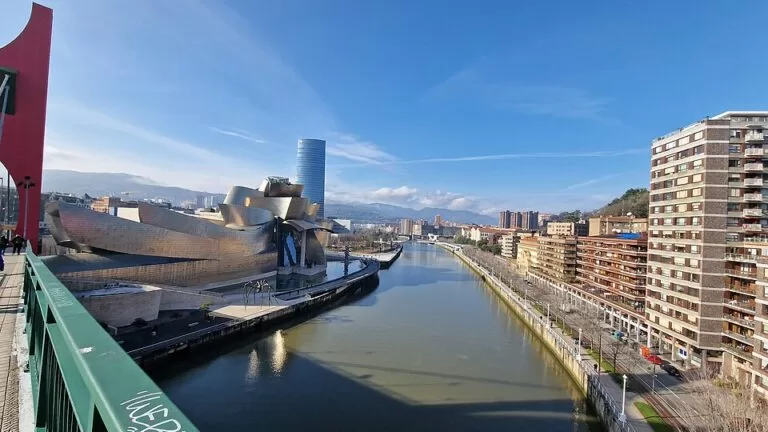
Bilbao is the largest city on Spain’s north coast and the capital of Bizkaia, built along a tidal estuary about 16 km inland from the Bay of Biscay. Most visitors come for the Guggenheim Museum on the Abandoibarra waterfront, then walk upriver along the estuary to the Casco Viejo, the medieval “Seven Streets” full of pintxo bars. The metro runs down the estuary to the beaches at Getxo and Sopelana in just over half an hour. It suits city-breakers who want art, architecture and food in one walkable place; skip it if you want a beach on your doorstep or reliable sunshine, as it rains here in every season.
Quick facts
- Names: Bilbao (Basque and Spanish). Locals call it “el Botxo”, the hole, because it sits in a valley ringed by hills.
- Where: Bizkaia, Basque Country, on the estuary of the Nervión-Ibaizabal, about 16 km from the open sea.
- Coordinates: 43.2684, -2.9341 (Abandoibarra, by the Guggenheim).
- Population: 347,342 (2024); about 1.04 million in the metropolitan area (English Wikipedia).
- Founded: by charter of Diego López V de Haro, lord of Biscay, on 15 June 1300.
- Airport: about 12 km north of the centre; a taxi takes about 15 minutes and costs 24–29 € (spain.info, checked November 2026).
Getting there and getting around
From the airport: spain.info lists the A3247 bus to the Bilbao Intermodal bus station, with stops in the centre, running from about 06:00 to midnight from the airport.
By train and bus: Bilbao-Abando is the main railway station, with Renfe trains to Madrid, Barcelona and other cities. Euskotren runs from the Zazpikaleak/Casco Viejo station to Durango, Bermeo, Eibar and San Sebastián (English Wikipedia). The Intermodal bus station by San Mamés handles long-distance coaches.
By ferry: Brittany Ferries sailings from Portsmouth and Rosslare arrive at the port terminal in Santurtzi, about 15 minutes from the centre by car (spain.info).
By car and parking: the AP-8 runs east to San Sebastián and the AP-68 south towards Burgos and Barcelona. Part of the Abando district is a low-emission zone with traffic and parking restrictions on weekdays from 07:00 to 20:00, so check with your hotel before driving in (spain.info). Once there, use public transport.
Around town: the metro, designed by Norman Foster, has three lines; spain.info gives its hours as 06:00–23:00, until 02:00 on Fridays and before holidays, and all night on Saturdays. A tram links Atxuri station and La Casilla past the Guggenheim. The Barik card works on the metro, Bilbobus, tram, Euskotren, the Bizkaia transporter bridge and the Artxanda funicular; the Bilbao Bizkaia Card (24, 48 or 72 hours) adds unlimited travel and discounts.
What to see
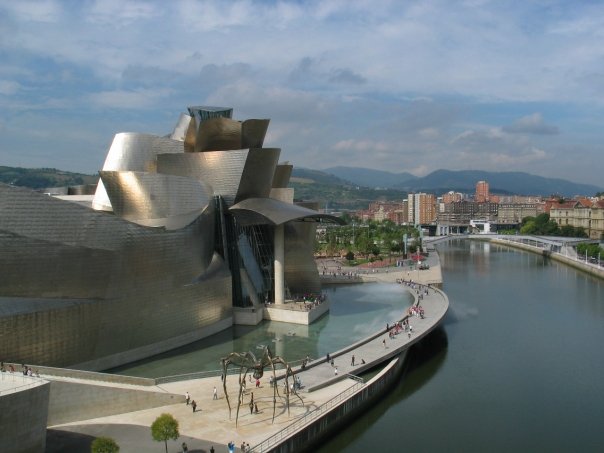
- Guggenheim Museum Bilbao: designed by Frank Gehry and opened in October 1997, clad in 33,000 thin titanium plates (spain.info). Outside stand Jeff Koons’s flower-covered dog Puppy and Louise Bourgeois’s spider Maman; inside, Richard Serra’s The Matter of Time (Tourism Euskadi).
- Casco Viejo: the old town of over 700 years, with the original Seven Streets, the cathedral, the Arriaga theatre modelled on the Paris Opera, and Plaza Nueva with its pintxo bars.
- La Ribera market: a market building on the estuary where you can eat pintxos or have food cooked (spain.info).
- Fine Arts Museum: one of the best art galleries in Spain, according to spain.info.
- The estuary and bridges: seventeen bridges cross the estuary inside the city, among them Calatrava’s Zubizuri footbridge (1997) and La Salve (English Wikipedia). Bilboats runs boat trips on the estuary (Tourism Euskadi).
- Mount Artxanda: reached by funicular from the centre, with a view over the whole city.
Getting to the sea
Bilbao itself has no beach. The estuary is the way out: the metro follows both banks to Santurtzi and to Getxo, Sopelana and Plentzia, and spain.info says the beaches and cliffs of Getxo are just over half an hour away by metro. Surfers head for Sopelana and, further east, Mundaka. Downstream, the Bizkaia Bridge (Puente Colgante) between Portugalete and Getxo was built in 1890–1893 as the world’s first transporter bridge and is a World Heritage Site; you can cross on its hanging gondola with a Barik card.
Prices and opening: the Guggenheim
Hours from Tourism Euskadi, checked November 2026: in summer open every day 10:00–20:00; from 20 September, Tuesday to Sunday 10:00–19:00, closed on Mondays except a few dates. Closed on 25 December and 1 January; closes at 17:00 on 24 and 31 December. We could not confirm current ticket prices; book on the museum’s own website.
Accessibility and safety
The riverside walk from the Guggenheim to the Casco Viejo is flat, and the metro and tram are the easiest way to get around. The Casco Viejo is mostly level but busy; watch your belongings in crowded pintxo bars. Bring a rain jacket: the rainiest months are October to April, with November the wettest (English Wikipedia).
Best time to visit
Late spring and early autumn combine milder weather with fewer crowds. July is one of the driest months, with around 50 mm of rain. The city’s main festival is Aste Nagusia, its “Big Week” festival, nine days of concerts, stalls and events held every year since 1978. One full day covers the Guggenheim and the Casco Viejo; two days let you add the Fine Arts Museum, Artxanda and a trip to the coast.
Nearby alternatives
- San Juan de Gaztelugatxe, 23.3 km away: the hermitage islet with 241 steps; free ticket needed.
- Bermeo, 24.1 km away: working fishing port at the end of the Euskotren line.
- Mundaka, 24.6 km away: surf village on the Urdaibai estuary.
- Isla de Izaro, 26.7 km away: the island off Bermeo and Mundaka.
- Zumaia Flysch, 54.6 km away: the layered flysch cliffs at Zumaia.
- Getaria, 59.3 km away: fishing village on the Gipuzkoa coast.
Distances are in a straight line from Abandoibarra.
FAQ
Does Bilbao have a beach?
Not in the city. The nearest beaches are at Getxo and Sopelana, just over half an hour away by metro.
How do I get from Bilbao airport to the city centre?
Take the A3247 bus to the Intermodal bus station, or a taxi, which takes about 15 minutes and costs 24–29 € (spain.info, checked November 2026).
Is the Guggenheim open on Mondays?
In summer it opens every day. From 20 September it is closed on Mondays, apart from a few dates, and open Tuesday to Sunday 10:00–19:00.
Is one day enough for Bilbao?
One full day covers the Guggenheim and the Casco Viejo. Allow two if you also want the Fine Arts Museum, the Artxanda funicular and the Bizkaia Bridge.
Can I park in central Bilbao?
Part of the Abando district is a low-emission zone with traffic and parking restrictions on weekdays 07:00–20:00. Ask your hotel about parking and use public transport in the city.
Sources and freshness
Checked 6 November 2026 · 6 sources Show
Checked 6 November 2026. Official: spain.info on Bilbao (sights, transport, airport, ferries, low-emission zone, travel cards); Tourism Euskadi on Bilbao, the Bilbao destination page and the Guggenheim Museum (collection, hours). The Bilbao tourism office and Guggenheim websites could not be reached. Background: English Wikipedia (population, founding, geography, climate, bridges, railways, Aste Nagusia). Location and distances: OpenStreetMap contributors (ODbL). Photos: Wikimedia Commons, licences as credited.
How this page is made. CostaMap is written with an AI editorial system run by Ebizapple. This page is based on the sources listed above. Last updated 6 November 2026. Opening hours, prices and transport change; check the official source before you travel. How we work · Partner links and ads