
Caldes d’Estrac (Caldetes)
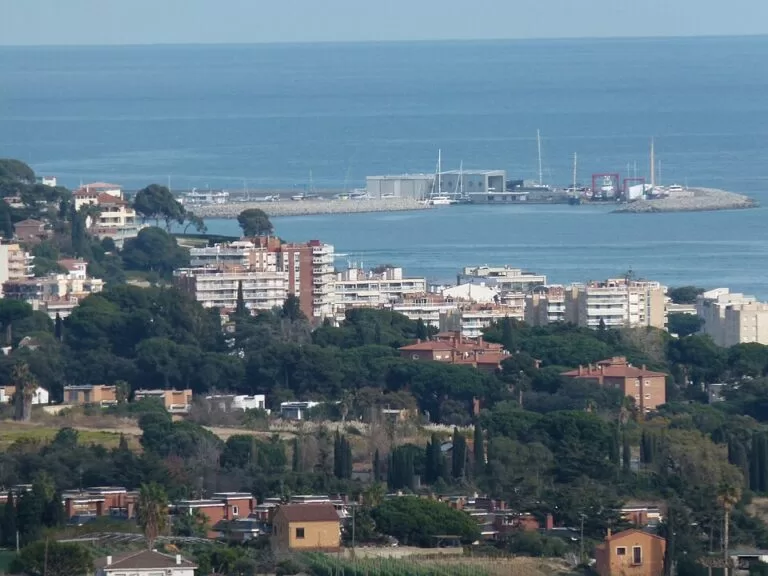
VillageCaldes d’Estrac, usually called Caldetes, is a small spa village on the Costa del Maresme between Arenys de Mar and Sant Vicenç de Montalt, about 36 km north-east of Barcelona in a straight line. Its thermal baths in the centre are, according to catalunya.com, the only publicly owned spa in Catalonia, a few minutes’ walk from the beach and from the Rodalies R1 station. It suits a quiet beach day, a thermal bath and the Picasso collection of the Fundació Palau; skip it if you want a lively resort or a big old town.
Quick facts
- Names: Caldes d’Estrac, popularly Caldetes. The Romans called the place Aquae Calidae (catalunya.com).
- Where: the Maresme coast in Barcelona province, Catalonia, at the mouth of the riera de Caldetes (Torrentbò), between the Puig de Castellar and the Turó de Caldes (catalunya.com).
- Coordinates: 41.5720, 2.5278 (village centre, OpenStreetMap).
- Size: about 1 km² and 3,148 inhabitants (catalunya.com); OpenStreetMap gives 3,348 (2025).
- Thermal water: rises through an underground gallery at 38 °C (Catalan Wikipedia).
- Main festival: 8 September, usually four or five days.
Getting there and parking
By train: Caldes d’Estrac has a station on the Rodalies R1, which runs directly to Barcelona and to Blanes (catalunya.com). The station is on the Baixada de l’Estació by the beach (OpenStreetMap); the spa is about 450 m from it and the Fundació Palau about 320 m, in a straight line.
By car: the N-II coast road crosses the village, and a local road links it with Sant Vicenç de Montalt (Catalan Wikipedia). We could not confirm where public parking is or what it costs; the village is small, so arriving by train is simpler in summer.
On foot and by bike: the centre and the seafront promenade are completely walkable, and cycle lanes link Caldes with Arenys de Mar and Sant Vicenç de Montalt (catalunya.com).
The thermal baths
The village grew up around its hot springs. Catalunya.com says the medicinal mineral water reaches the centre from the granite massif of the Maresme through an underground gallery, and that the spa in the middle of the village is the only public one in Catalonia. The town council bought the rights to the baths at the beginning of the 19th century. Catalan Wikipedia places the 19th-century baths next to the Plaça de la Vila and describes the water as mesothermal, at 38 °C.
Catalunya.com also lists a second hotel with a water centre in the village and the Hotel Colon, in the former Casino Colon, which specialises in thalassotherapy with sea water.
Prices and opening: we could not confirm the 2026 opening hours or prices of the public baths, because the town hall site could not be reached. Check with the spa before you travel.
What to see
The Fundació Palau, opened in 2003, keeps the collection of the poet and Picasso scholar Josep Palau i Fabre: about seventy works by Picasso, from student oil paintings to ceramics, drawings and lithographs. A second room shows Catalan painting, with Isidre Nonell, Joaquim Torres-García, Pau Gargallo, Joan Miró and Antoni Tàpies, and a third shows current artists such as Perejaume and Miquel Barceló. In summer it organises a poetry festival, Poesia i + (catalunya.com).
The Passeig dels Anglesos, the seafront promenade, keeps many of the mansions built when, from the end of the 18th century, Caldes became one of the main summer resorts of the Catalan upper class (catalunya.com). Writers such as Apel·les Mestres, Jacint Verdaguer and Joan Maragall came here. Among the Modernista and Noucentista houses, Casa Ugalde by the architect Coderch is a listed Bé Cultural d’Interès Nacional.
In the old town on the hill stand two 16th-century defence towers, the Torre Busquets and the Torre Verda; the Torre dels Encantats, of the 13th century, was also built against pirates. Village life centres on the Plaça Muntanyà, by the old municipal washhouse. The parish church of Santa Maria is in the old town and the church of El Carme near the sea, both of the 19th century (catalunya.com).
For green space, the Parc Muntanyà is a landscaped wood close to the centre with a great variety of plants and guided visits, and the Parc Joan Maragall faces the former Casino Colon.
Beaches
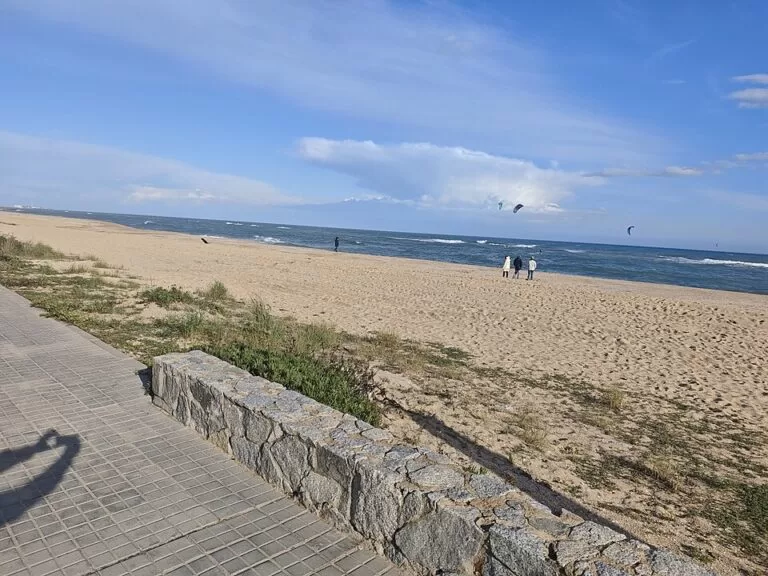
Catalunya.com speaks of wide beaches; OpenStreetMap names four: Els Tres Micos, Les Barques, Els Nàufrags and El Bassiot. The best documented is Els Tres Micos, 600 m long and 40 m wide, of rock and golden sand, in front of a wooded estate of houses. Spain.info lists sunbed, umbrella and boat hire, toilets, showers, a sports area and a children’s area (spain.info). Water sports offered in the village include surfing and water skiing, along with horse riding, golf, tennis and padel (catalunya.com).
Food and festivals
- Pesolada, from early spring to the end of April: a food event around local peas.
- Mongetes del ganxet days: three weeks of dishes with this local bean after All Saints (1 November).
- El Carme procession in July, and the Festa de Santa Llúcia in December.
- Festa Major on 8 September.
The giants of Caldes, Fàtima and Busquets, come from a local legend about a Moorish princess cured by the waters and the two watchtowers (Catalan Wikipedia).
Accessibility and safety
The seafront and the new town are flat; the old town and the towers are up the hill. We could not confirm step-free access to the baths or the lifeguard season on the beaches. If you have a health condition, ask your doctor before using hot thermal baths.
Best time to visit
Catalunya.com recommends summer for the beaches, thermal baths and cultural programme. The baths and the Fundació Palau make it a year-round visit; spring brings the pea festival and November the bean days. Most rain falls in the three autumn months.
Nearby alternatives
- Sant Pol de Mar, 8.7 km away: the white fishing village with eight beaches and the Sant Pau hermitage.
- Lluís Domènech i Montaner House-Museum, 4.8 km away: the Modernista architect’s house in Canet de Mar.
- Castle of Santa Florentina, 5.2 km away: the castle rebuilt by Domènech i Montaner above Canet.
- Iluro, 7.6 km away: the Roman town under Mataró.
- Mataró Museum, 7.7 km away: the town museum in the Can Serra manor house.
Distances are in a straight line from the village centre.
FAQ
Is Caldetes the same as Caldes d’Estrac?
Yes. Caldetes is the popular name of Caldes d’Estrac (Catalan Wikipedia). Catalunya.com adds that the old neighbourhood of Caldetes was annexed to the town in the middle of the 19th century.
Are the thermal baths in Caldes d’Estrac public?
Yes. Catalunya.com describes the spa in the village centre as the only publicly owned one in Catalonia.
How do I get to Caldes d’Estrac from Barcelona?
Take the Rodalies R1 train, which stops in the village by the beach, or drive the N-II along the coast.
How many Picasso works are in the Fundació Palau?
About seventy, from Josep Palau i Fabre’s collection, plus Catalan painting and current artists.
What is the best beach in Caldes d’Estrac?
Els Tres Micos is the best equipped: 600 m of sand and rock with hire, showers and a children’s area (spain.info).
Sources and freshness
Checked 9 November 2026 · 6 sources Show
Checked 9 November 2026. Official: catalunya.com (Agència Catalana de Turisme) on Caldes d’Estrac (spa, heritage, parks, food, festivals, history, transport, population), the Fundació Palau and the Maresme (Passeig dels Anglesos). Spain.info (Turespaña): Els Tres Micos beach. Background: Catalan Wikipedia (water temperature, roads, legend). Location, station, beaches and distances: OpenStreetMap contributors (ODbL). The town hall site could not be reached. Photos: Wikimedia Commons, licences as credited.
This place is part of our Costa del Maresme map and travel guide: Calella, Canet, Arenys and Mataró — see every town, beach and cove we have mapped on that coast.
How this page is made. CostaMap is written with an AI editorial system run by Ebizapple. This page is based on the sources listed above. Last updated 9 November 2026. Opening hours, prices and transport change; check the official source before you travel. How we work · Partner links and ads