
Roca Grossa beach (Calella)
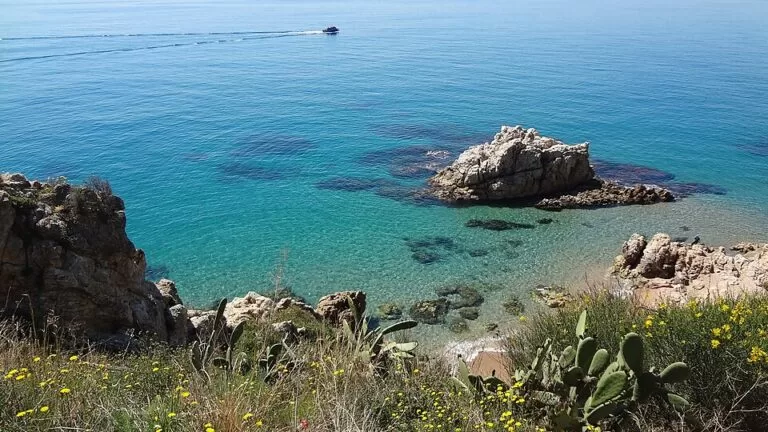
CoveRoca Grossa is a small cove beach at the southern end of Calella, on the Costa del Maresme, right on the boundary with Sant Pol de Mar: about 130 m of coarse sand split in two by rocks, with cliffs on both sides and clear water over a rocky seabed. It lies below the N-II coast road, 0.7 km south-west of the Calella lighthouse, and a small free car park on the sea side of the road doubles as a viewpoint. It suits snorkellers and people who want a cove instead of a long town beach; skip it if you need shallow water for small children, or if you mind a nudist half next door.
Quick facts
- Names: Platja de la Roca Grossa (Catalan), Playa de la Roca Grossa (Spanish), also called Platja de la Cabra. “Roca Grossa” means “big rock”; OpenStreetMap marks the rock itself at the point below.
- Where: Calella (Maresme, Barcelona province), below the N-II between Calella and Sant Pol de Mar, about 1.3 km from Sant Pol de Mar station and 2.4 km from Calella station in a straight line.
- Coordinates: 41.6048, 2.6397.
- Size: about 130 m long, coarse sand (Catalunya.com).
- Two halves: the Sant Pol side is the family half, with a bar-restaurant and showers; the Calella side is longer and wider, and nudism is practised there.
- Part of: Les Roques, the group of coves south of the lighthouse: Rocapins, La Vinyeta, Cala d’en Pere and Roca Grossa (Catalunya.com).
- Entry: free.
Access and parking
By car: Catalunya.com, Catalonia’s official tourism site, says you can leave the car in a small car park on the sea side of the N-II, which also works as a viewpoint over this part of the coast. OpenStreetMap shows that car park just above the cove, tagged as free, and a second free car park about 300 m east along the road towards the lighthouse. Both are small; in summer, arrive early.
On foot: the cove is closed at one end by the railway line, and Les Roques coves are reached on foot over the level crossings on the N-II, one at La Vinyeta cove and one from the lighthouse at Rocapins (Catalunya.com). Expect steps and uneven paths down to the sand.
By train: the R1 coast line stops at Sant Pol de Mar (1.3 km) and Calella (2.4 km). From Calella you can walk along Platja Gran and Garbí beach to the lighthouse headland, then follow the road south; from Sant Pol the walk is shorter, along the N-II.
What to expect
The Maresme is a coast of long straight beaches; Les Roques is the exception. Catalunya.com describes these coves as flanked by pine trees and cliffs, which makes them unlike the open beaches of the rest of the comarca. Roca Grossa is divided into two sections by rocks that run into the sea, each with its own access (Catalunya.com).
The water gets deep quickly: the entry slope is fairly steep, and underwater rocks make it a good spot for snorkelling and diving. The railway line closes the beach at one end, so trains pass close by.
The half nearest Sant Pol has a bar-restaurant with a terrace and showers; it is the more family-oriented side. The half nearest Calella is longer and wider, and nudity is practised there. Further north, under the lighthouse, La Vinyeta is also a nudist cove, and Cala d’en Pere is listed as nudist too.
Between the coves and the lighthouse, OpenStreetMap marks a climbing wall, a restaurant at Rocapins with public toilets, and information boards on the coastal birds, including the European shag (corb marí emplomallat).
Practical details
- Services: for Les Roques as a whole, Catalunya.com lists police and Red Cross service, showers and a bar-restaurant. We could not confirm lifeguard hours at Roca Grossa itself.
- Shade: pine trees on the cliffs; no parasol rental is listed for this cove.
- Bring: water shoes for the rocks, a mask for snorkelling, and food if you do not want to depend on the single bar.
- Nearby sights: the Calella lighthouse, built in 1859, houses an interpretation centre on lighthouses and optical telegraphy, and the Les Torretes viewpoint, a mid-19th-century optical telegraph tower, looks over the sea and woods (Catalunya.com, Calella).
Accessibility and safety
Roca Grossa is not accessible for wheelchairs: access is by paths and level crossings from the road, and Catalunya.com lists no adapted services here. If you need step-free access, use Calella’s Platja Gran, where wooden walkways go down to the shore. The steep entry and submerged rocks call for care, especially with children and on days with swell. Cross the N-II and the railway only at the marked crossings.
Best time to visit
June to September for swimming; the bar and showers are a summer service. The cove is small, and the car park fills fast on summer weekends, so morning is best. Outside summer the cove and the coastal path to the lighthouse are quiet, and the Lighthouse Interpretation Centre is promoted for visits in spring, summer and autumn (Catalunya.com).
Nearby alternatives
- Calella Lighthouse, 0.7 km away: the lighthouse of 1859 on the headland, with its interpretation centre and viewpoint.
- Càmping Bellsol, 3.6 km away: a seafront campsite in Pineda de Mar.
- Camping Globo (El Globo Rojo), 4.3 km away: a campsite opposite the beach of Canet de Mar.
- Lluís Domènech i Montaner House-Museum, 5.2 km away: the architect’s house in Canet de Mar.
- Castle of Santa Florentina, 5.2 km away: the castle restored by Domènech i Montaner in Canet de Mar.
Distances are in a straight line from the cove. For the town, see our Calella guide.
FAQ
How do I get to Roca Grossa beach in Calella?
By car on the N-II between Calella and Sant Pol de Mar: a small free car park sits on the sea side of the road above the cove. By train, get off at Sant Pol de Mar, about 1.3 km away, or Calella, about 2.4 km away.
Is there parking at Roca Grossa?
Yes, a small car park on the sea side of the N-II, marked free on OpenStreetMap, with another free car park about 300 m towards the lighthouse. Both fill quickly in summer.
Is Roca Grossa a nudist beach?
Partly. Rocks divide the cove in two: the Sant Pol half is a family beach, and nudity is practised on the half nearest Calella.
Is Roca Grossa good for snorkelling?
Yes. Catalunya.com says the underwater rocks make it a good place for diving and snorkelling. The seabed drops quickly, so it is better for confident swimmers.
Is Roca Grossa suitable for children?
Only with care. The entry into the sea is fairly steep. For shallow water and full services, Calella’s Platja Gran or the beaches of Pineda de Mar are easier.
Sources and freshness
Checked 9 November 2026 · 7 sources Show
Checked 9 November 2026. Official: Catalunya.com (Agència Catalana de Turisme) on Platja Roca Grossa (size, sand, two sections, parking, nudism, snorkelling), Les Roques (coves, services, level crossings, climbing wall), Garbí beach (La Vinyeta), Calella (lighthouse, Les Torretes), Platja Gran (wooden walkways) and the lighthouse excursion. Location, car parks, paths, stations and distances: OpenStreetMap (ODbL). Not confirmed: lifeguard service and hours, Blue Flag status, parking capacity. The Calella town hall and Turisme Maresme sites could not be reached when we checked. Photo from Wikimedia Commons: Isidro Jabato (CC BY-SA 4.0).
This place is part of our Costa del Maresme map and travel guide: Calella, Canet, Arenys and Mataró — see every town, beach and cove we have mapped on that coast.
How this page is made. CostaMap is written with an AI editorial system run by Ebizapple. This page is based on the sources listed above. Last updated 9 November 2026. Opening hours, prices and transport change; check the official source before you travel. How we work · Partner links and ads