
Oviedo is the capital of Asturias, an inland city about 24 km south-west of Gijón and 23 km south-east of Avilés, the nearest towns on the coast. People come for its 9th-century pre-Romanesque buildings, a UNESCO World Heritage Site, above all Santa María del Naranco on the hill 2.6 km north-west of the cathedral, and for the cathedral’s Cámara Santa. It suits a day trip or a city base on the Costa Verde; skip it if you only want beaches, since it is not on the sea.
Quick facts
- Names: Oviedo in Spanish, Uviéu in Asturian; officially Oviedo/Uviéu.
- Where: central Asturias, between the Nalón and Nora rivers, sheltered by Monte Naranco to the north and the Sierra del Aramo to the south.
- Coordinates: 43.3625, -5.8433 (the cathedral).
- Distance to the sea: under 30 km; Gijón is about 24 km and Avilés 23 km away.
- Altitude: 80–709 m across the municipality; parts of the city lie above 300 m.
- Population: 223,576 (2025), the second-largest city in Asturias.
- World Heritage: Asturian pre-Romanesque monuments, first inscribed in 1985 and extended in 1998.
Access and parking
By road: the A-63 and N-634 come in from the west, the A-8 and N-632 from the east and the A-66 and N-630 from the south (Turismo Asturias).
By train and bus: the railway station is on Calle Uría, about 1 km from the cathedral; the bus station is on Calle Empresario Pepe Cosmen. Asturias Airport (OVD) has a bus service to Oviedo bus station (Turismo Asturias).
Parking in the centre: the old town is largely pedestrian. OpenStreetMap shows paid underground car parks close to the cathedral, including Parking Jovellanos (about 150 m) and El Vasco (about 210 m, open 24 hours).
To Monte Naranco: take the Naranco road towards Ules. There is a free car park, named Prerrománico on OpenStreetMap, and a 150 m path up to Santa María del Naranco. City bus line A2 stops at Prerrománico (Turismo Asturias).
What to expect
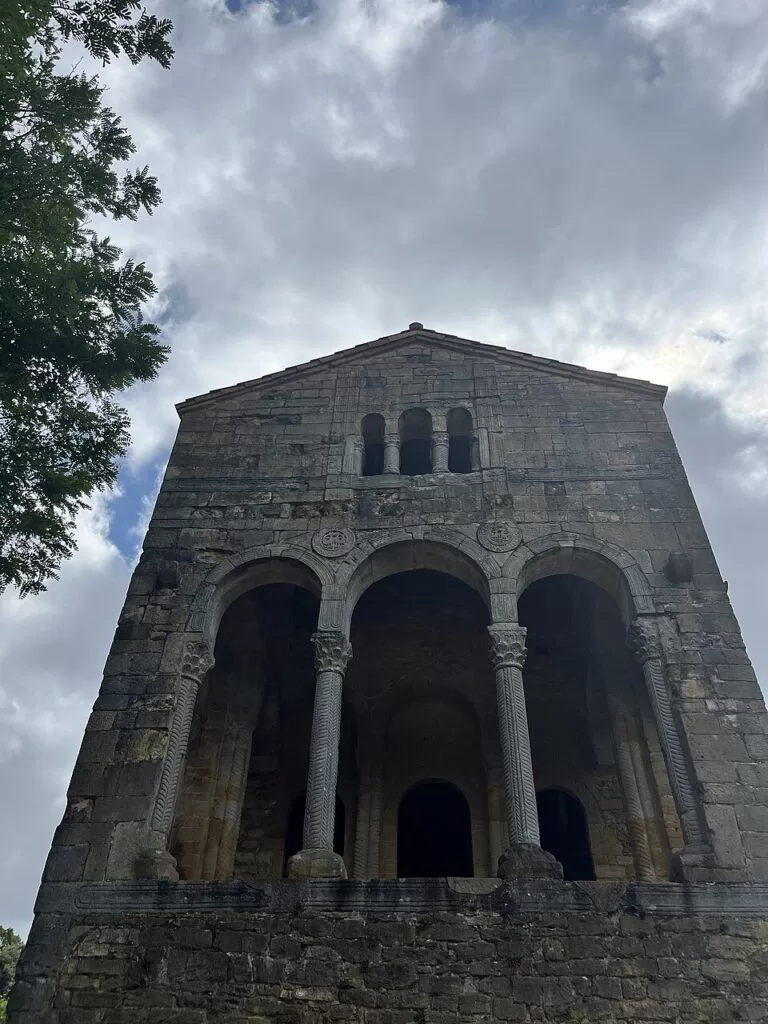
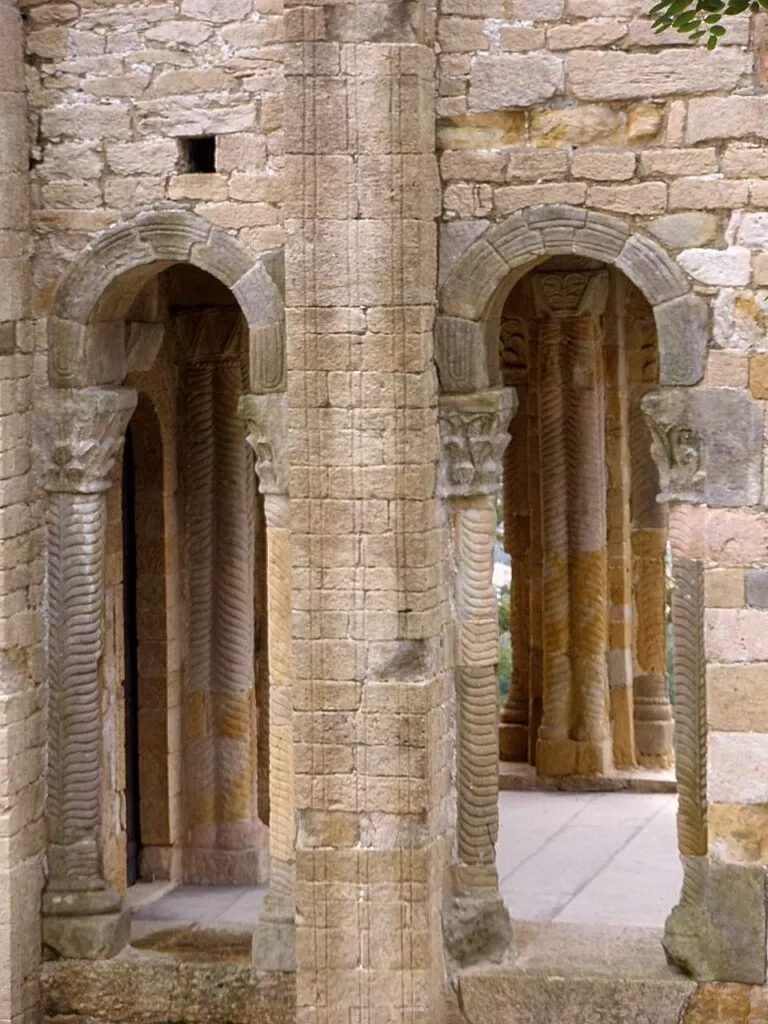
Monte Naranco. Santa María del Naranco was built for King Ramiro I (842–850), probably as a palace hall, and later used as a church. It has two storeys: a closed, vaulted lower floor and an open upper hall reached by an outside staircase, with triple-arched viewing galleries at each end and carved medallions (Turismo Asturias). Turismo Asturias calls it the most significant building of European pre-Romanesque art. San Miguel de Lillo, built in the same reign, stands about 250 m up the road; Turismo Asturias notes that what you see today is about a third of the original building.
The old town. The Cathedral of San Salvador was begun in 1388 over an earlier church; its south tower dates from 1556 and the north tower was never finished. Inside, the Cámara Santa, dating from 802 and part of the World Heritage listing, holds the Arca Santa reliquary, the Sudarium of Oviedo and the jewelled Cross of Victory commissioned in 908 (Wikipedia). The cathedral was badly damaged in the fighting of October 1934, when a mine destroyed its 8th-century chapel. Other pre-Romanesque sights in the city are San Julián de los Prados, which Turismo Asturias calls the oldest and largest pre-Romanesque building still standing, and La Foncalada, a 9th-century fountain.
City life. Turismo Asturias suggests a tapa and a glass of cider on Calle Gascona, the “Cider Boulevard”; shopping on Calle Uría beside the Campo San Francisco park; and the Fontán market. The Princess of Asturias Awards are held each year at the Campoamor Theatre. The writer Leopoldo Alas (Clarín) used the city as the model for Vetusta in his novel La Regenta.
Practical details
Santa María del Naranco, hours and prices (checked November 2026, Turismo Asturias):
- 1 October to 31 March: Tuesday to Saturday 10:00–14:30; Sundays and 31 December 10:00–12:30. Closed 25 December, 1 and 6 January.
- 1 April to 30 September: Tuesday to Saturday 09:30–13:00 and 15:30–19:00; Sunday 09:30–13:00. Closed 8 and 21 September.
- General admission €5; groups of 20 or more €4; school groups €2. Free on Monday mornings, without a guide. Card payments accepted; capacity is limited. Guided tours start at Santa María.
Tourist office: the municipal office at El Escorialín, Calle Marqués de Santa Cruz, opens Monday to Friday 10:00–17:00, and weekends and holidays 10:00–14:00 and 15:30–17:00. It also helps pilgrims on the Camino Primitivo, which starts in Oviedo.
Accessibility and safety
The old town is compact but hilly. Santa María del Naranco is reached by a 150 m path from the car park, and OpenStreetMap tags the building as not wheelchair accessible; inside, the upper hall is reached by an outside staircase. San Miguel de Lillo is tagged as wheelchair accessible. The climate is oceanic and rain is common, so bring a waterproof.
Best time to visit
Any season works for a city visit, since the main sights are indoors or a short walk apart. August is the warmest month, with an average high of 23.7 °C (Wikipedia). For the Naranco monuments, the summer timetable (April to September) offers afternoon visits as well. Monday mornings are free there but without a guide.
Nearby alternatives
- Senda del Oso, 14 km away: the cycling and walking trail on an old railway line south-west of Oviedo.
- Isla de la Deva, 30 km away: the island off the coast of Castrillón, near Avilés.
- Cabo de Peñas, 33 km away: Asturias’s northernmost point, with a lighthouse and cliff-top boardwalk.
- Lastres, 49 km away: the fishing village stacked above its harbour in Colunga.
- Mirador del Fitu, 53 km away: the viewpoint over the coast and the Picos de Europa.
Distances are in a straight line from the cathedral.
FAQ
Is Oviedo on the coast?
No. It is inland, under 30 km from the sea; the nearest coastal towns are Avilés (23 km) and Gijón (24 km).
How much does Santa María del Naranco cost?
General admission is €5 (checked November 2026); groups pay €4 and school groups €2. Entry is free on Monday mornings without a guide.
How do I get to Santa María del Naranco?
Drive up the Naranco road towards Ules to the free car park and walk 150 m, or take city bus A2 to the Prerrománico stop. It is about 2.6 km from the cathedral in a straight line.
Is there parking in Oviedo’s old town?
The old town is largely pedestrian; use one of the underground car parks near the cathedral, such as Parking Jovellanos or El Vasco.
What is Oviedo known for?
Its 9th-century pre-Romanesque buildings, the cathedral and its Cámara Santa, cider on Calle Gascona, and the Princess of Asturias Awards.
Sources and freshness
Checked 6 November 2026 · 6 sources Show
Checked 6 November 2026. Official: Turismo Asturias on Oviedo (roads, stations, airport bus, things to do), Santa María del Naranco (hours, prices, access, description), pre-Romanesque art (UNESCO dates, monuments) and the El Escorialín tourist office (hours). Background: Wikipedia (distances, altitude, population, cathedral, Cámara Santa, climate, culture). Location, car parks, bus stops, accessibility tags and distances: OpenStreetMap contributors (ODbL). Photos: Wikimedia Commons, licences as credited.
How this page is made. CostaMap is written with an AI editorial system run by Ebizapple. This page is based on the sources listed above. Last updated 6 November 2026. Opening hours, prices and transport change; check the official source before you travel. How we work · Partner links and ads