
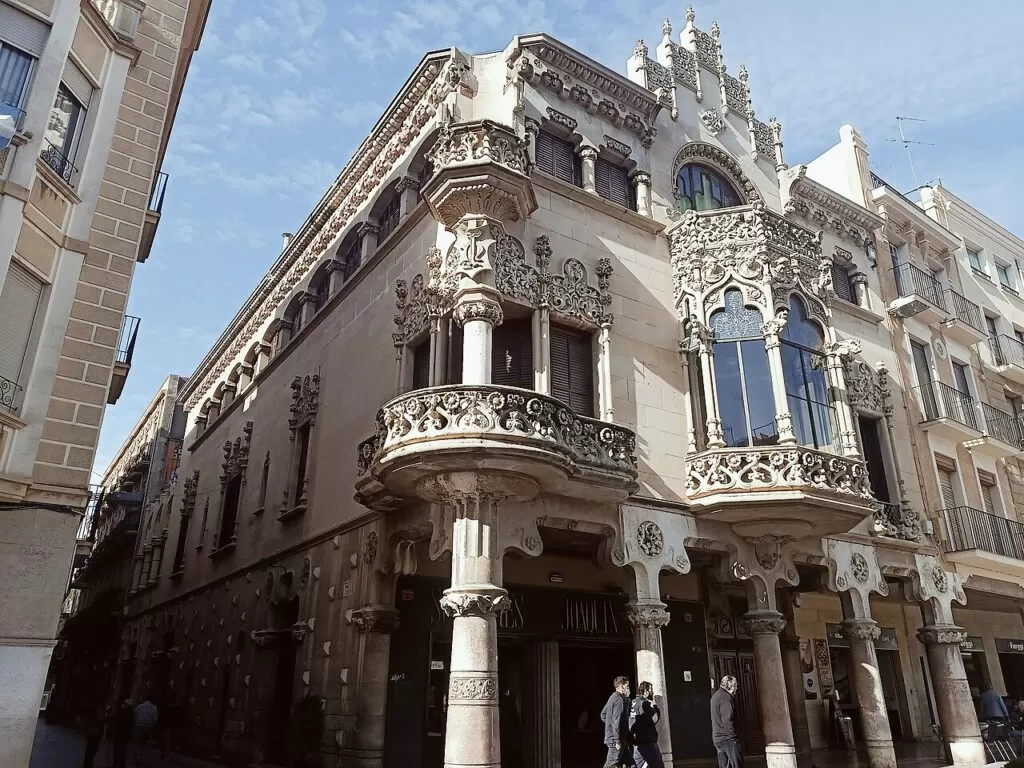
Reus: Gaudí Centre, Modernisme route and the Costa Daurada airport 5 km away
Reus is an inland city of about 112,000 people in the Baix Camp, roughly 9 km from the nearest beach at Salou, and it is the town next to the airport that serves the Costa Daurada. It suits travellers who want a real Catalan city with Modernista buildings, a Gaudí museum and a vermouth tradition, and who are happy to reach the sand by bus or train. It is also a sensible base if you have an early or late flight. It is part of our Costa Dorada guide.
Quick facts
- Where: Reus, province of Tarragona, in the Baix Camp comarca. It is inland, not on the sea.
- Residents: 111,911 (2025, Idescat).
- Nearest beach: none in the municipality. Salou’s waterfront is about 9 km away and Cambrils about 10 km, both in a straight line (our own calculation from map points, not road distances).
- Airport: Reus Airport (IATA code REU) lies about 5 km east of the centre in a straight line; Reus Transport line 50 links it with the city centre, the train station and the bus station, according to Aena.
- Other distances: Tarragona is about 13 km away in a straight line.
- Train: Rodalies line R14 runs from Barcelona to Lleida through Tarragona and Reus.
- Language: Catalan and Spanish; Spanish works everywhere.
- Character: a working city, not a resort. The Costa Daurada tourist board says Reus has more modernist buildings than any other city except Barcelona.
Where to base yourself
Reus is a city, so you choose by how you plan to travel rather than by beach. The three practical options are the historic centre, the area around the stations and the airport side. We did not read a lodging listing for the city, so we describe areas, not hotels.
The historic centre
The Reus tourist office says the historic centre holds most of the city’s shops and restaurants. Plaça del Mercadal, where the Gaudí Centre stands, is the natural middle of it. Stay here if you want to walk to museums, buildings and dinner and do not mind that nights out are a city affair rather than a beach one.
Around the train and bus stations
Aena lists the Renfe train station and the bus station among the stops of airport line 50. A room near them suits anyone who is moving on by train to Tarragona or Barcelona, or by bus to the coast, and who wants to keep luggage handling short.
Airport side
Lodging near the airport makes sense only for a very early flight. You give up the evenings in the old town, and you will need transport to reach the beach.
If the beach is the main aim of your trip, base yourself on the coast instead: Salou for a resort waterfront or Cambrils for a fishing harbour, and come to Reus for a day.
Things to do
Reus rewards a day or two on foot. The sights are about architecture, one famous architect and a drink, not about ticking off a long list of monuments.
Gaudí Centre
The Gaudí Centre is at Plaça del Mercadal 3. The Catalan heritage service says it has explained Gaudí’s life and work since 2007, with 1,200 square metres of exhibition space on three levels, and that it shows what it calls the only surviving handwritten notebook of the architect. The centre’s page speaks of “the Reus of his birth”; accounts of Gaudí’s birthplace differ between sources, so we simply say the city is closely tied to him. Check opening hours and ticket prices with the centre before you go, because we did not find them on the pages we read.

The Modernisme route
The Costa Daurada tourist board writes that Reus is, after Barcelona, the city with the most modernist buildings. The Reus tourist office lists a Ruta Modernista called “Reus 1900” among its experiences, but its page gives no route length or number of stops, so we quote neither. Pick up the route at the tourist office or on its website and treat the façades as a walk through the old centre.
Vermouth
The Costa Daurada tourist board says Reus has a Vermouth Museum and that many people place the origin of the drink in the city. The Reus tourist office lists the Estació Enològica among its must-see sites. A simple plan for a free hour is a vermouth in the centre before lunch.
Other places on the tourist office list
The Reus tourist office also lists the Institut Pere Mata among its must-see sites, and the Museu de Reus has shown an exhibition of original Gaudí drawings in 2026. Details and dates change, so confirm them before you plan around them.
Beaches and places nearby
Reus has no beach of its own. The sea is in the next municipalities on the coast, and the bus and train links described below make each trip simple.

- Salou, about 9 km away in a straight line, is the closest waterfront and the gateway to the theme park.
- Cambrils, about 10 km away, is a fishing harbour with long town beaches.
- Tarragona, about 13 km away, is the nearest large city, reachable on the same regional rail corridor.
Skip Reus as a base if you want to spend every morning on the sand: you will always be travelling to the sea. Choose it if the beach is a half-day outing and the city is the point.
Other town guides nearby: Torredembarra (about 24 km in a straight line), El Vendrell (about 37 km in a straight line), Calafell (about 39 km in a straight line).
On CostaMap near Reus: PortAventura World (8.6 km) · Roman Villa of Centcelles (9.8 km).
Food and drink
The Costa Daurada tourist board describes menjar blanc de Reus as a sweet white cream flavoured with cinnamon, typical of the area, and the same page notes more and more hazelnut fields as you leave the urban area. Both are good things to look for on a dessert menu or in a pastry shop.
Vermouth is the other local marker, as above. Beyond that, the city is a normal Catalan market and tapas town: look for set lunch menus in the streets around the centre, where locals eat. We do not name individual restaurants or market days, because we could not verify current details on an official page.
Where to stay
Expect city hotels, apartments and guesthouses rather than beach resorts. We did not read a lodging price list, so we quote no prices. As a general rule, city rooms in Reus cost less than rooms on the Salou waterfront in high summer, but check current rates for your dates. If you travel without a car, pick somewhere within walking distance of Plaça del Mercadal or the stations. If you drive, ask whether parking is included, because the centre is built for pedestrians.
Getting there and around
By air, Reus Airport (REU) is about 5 km east of the centre in a straight line, and it lies at 71 m above sea level according to OurAirports. Aena lists Reus Transport line 50 from the airport to Plaça de la Llibertat in the city centre, stopping at the Renfe station and the bus station. Aena also lists flight-timed buses from the airport to PortAventura, Salou and Cambrils (BusPlana), to Tarragona and to Barcelona (Hispano Igualadina). There is no direct bus from the airport to the Camp de Tarragona high-speed station: take line 50 to the Reus bus station and change to a BusPlana line. The Aena pages give no journey times, so check each operator.
By train, Rodalies de Catalunya lists Reus on line R14 between Barcelona and Lleida; the line is 169 km long with 31 stations and also serves Tarragona. Rodalies also lists a local RT1 service between Tarragona and Reus.
By car, Reus is a good pick-up point for the coast and the inland wine villages. In the centre itself you can walk almost everywhere, and the sights are close together.
Best time to visit
The AEMET climate normals for Reus Airport (1981–2010) give a January mean of 9.0°C, with highs of 14.1°C, lows of 3.9°C and 29 mm of rain. July averages 24.2°C with highs of 29.3°C and only 15 mm of rain, and AEMET lists 306 hours of sunshine for the month. October is the wettest of the months we checked, with 75 mm. The annual mean is 16.1°C and the annual rainfall about 500 mm.
For a city visit that is mostly indoors and on foot, spring and autumn are the easy seasons; July and August are hot in the stone streets, but the sea is a short trip away. We list no festivals with dates, because we did not find a dated, year-stamped source for them.
FAQ
Is Reus worth visiting?
Yes, if you want a Catalan city with modernist buildings, a Gaudí museum and a vermouth tradition, and you do not need a beach on the doorstep. It is less suited to a pure beach holiday.
Is Reus on the coast?
No. Reus is inland. The nearest waterfront is Salou, about 9 km away in a straight line, our own calculation from map points.
How far is Reus Airport from the city centre?
About 5 km in a straight line, our own calculation from map points. Aena lists Reus Transport line 50 between the airport and the city centre.
How do I get from Reus to Tarragona?
Rodalies lists the R14 line through both cities and a local RT1 service between Tarragona and Reus. Tarragona is about 13 km away in a straight line. Check Rodalies for current timetables.
What is the Gaudí Centre?
A museum at Plaça del Mercadal 3 that has presented the life and work of Antoni Gaudí since 2007, with 1,200 square metres of exhibition space on three levels.
Sources and freshness
Checked October 2026 · 9 sources Show
Last checked: October 2026. Sources:
Main photo: Pitxiquin, CC BY-SA 4.0, via Wikimedia Commons.
Nearby on the Costa Dorada
How this page is made. CostaMap is written with an AI editorial system run by Ebizapple. This page is based on the sources listed above. Last updated 28 October 2026. Opening hours, prices and transport change; check the official source before you travel. How we work · Partner links and ads