
Altamira Cave and Museum (Santillana del Mar)
MuseumAltamira is the cave near Santillana del Mar in Cantabria whose painted ceiling of bison was the first Palaeolithic cave art recognised anywhere. The original cave is closed to ordinary visitors for conservation, so what you visit is the Altamira National Museum, about 2 km from Santillana, with the Neocueva (Neocave), a full-size replica of the cave and its ceiling. Tickets can be bought in advance on the museum’s website. It suits anyone curious about prehistory, including families; skip it only if a replica will not satisfy you, because the real cave is effectively off limits.
Quick facts
- Names: Cueva de Altamira (the cave); Museo Nacional y Centro de Investigación de Altamira (the museum); Neocueva (the replica).
- Where: Avda. Marcelino Sanz de Sautuola s/n, 39330 Santillana del Mar, Cantabria; about 35 km from Santander (spain.info).
- Coordinates: 43.3774, -4.1224 (the museum).
- UNESCO: World Heritage Site since 1985, as part of “Cave of Altamira and Paleolithic Cave Art of Northern Spain”.
- The cave: about 270 m long, with an entrance hall, main gallery and side hall (spain.info).
- Museum opened: 2001, designed by the architect Juan Navarro Baldeweg (Spanish Wikipedia).
- Contact: +34 942 818 005, informacion.maltamira@cultura.gob.es.
Access and parking
By car: the museum stands about 2 km from the village of Santillana del Mar (spain.info). OpenStreetMap shows a free car park for visitors about 250 m from the museum building, and a separate coach park.
On foot: from Santillana del Mar it is about 2 km. Combine the two: the museum in the morning, the village for lunch.
Public transport: we could not confirm a bus that stops at the museum itself.
What to expect
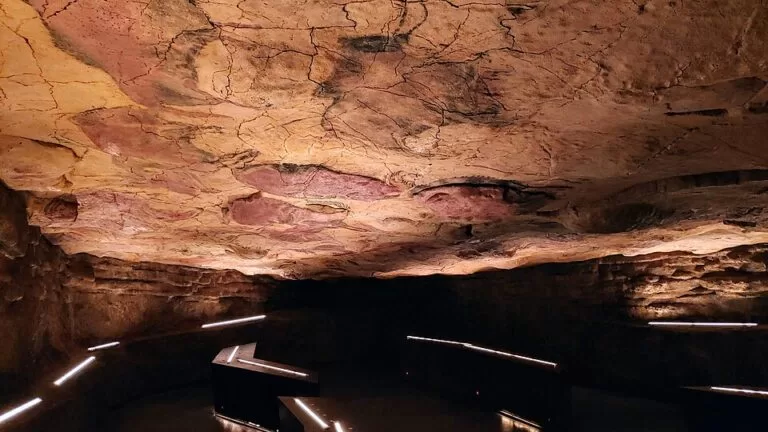
Why a replica. The cave was found by a local man, Modesto Cubillas, in 1868. In 1879 Marcelino Sanz de Sautuola was exploring it when his eight-year-old daughter María noticed the paintings on the ceiling (English Wikipedia). Experts at first refused to believe they were prehistoric. A century later, visitors’ breath was damaging them: the cave was closed in 1977, reopened to a few visitors in 1982, and closed again in 2002 after green mould appeared on some paintings. The museum and replica were built next to it and finished in 2001.
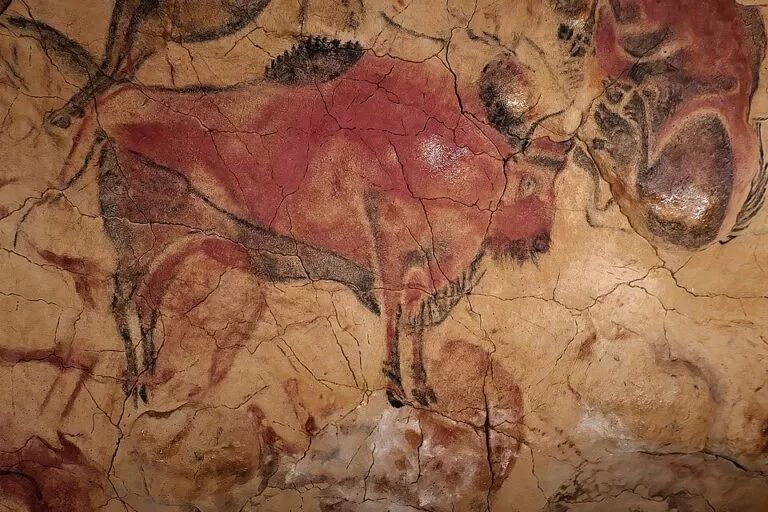
The Neocueva. Spain.info describes it as a careful replica of the cave as it was between 35,000 and 13,000 years ago. The great ceiling of polychrome bison was reproduced by Pedro Saura and Matilde Múzquiz, of the Complutense University of Madrid, with the same drawing, engraving and painting techniques the Palaeolithic artists used (Spanish Wikipedia). The paintings show bison, deer, boars and horses in natural red ochre, outlined in black, and there is a “painters’ workshop” area that explains how they were made (spain.info).
The museum. The permanent exhibition, The Times of Altamira, covers prehistoric life in Spain: art, culture, daily life and hunting, with finds from Altamira and nearby caves such as El Morín, El Juyo and El Rascaño. There are also workshops on prehistoric technology.
The real cave. Spain.info says only five people a week (260 a year) can enter the original cave, by appointment, through a waiting list set up in 2002, and that this list is currently closed to new applications. In practice, plan on the museum and the Neocueva only.
Prices and opening
We could not open the museum’s official website from our research setup, so we cannot confirm current ticket prices. Spain.info links to the museum’s online ticket shop, and advance booking is sensible in summer and at Easter. OpenStreetMap lists the hours as Tuesday to Saturday 09:30–20:00 and Sunday 09:30–15:00, closed on Mondays; this is not an official source, so phone +34 942 818 005 before you go.
Accessibility and safety
The museum is a modern building, and OpenStreetMap marks it as wheelchair accessible; we could not confirm this from an official source. The Neocueva is a replica, so there are none of the slippery floors or low passages of a real cave. Toilets are by the museum building. Cantabria’s weather changes fast; bring a layer for the walk from the car park.
Best time to visit
Any time of year works, as the visit is indoors. Go on a weekday morning outside July and August to avoid groups, and book ahead in high season. Allow about two hours for the Neocueva and the exhibition, then go on to Santillana del Mar.
Nearby alternatives
- Santillana del Mar, 2.1 km away: the historic village closest to the museum.
- Comillas, 13.8 km away: seaside town to the west, on the coast.
- Playa de Oyambre, 16.8 km away: long open beach west of Comillas.
- Santander, 27.3 km away: Cantabria’s capital city.
- Isla de Mouro, 31.5 km away: the small islet off Santander.
- Llanes Coastal Path, 51.3 km away: cliff-top walk on the Asturian coast.
Distances are in a straight line from the museum.
FAQ
Can you go inside the real Altamira cave?
Realistically, no. Spain.info says only five people a week enter, through a waiting list that is currently closed to new applications. The museum’s Neocueva is the way to see the ceiling.
Do you need tickets for Altamira?
Yes, entry to the museum and Neocueva is ticketed, and tickets can be bought in advance online through the museum’s website. We could not confirm current prices.
Is there parking at the Altamira museum?
Yes. OpenStreetMap shows a free visitor car park about 250 m from the museum, plus a coach park.
How far is Altamira from Santillana del Mar?
About 2 km from the village; you can drive or walk.
Is the Altamira museum open on Mondays?
OpenStreetMap lists it as closed on Mondays, open Tuesday to Saturday 09:30–20:00 and Sunday 09:30–15:00. Check with the museum before you travel.
Sources and freshness
Checked 6 November 2026 · 5 sources Show
Checked 6 November 2026. Official: spain.info pages on the Altamira National Museum (Neocueva, exhibition, access to the real cave, address, contact, ticket link) and the Altamira cave (length, paintings). The museum’s own website and the Cantabria tourism site could not be reached. Background: English Wikipedia (discovery, closures, UNESCO) and Spanish Wikipedia on the museum (architect, replica, collections). Location, parking, opening hours as mapped and distances: OpenStreetMap contributors (ODbL). Photos: Wikimedia Commons, licences as credited.
How this page is made. CostaMap is written with an AI editorial system run by Ebizapple. This page is based on the sources listed above. Last updated 6 November 2026. Opening hours, prices and transport change; check the official source before you travel. How we work · Partner links and ads