
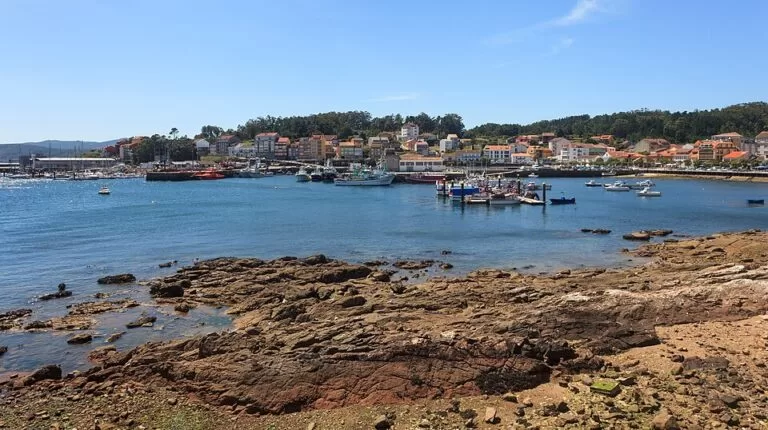
Camariñas is a fishing town on the Costa da Morte in Galicia, at the mouth of the Camariñas ría, known across Spain for its bobbin lace, the encaixes de Camariñas. It lies about 4 km south-east of the Cabo Vilán lighthouse and 4 km across the water from Muxía; you reach it by car on the AC-432, which leaves the C-552 at Vimianzo. It suits lighthouse and coastal-walk fans, anyone interested in traditional crafts, and people touring the Costa da Morte by car; skip it if you want a big beach resort or a town you can reach easily by public transport.
Quick facts
- Names: Camariñas in Galician and Castilian. Galician Wikipedia links the name to the camariña, a shrub that still grows on the dunes of Trece.
- Where: municipality of Camariñas, comarca of Terra de Soneira, province of A Coruña, on the north side of the Camariñas ría. About 17.5 km south-west of Laxe and 28.5 km north of Cape Finisterre in a straight line.
- Coordinates: 43.1302, -9.1806 (Praza da Insuela by the town hall, OpenStreetMap).
- Known for: bobbin lace, the Museo do Encaixe (Lace Museum) and the Mostra do Encaixe lace fair in Holy Week, a Festival of Galician Tourist Interest (Turismo de Galicia).
- Walking: the port of Camariñas is the end of stage 5 and the start of stage 6 of the Camiño dos Faros, the lighthouse path along the Costa da Morte (Galician Wikipedia).
Access and parking
By car: Turismo de Galicia gives the route: leave the C-552 at Vimianzo and follow the AC-432 to Camariñas; from the port a road continues to the Cabo Vilán lighthouse, and a coastal earth track starts in Arou (Turismo de Galicia). In a straight line Camariñas is about 67 km from both Santiago de Compostela Airport (SCQ) and A Coruña Airport (LCG).
Parking: OpenStreetMap shows free parking in and around the centre: a small free surface car park and street parking next to the town hall and the lace museum, more free car parks near the market square, and street parking by the nautical club on the harbour, about 450 m from the town hall.
Without a car: we could not confirm bus routes or timetables.
What to expect
Turismo de Galicia calls Camariñas “a peaceful haven” on a threatening coast: the town sits at the entrance to its ría, protected by Punta da Barca and Cabo Vilán, and keeps many traditional houses and quiet streets with the atmosphere of the fishing villages of old (Turismo de Galicia). Inside the ría the sea is calm, and its shore, from the Area da Vila beach to Espiñeirido in Muxía, is a pattern of white beaches, coves, pines and rocks (Turismo de Galicia).
Lace. Camariñas is the home of a famous bobbin lace made by local women, the palilleiras. Some say an Italian traveller brought the craft, others that it came from the Netherlands. The Museo do Encaixe shows lace from Camariñas and from other places in the world, some of it centuries old, together with the tools used to make it. OpenStreetMap places it beside the town hall on Praza da Insuela. We could not confirm its opening hours or prices on an official page.
The Mostra do Encaixe. Since 1991 the town has held the Mostra do Encaixe de Palillos in Holy Week. It lasts five days: lacemakers from Galicia and abroad show and sell their work, the municipal lace schools give demonstrations, and designers hold fashion parades, including wedding dresses made with bobbin lace (Turismo de Galicia).
Cabo Vilán. About 4 km north-west, the present lighthouse of 1896 replaced a steam-powered light of 1854 and was the first in Spain to work with electric light. The 25 m tower stands on a rock 105 m above the sea (Turismo de Galicia). The building now holds a shipwreck exhibition. See our Cabo Vilán guide.
The English Cemetery and Trece. From the lighthouse road a path leads to the wild beach of Trece. On the way are the Foxo do Lobo, converging stone walls built to trap wolves, probably of prehistoric origin, and the camariña heather, which in Galicia grows only here and on the Cíes Islands (Turismo de Galicia). Further on is the Cemiterio dos Ingleses, where the sailors of the British training ship Serpent, wrecked on 10 November 1890, are buried; the priest of Xaviña organised the burials (Turismo de Galicia). The path ends at Trece bay, below a climbing dune on Monte Branco.
Beaches
Lengths and types as Turismo de Galicia gives them, checked November 2026.
- Area de Trece – a 500 m open beach of fine sand below the dune, reached on foot or by bike from the Cabo Vilán road (Turismo de Galicia). No services.
- Arou – a 400 m open beach with a Blue Flag in the parish of Camelle, where the coastal track to Trece and Vilán begins (Turismo de Galicia).
- Area Longa – a 200 m open beach south-west of the town, on the way to Punta da Barca (Turismo de Galicia).
Practical details
- Where to stay: a few hotels and guesthouses around the centre and the harbour are shown on OpenStreetMap; Muxía, 4 km across the ría (further by road, round the head of the ría), is the other base nearby.
Accessibility and safety
The centre is small and mostly flat around the town hall square and the harbour. The track to Trece and the English Cemetery is unsurfaced and exposed to wind. Turismo de Galicia says more than 150 wrecks have been recorded on this stretch, and the Costa da Morte has strong currents and sudden storms: swim only in the sheltered coves inside the ría, not at Trece, and keep back from the cliff edges at Vilán. In an emergency, call 112.
Best time to visit
Holy Week, for the Mostra do Encaixe. Summer, for the ría beaches. For the Camiño dos Faros and the Trece path, spring and early autumn are quieter; bring a windproof layer.
Nearby alternatives
- Cabo Vilán Lighthouse, 4 km north-west: the first electric lighthouse in Spain.
- Muxía, 4 km south across the ría: the Virxe da Barca sanctuary.
- Ézaro Waterfall, 25 km south: a river falling into the sea.
- Cape Finisterre, 28.5 km south: lighthouse and Camino km 0.
- Carnota Beach, 34 km south: the longest beach in Galicia.
Distances are in a straight line from the centre of Camariñas.
FAQ
What is Camariñas famous for?
Bobbin lace, the encaixes de Camariñas, with a lace museum and the Mostra do Encaixe fair every Holy Week.
How far is Cabo Vilán from Camariñas?
About 4 km. A road runs from the port of Camariñas to the lighthouse, and a coastal earth track comes in from Arou past Trece.
Where is the English Cemetery in Camariñas?
On the coast path between Cabo Vilán and Trece beach, for the sailors of HMS Serpent, wrecked in 1890.
Can you swim at Camariñas?
Yes, in the sheltered beaches and coves inside the ría. Trece and the beaches facing the open Atlantic are wild and often rough.
Is Camariñas on the Camino?
It is on the Camiño dos Faros coastal walk (end of stage 5, start of stage 6). Muxía, across the ría, is on the Camino de Santiago extension to the sea.
Sources and freshness
Checked 9 November 2026 · 10 sources Show
Checked 9 November 2026. Official: Turismo de Galicia on the town of Camariñas (lace, museum, Holy Week festival), the Mostra do Encaixe, the Camariñas ría, Cabo Vilán (road access), the lighthouse, the English Cemetery, the lighthouses and wild beaches route, the Costa da Morte and the beaches linked above. Background: Galician Wikipedia on Camariñas (place name, Camiño dos Faros). Location, parking, museum and distances: OpenStreetMap contributors (ODbL). The town’s tourism website could not be reached. Photo: Wikimedia Commons, licence as credited.
How this page is made. CostaMap is written with an AI editorial system run by Ebizapple. This page is based on the sources listed above. Last updated 9 November 2026. Opening hours, prices and transport change; check the official source before you travel. How we work · Partner links and ads