
Lucentum (Tossal de Manises, Alicante)
Historic siteLucentum is the Iberian and Roman town from which Alicante grew, and its ruins at the Tossal de Manises are the city’s main archaeological site: walls and towers, Roman baths, the forum and streets of houses on a low hill above L’Albufereta beach, about 3 km north-east of the centre. The tram stops about 500 m away, and the finds are shown at the MARQ museum in town, with a joint ticket for both. It suits anyone interested in Roman Spain and families combining history with the beach next door; skip it if you expect standing columns and theatres on the scale of Tarragona or Mérida.
Quick facts
- Names: Lucentum (Latin); Tossal de Manises, the hill it stands on (Valencian; also spelt Tossal de Manisses). The Greeks may have called the place Akra Leuke, the “white promontory” (Wikipedia).
- Where: the Albufereta district of Alicante, around three kilometres from the city centre (Comunitat Valenciana), between the Serra Grossa and L’Albufereta beach.
- Coordinates: 38.3654, -0.4380 (OpenStreetMap, site entrance area on Carrer de la Porta Oriental).
- Type: open-air archaeological site, about 30,000 m² (Wikipedia), run with the Provincial Archaeological Museum (MARQ).
- Periods: Iberian settlement and necropolis (6th to 2nd centuries BC), Roman town with its peak from the 1st century BC to the 1st century AD, and a later Muslim cemetery.
- Protection: declared a historic-artistic monument in 1961 (Wikipedia).
Access and parking
By tram: the Lucentum stop is about 500 m north of the site, on the line from the city centre towards Playa de San Juan and El Campello; the Albufereta and La Isleta stops serve the beach below (OpenStreetMap). MARQ has its own stop on the same tram network (Wikipedia). We could not open the operator’s site to confirm which lines stop at Lucentum at a given hour.
On foot: from L’Albufereta beach it is about 700 m in a straight line. From the Explanada de España it is about 4.7 km, too far for most people in summer heat.
By car: the site is surrounded by residential streets. We could not confirm a dedicated car park; street parking in the Albufereta district is the likely option, and the tram is simpler.
What to expect
The regional tourist board calls Tossal de Manises one of the Region of Valencia’s most prized archaeological treasures and the birthplace of present-day Alicante (Comunitat Valenciana). The hill was first settled by Iberians; the Romans later built their town on top of the earlier remains. Under Emperor Augustus, from the 1st century BC to the 1st century AD, Lucentum was recognised as a city and enjoyed a golden period in which a forum, baths, a sewer system and a place of worship were built.
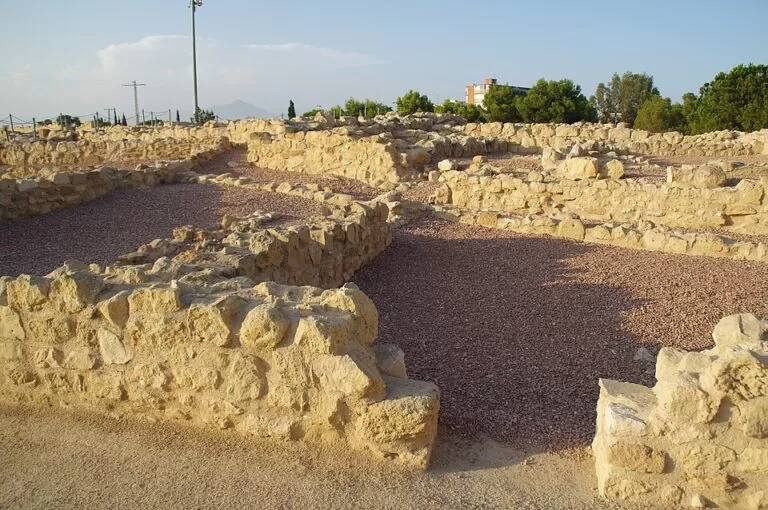
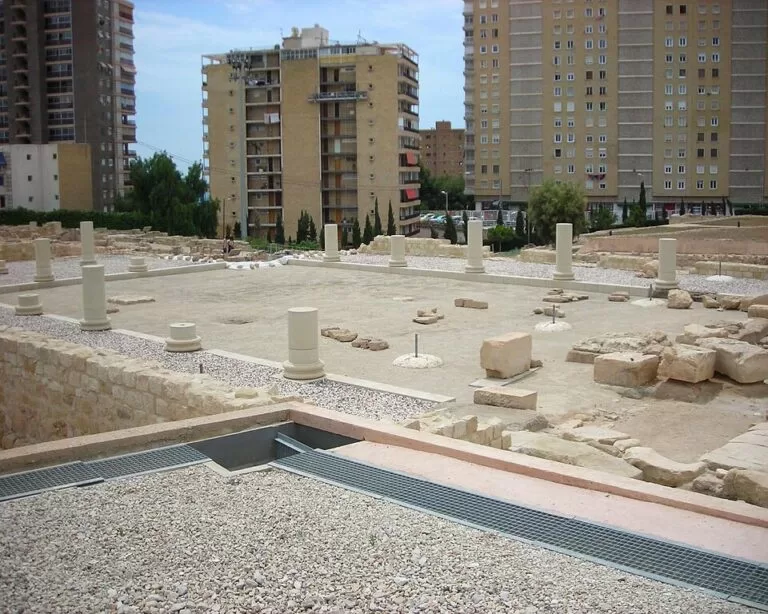
On the ground you walk among low walls rather than tall buildings. The tourist board lists baths, stretches of the city walls and turrets; Wikipedia adds the foundations of the pre-Roman defensive towers, the forum, part of the Muslim necropolis and many houses (Wikipedia). The site is enclosed by tall apartment blocks built before it was fully protected, so the views are of the modern city as much as of the bay.
The story of the site is part of the visit. In 1780 the Count of Lumiares, who had dug here for years, argued that these ruins were Lucentum. After the Spanish Civil War the hill was threatened by building, and the Swedish archaeologist Solveig Nordström was among those who fought to save it; the 1961 protection followed. Conservation work from the 1990s, led by the architect Rafael Pérez Jiménez and the archaeologist Manuel Olcina, made the remains visitable (Wikipedia).
The town declined from the 2nd century AD, losing trade to neighbouring Ilici, today’s Elche, and was abandoned by the end of the 3rd century; in the 10th and 11th centuries the hill was used as a Muslim cemetery (Wikipedia).
Prices and opening
We could not confirm current opening hours or ticket prices: the MARQ website, which manages the site, could not be reached when we checked in November 2026. The regional tourist board recommends buying a joint ticket for the site and the museum (Comunitat Valenciana), and El Campello’s page on La Illeta dels Banyets mentions a joint ticket covering La Illeta, Lucentum and MARQ (Comunitat Valenciana). Check times on the MARQ site or at a tourist office before you go, especially in summer, when an outdoor site is best visited early.
See the finds at MARQ
The objects found at Lucentum are not on the hill but at the Provincial Archaeological Museum of Alicante (MARQ), founded in 1932, whose galleries cover the Iberian, Roman and Medieval periods with audiovisual displays (Comunitat Valenciana). The tourist board says the finds from the Iberian necropolis are shown there (Comunitat Valenciana), and Spain.info notes that MARQ exhibits the remains of the Tossal de Manises site (Spain.info). Wikipedia lists incense burners, Iberian pottery painted with birds and fish, jewellery and amulets of Egyptian origin from the necropolis (Wikipedia). Visiting the museum first makes the ruins far easier to read.
Accessibility and safety
We could not confirm step-free routes inside the site. The ground is gravel and uneven stone, with low walls and changes of level, so wear closed shoes. There is little shade on an open hilltop: bring water and a hat between June and September.
Best time to visit
Spring and autumn are the most comfortable seasons for an outdoor site; in summer, go at opening time and finish at the beach. Alicante’s tourist board pairs the ancient site with the modern city of Baroque and Modernist buildings, so a morning at Lucentum and MARQ and an afternoon in the old town works well (Comunitat Valenciana).
Nearby alternatives
- MARQ – Archaeological Museum of Alicante, 3.6 km away: the finds from Lucentum and the province’s archaeology.
- Playa del Postiguet, 3.9 km away: the city-centre beach below the castle.
- Santa Bárbara Castle, 3.9 km away: the fortress on Mount Benacantil, with views over the bay.
- Marina Alicante, 4.9 km away: the marina next to the Explanada de España.
- Torre de la Illeta (El Campello), 8.8 km away: a 1557 watchtower beside La Illeta dels Banyets, the other archaeological site on the joint ticket.
Distances are in a straight line from the site. For the city as a whole see our Alicante guide.
FAQ
What is Lucentum?
The Iberian and Roman town on the Tossal de Manises hill from which Alicante developed. Its excavated remains include walls, towers, baths, the forum and houses.
How do I get to Lucentum from Alicante city centre?
Take the tram towards Playa de San Juan or El Campello and get off at the Lucentum stop, about 500 m from the site. It is around 3 km from the centre.
Is there a combined ticket for Lucentum and MARQ?
Yes. The regional tourist board recommends a joint ticket for the site and the museum, and a joint ticket also covers La Illeta dels Banyets in El Campello. We could not confirm current prices.
When was Lucentum abandoned?
The town flourished from the 1st century BC to the 1st century AD, declined from the 2nd century as trade moved to Ilici (Elche), and was abandoned by the end of the 3rd century.
Is there a beach near Lucentum?
Yes. L’Albufereta beach lies just below the hill, a calm city beach with a beach bar and accessible bathing.
Sources and freshness
Checked 9 November 2026 · 10 sources Show
Checked 9 November 2026. Official: Turisme Comunitat Valenciana on Tossal de Manises, Alicante, MARQ, Illeta dels Banyets (joint ticket) and L’Albufereta beach; Spain.info on Alicante. Background: English and Spanish Wikipedia on Lucentum (en, es) and the Alicante Tram. Location, tram stops and distances: OpenStreetMap contributors (ODbL). Photos: Wikimedia Commons, licences as credited. Not confirmed: opening hours, ticket prices, guided tours and step-free access (the MARQ and Alicante tourism sites could not be reached).
This place is part of our Costa Blanca, Spain: towns, beaches and where to stay — see every town, beach and cove we have mapped on that coast.
How this page is made. CostaMap is written with an AI editorial system run by Ebizapple. This page is based on the sources listed above. Last updated 9 November 2026. Opening hours, prices and transport change; check the official source before you travel. How we work · Partner links and ads