
Almería Civil War Shelters (Refugios de la Guerra Civil)
Historic siteThe Almería Civil War Shelters (Refugios de la Guerra Civil) are a network of tunnels about 9 m under the centre of Almería, built in 1937–1938 to protect the city’s people from air and sea raids. Almost 1 km of the 4.5 km the architect Guillermo Langle Rubio designed has been restored and is shown on guided visits, which start from an entrance pavilion on the Plaza Manuel Pérez García, just off the Paseo de Almería. The site closed after a fire in March 2025 for a full restoration, so check that visits have restarted before you go. It suits anyone interested in 20th-century history; skip it if you dislike enclosed underground spaces.
Quick facts
- Names: Refugios de la Guerra Civil or Refugios subterráneos de Almería in Spanish; in English, the Civil War Shelters or air-raid shelters of Almería.
- Where: entrance pavilion on the Plaza Manuel Pérez García, in the old centre of Almería; the exit is on the Plaza Pablo Cazard. The open gallery runs under the Paseo de Almería.
- Coordinates: 36.8416, -2.4647 (entrance pavilion, OpenStreetMap).
- Built: designed in 1936–1937 by Guillermo Langle Rubio; work began in February 1937 and ended in 1938 (Andalusian tourist board).
- Size: about 4.5 km of tunnels were built, at an average depth of 9 m; almost 1 km is open to visitors.
- Planned capacity: about 40,000 people, for a city of about 52,000 at the start of the war (Spanish Wikipedia, citing local sources).
- Visits: guided only, with tickets bought in advance.
- Status in 2026: closed after an electrical fire on 5 March 2025; a full restoration was planned to finish in early summer 2026. We could not confirm the reopening on an official page.
History
Almería was bombed 52 times from the air and from the sea during the Spanish Civil War, and 754 bombs fell on the city. The worst attack, the bombardment of Almería in 1937, came while the shelters were being dug. The project to build a public shelter network was signed on 22 January 1937, with a budget of 4.5 million pesetas, and the work took 16 months (Spanish Wikipedia).
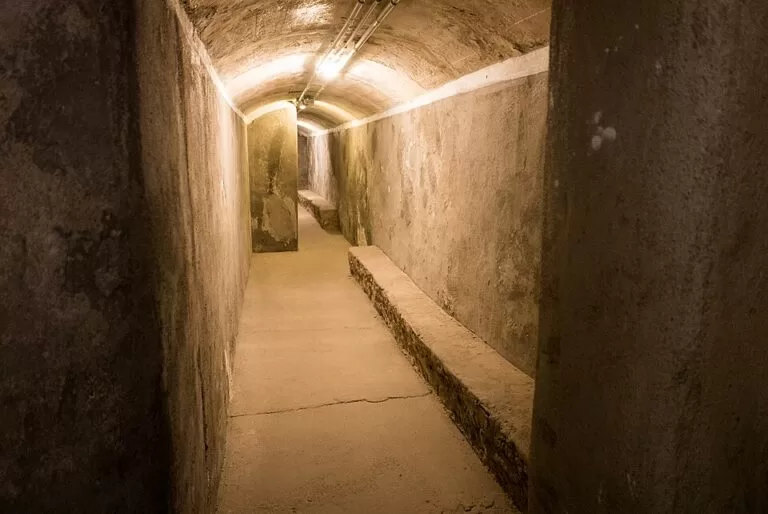
Langle planned the galleries so that nobody in the city would be more than about 100 m from an entrance. The galleries for sheltering are 2 m wide, with narrower connecting tunnels, barrel vaults and walls lined with 60 cm of concrete. The benches along the walls were added in 1939, because people brought their own chairs and blocked the passages. Inside, smoking, weapons and talk of politics or religion were not allowed.
After the war the entrances were sealed, several of them under small kiosks that Langle also designed and that still stand in squares of the centre. The tunnels were forgotten until 2001, when works for an underground car park on the Rambla Obispo Orberá broke into them. The city restored them to a design by the architect José Ángel Ferrer and opened them to the public on 14 December 2006. During the works, remains of the old Pechina gate of the Muslim city wall were found; they lie under a glass floor in the waiting room.
What to expect
The Andalusian tourist board describes the visit as the recovered main gallery under the Paseo de Almería, with recreated rooms: the food store, the private shelter linked to Langle’s name and the operating theatre, fitted with medical instruments of the period. Spanish Wikipedia adds that the store room, near the Mercado Central, is the deepest point, about 16 m down, and that the operating theatre was added in 1938, after refugees from the Málaga–Almería road massacre reached the city. Its instruments, dating from 1941, were donated by a local doctor. Look out for drawings of planes and bombs scratched into the concrete, many of them apparently by children.
The tourist board calls the network the largest air-raid shelters open to the public in Europe. Most visitors combine it with the Alcazaba and the cathedral, both within 600 m.
Tickets, times and access
Tickets: the tourist board says visits are guided and tickets must be bought in advance on the city’s culture ticket site, almeriaculturaentradas.es. Groups are limited to 30 people. We could not open that site or the city tourist office site from our setup, so we give no prices or times: check them there before you go.
Reopening: on 5 March 2025 an electrical panel caught fire, visitors were evacuated and the shelters closed. The city then decided to keep them shut during the pedestrianisation of the Paseo de Almería and restore them fully, with better access and new displays, and planned to reopen in early summer 2026 (Spanish Wikipedia). The last stretch of the new pedestrian Paseo opened on 12 October 2026 (Spanish Wikipedia).
On foot: the entrance is in the pedestrian centre, about 1.1 km in a straight line from the Almería intermodal bus and train station.
Parking: OpenStreetMap marks a car park on the Plaza de San Pedro, about 200 m south of the entrance. Street parking in the old centre is limited.
Accessibility and safety
The tourist board lists services for people with disabilities, OpenStreetMap tags the entrance wheelchair-accessible, and the restoration of 2006 added a lift at the exit on the Plaza Pablo Cazard. Spanish Wikipedia says the route is adapted for wheelchair users. The tunnels are narrow, closed and partly below sea level, with damp on some walls; people with claustrophobia may find the visit hard. We could not confirm whether the post-2025 restoration changed the route.
Best time to visit
The tunnels keep their own temperature and are a good plan on a hot summer afternoon or a rare rainy day. The tourist board lists them as open all year; book ahead in July and August, when the city is busiest.
Nearby alternatives
- Almería Cathedral, 0.4 km away: the 16th-century fortress cathedral; the war shelters also had a branch inside it.
- Alcazaba de Almería, 0.6 km away: the 10th-century fortress above the city.
- Museum of Almería, 0.9 km away: the province’s archaeology, from Los Millares to El Argar.
- Cable Inglés, 1.1 km away: the iron ore pier of 1904, now a walkway over the port.
- Los Millares, 14 km away: the Copper Age settlement in the Andarax valley.
Distances are in a straight line from the shelter entrance. The city as a whole is covered in our Almería guide and the Almería city area guide.
FAQ
Are the Almería Civil War Shelters open?
They closed after a fire on 5 March 2025 and were being restored, with reopening planned for early summer 2026. We could not confirm on an official page that they have reopened, so check the city ticket site before you go.
Do you need tickets for the Almería shelters?
Yes. Visits are guided only, and the Andalusian tourist board says tickets must be bought in advance online.
How long are the Almería Civil War Shelters?
About 4.5 km of tunnels were built; almost 1 km, under the Paseo de Almería, is restored and shown on the visit.
Where is the entrance to the shelters?
In a pavilion on the Plaza Manuel Pérez García, just off the Paseo de Almería in the old centre (36.8416, -2.4647). The exit is on the Plaza Pablo Cazard.
Are the shelters wheelchair accessible?
The tourist board and OpenStreetMap list them as accessible, and there is a lift at the exit. Ask when you book, as the route may change after the restoration.
Sources and freshness
Checked 9 November 2026 · 4 sources Show
Checked 9 November 2026. Official: Andalusian tourist board, Refugios de la Guerra Civil (depth, length, recreated rooms, dates, guided visits, advance tickets, accessibility). Background: Spanish Wikipedia, Refugios subterráneos de Almería (bombardments, budget, design, rediscovery in 2001, opening in 2006, 2025 fire and restoration) and Paseo de Almería (pedestrianisation). The city tourist office (turismodealmeria.org) and the ticket site could not be reached from our setup, so prices, times and the reopening date are not confirmed. Location, entrance and parking: OpenStreetMap contributors (ODbL).
How this page is made. CostaMap is written with an AI editorial system run by Ebizapple. This page is based on the sources listed above. Last updated 9 November 2026. Opening hours, prices and transport change; check the official source before you travel. How we work · Partner links and ads