
Castelló d’Empúries is a medieval town on the plain of the Alt Empordà, about 4 km inland from the Bay of Roses on the northern Costa Brava and 9 km east of Figueres. It was the capital of the counts of Empúries, and its Gothic basilica of Santa Maria, known as the cathedral of the Empordà, rises over a compact old town with a Jewish quarter, a medieval bridge and a prison from 1336. It suits people who like old stone streets and birdwatching, since the Aiguamolls de l’Empordà Natural Park starts at its door; skip it if you only want a beach day, which is what neighbouring Empuriabrava is for.
Quick facts
- Names: Castelló d’Empúries (Catalan, the official name); Castellón de Ampurias in Spanish. The municipality includes the canal resort of Empuriabrava on the coast.
- Where: Alt Empordà (Girona), on the River Muga and the Molí canal, between Figueres and the Bay of Roses. About 9 km east of Figueres and 4 km from Empuriabrava.
- Coordinates: 42.2591, 3.0746 (town centre, OpenStreetMap).
- Population: about 4,200 in the town itself (OpenStreetMap).
- History: capital of the county of Empúries from 1079, when the counts moved from Sant Martí d’Empúries, which was too exposed to pirates (Wikipedia).
- Natural park: El Cortalet, the Aiguamolls information centre, is about 4 km south-east.
Access and parking
By car: from the AP-7 (exit 4 from Barcelona, exit 3 from France) follow signs for Roses on the C-260 (Parcs Naturals de Catalunya).
Parking: OpenStreetMap maps two free asphalt car parks on the west side of the old town, one for about 120 cars (0.55 km from the basilica) and one for about 37 (0.4 km), plus smaller free car parks on the east side within about 200 m of the basilica.
By train and bus: the park’s access page says to take the train to Figueres (or the high-speed train to Figueres-Vilafant, with a bus into town); buses from Figueres to Castelló are very frequent. On OpenStreetMap the bus station is about 0.8 km south-west of the basilica, and the Moventis Sarfa lines Figueres–Roses–Cadaqués (e6) and Girona–Roses–Cadaqués (4) pass through the town. We did not check timetables.
What to see
Basilica of Santa Maria: the 13th-century church that the tourist board says is nicknamed the cathedral of the Empordà. The tourist board’s photos credit its marble portal to the 15th century and the master builder Antoni Antigó. In the sacristy, the Parish Museum, known as the Treasure, shows the basilica’s religious silverwork and some two hundred pieces of religious art, including a 16th-century Plateresque processional cross and liturgical vestments (catalunya.com). OpenStreetMap marks the museum as paid.
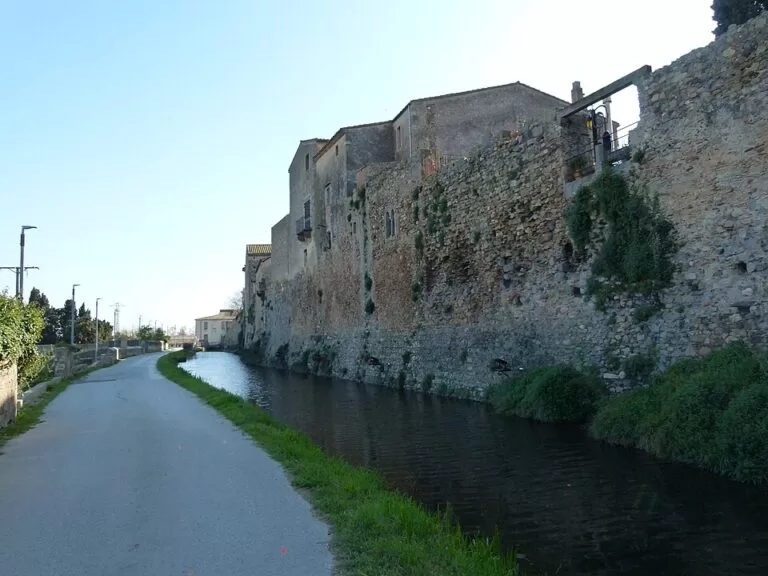
Portal de la Gallarda: the tourist board suggests starting here. It was the eastern gate of the walled town, from the 13th century and the only one of its gates still standing, next to the best-preserved stretch of wall.
The old streets: walk the carrer del Bordell, the arcaded squares, the old craft quarters and the call, the Jewish quarter, which takes in the carrer de la Muralla, dels Jueus, del Call, del Calabró, de les Peixateries Velles and the plaça de la Llana. Look for the Gothic Casa Gran, the 14th-century Llotja (the old town hall) and palace of the counts, and the convents of Sant Agustí and Santa Clara (catalunya.com).
Cúria and Presó: a Gothic building of 1336 that served as court and prison; graffiti left by prisoners survive on its walls. OpenStreetMap lists it as a paid museum.
Pont Vell: a 14th-century bridge with seven unequal arches over the Muga, near the old Sant Marc quarter, about 0.7 km west of the basilica.
Ecomuseu-Farinera: a late-19th-century flour factory built on the site of the medieval Molí del Mig. You follow the wheat through the floors and the original machinery, which introduced the Austro-Hungarian milling system that first made white flour possible. It belongs to the network of the Museu de la Ciència i de la Tècnica de Catalunya (catalunya.com).
Aiguamolls and Empuriabrava
The Aiguamolls de l’Empordà Natural Park was created on 28 October 1983. It lies inside the Bay of Roses, between the mouths of the Fluvià and the Muga, and the park calls it one of the main wetlands of Catalonia with the deltas of the Ebre and the Llobregat (Parcs Naturals de Catalunya). From Castelló you can walk or cycle to the El Cortalet information centre on the GR 92 or the Estanys route, about 5 km, or take the bus to the Aiguamolls de l’Empordà stop, ten minutes’ walk from the centre. The park gives the centre’s hours as 9:00 to 18:30 from 1 March to 24 October and 9:00 to 17:00 from 25 October to 28 February (checked November 2026).
Empuriabrava, on the coast, was built from 1967 as a residential marina on a grid of navigable canals with more than 5,000 moorings and its own aerodrome. (The tourist board gives canal lengths from 23 to 40 km.) A 5 km greenway along the Muga, for walkers and cyclists only, links the old town with Empuriabrava, whose beaches cover about 7 km of coast.
Practical details
- Food: the tourist board names duck, foie gras, fish and local vegetables, and the sweets bruels, delícies de trobadors and rocs de Castelló.
- Festivals: the Candelera in February; Terra de Trobadors, a medieval fair with market, parade and troubadour music; and the Foc de Castelló in early November, a re-enactment of the 1874 battle between Carlists and Liberals.
- Guided tours: the tourist office runs guided walks; days and prices not confirmed.
Accessibility and safety
The old town is on the flat plain, and the tourist board recommends exploring it on foot, but its medieval lanes are narrow and we could not confirm step-free access to the basilica or the museums. The Aiguamolls can be explored on foot or by bicycle, and the tourist board describes the lakes route as suitable for families. In summer carry water: there is little shade on the paths to the park.
Best time to visit
Spring and autumn are comfortable for walking the old town and the paths to the Aiguamolls; check the park’s information centre hours, which are shorter from late October. Early November brings the Foc de Castelló, and February the Candelera.
Nearby alternatives
- Aiguamolls de l’Empordà Natural Park (4 km): lagoons, hides and the El Cortalet centre.
- Ciutadella de Roses (7.9 km): Greek Rhode and a 16th-century fortress.
- Port de Roses (8.6 km): the fishing port and marina of Roses.
- Dalí Theatre-Museum (9.5 km): Dalí’s museum in Figueres.
- Empúries (14 km): the Greek and Roman city by the sea at L’Escala.
- Monastery of Sant Pere de Rodes (about 10 km): the Romanesque abbey above El Port de la Selva.
FAQ
Is Castelló d’Empúries worth visiting?
Yes, if you like medieval towns: the basilica, the Jewish quarter, the 1336 prison and the Pont Vell fill a half day, and the Aiguamolls are next door.
Where can I park in Castelló d’Empúries?
In the free car parks on the west and east sides of the old town, all within about 0.6 km of the basilica (OpenStreetMap).
How do I get to Castelló d’Empúries from Figueres?
It is 9 km east of Figueres on the road to Roses. Buses from Figueres bus station, next to the railway station, are very frequent, according to the natural park.
What is the difference between Castelló d’Empúries and Empuriabrava?
They are the same municipality. Castelló is the medieval town inland; Empuriabrava is the canal resort built on the coast from 1967, with beaches and a large marina.
Can you walk to the Aiguamolls?
Yes: El Cortalet is about 5 km away on the GR 92 or the Estanys route, on foot or by bike.
Sources and freshness
Checked 7 November 2026 · 9 sources Show
Checked 7 November 2026. Catalan Tourist Board (catalunya.com): Castelló d’Empúries, Ecomuseu-Farinera, Parish Museum, Empuriabrava marina and Empuriabrava beach. Parcs Naturals de Catalunya: Aiguamolls key data and how to get there. Background: Wikipedia. Town centre, population, car parks, bus station and lines, distances: OpenStreetMap. The town’s tourism website could not be reached; museum hours and prices, festival dates and bus times are not confirmed.
How this page is made. CostaMap is written with an AI editorial system run by Ebizapple. This page is based on the sources listed above. Last updated 6 November 2026. Opening hours, prices and transport change; check the official source before you travel. How we work · Partner links and ads