
Monastery of Sant Pere de Rodes (El Port de la Selva)
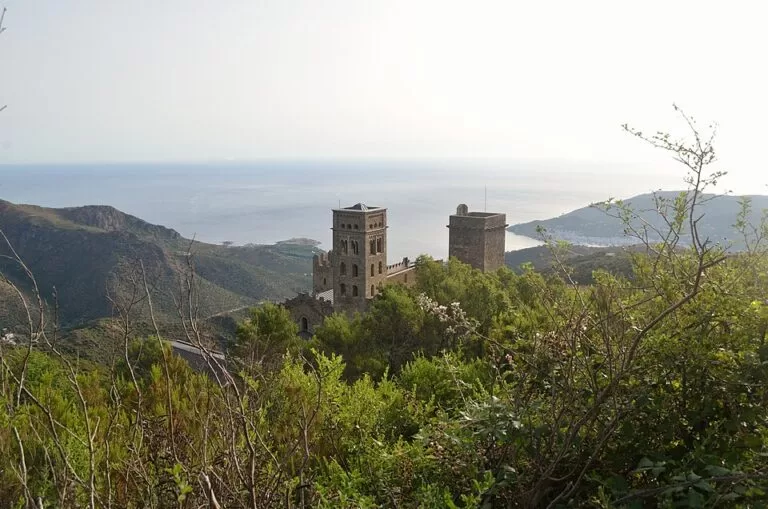
Historic siteThe Monastery of Sant Pere de Rodes is a former Benedictine abbey high on the Verdera mountain above El Port de la Selva, on the northern Costa Brava, facing the bays of Llançà and El Port de la Selva. The Catalan tourist board calls it the finest example of native Catalan Romanesque; you reach it by a mountain road (GIP-6041) from El Port de la Selva, park in one of the free car parks a few hundred metres away and walk up. It suits anyone who likes medieval buildings and big views; skip it in strong tramuntana wind or if you cannot manage slopes and steps.
Quick facts
- Names: Monestir de Sant Pere de Rodes (Catalan), Monasterio de San Pedro de Roda or de Rodas (Spanish). The older Catalan form Sant Pere de Roda is also used.
- Where: municipality of El Port de la Selva, Alt Empordà (Girona), in the Rodes mountains inside the Cap de Creus Natural Park. About 3.6 km in a straight line south-west of El Port de la Selva and 5.4 km from the harbour of Llançà.
- Coordinates: 42.3234, 3.1653 (OpenStreetMap). The site lies at about 507 m above sea level.
- Age: monastic life here is first documented in 878; the church was consecrated in the 11th century (catalunya.com).
- Status: Historical Artistic Monument since 1930, restored by the Generalitat in two phases (the second from 1990). It houses the head office of the Cap de Creus Natural Park, the first maritime-terrestrial park in Catalonia (catalunya.com).
- Tickets and hours: we could not reach the Generalitat’s heritage website (patrimoni.gencat.cat), so we give no prices or opening hours here.
Access and parking
By car: on OpenStreetMap the access road is the GIP-6041, signed Carretera de Sant Pere de Rodes and, near the top, Camí del Monestir. A minor road, the Carretera del Port de la Selva a Sant Pere de Rodes, also climbs from the coast. Expect cyclists: OpenStreetMap shows two signed cycle climbs, from El Port de la Selva and from Vilajuïga, ending here.
Parking: OpenStreetMap shows three free surface car parks: one about 0.5 km east of the monastery, a small one for about 20 cars near Santa Helena (about 0.45 km away) and one for about 50 cars about 0.9 km to the north-west. Spaces right beside the monastery are for permit holders.
On foot: OpenStreetMap maps a signed path from El Port de la Selva to Sant Pere de Rodes and Selva de Mar, and the GR 11 also passes the monastery. It is a climb of about 500 m from sea level; carry water.
By bus: there is no bus stop at the monastery on OpenStreetMap; Moventis Sarfa line 30 runs from Figueres to El Port de la Selva, at the foot of the path.
What to see
The tourist board describes Sant Pere de Rodes as a synthesis of earlier influences, Carolingian and pre-Romanesque, with features of Roman art. The buildings are set on terraces down the slope. The church, with its bell tower, the monks’ cells, the refectory and other rooms are arranged around the cloister (catalunya.com).
The church is the main reason to come. It was consecrated in the 11th century by the archbishop of Narbonne; the tourist board’s photo captions give the date as 5 October 1022. It has a Latin-cross plan with three naves, and the tourist board says its layout strongly influenced later Catalan Romanesque churches. Wikipedia notes Carolingian-style capitals, columns reused from a Roman building and a crypt under the apse.
The towers: the square bell tower is 12th-century Lombard work, according to Wikipedia. Beside it stands the defensive tower: even with a castle on the summit, the monastery needed its own.
The cloister forms the centre of the complex. The restoration from 1990 added modern materials and structures; the tourist board itself says perhaps too many for some tastes.
History in brief: the record of 878 is of a small cell dedicated to Saint Peter. Wikipedia says an independent Benedictine abbey followed in 945, which peaked in the 11th and 12th centuries as a place of pilgrimage, was sacked several times in the 17th century and was abandoned by its monks at the end of the 18th (1798 per the tourist board, 1793 per Wikipedia).
Santa Helena, Santa Creu and the castle
With the monastery, three sites form the monumental ensemble of the Serra de Rodes. Santa Helena de Rodes, also called Santa Creu, is a pre-Romanesque church on the Verdera mountain, about half a kilometre north-east of the monastery according to the tourist board (on OpenStreetMap it lies about 0.55 km away). Traces of a 9th-century building survive; a trapezoidal apse with a barrel vault was added in the 10th century and two side naves in the 16th and 17th centuries. It has a gabled roof and a single-walled bell tower, and from beside it you look down on the monastery and the bay of El Port de la Selva (catalunya.com).
Santa Creu de Rodes, the medieval village around the church, is a Site of National Cultural Interest; OpenStreetMap shows information boards among its remains.
Sant Salvador de Verdera is the ruined castle on the summit. The tourist board gives 670 m for the castle and says it has the best panoramic view of the area; OpenStreetMap marks the summit at 682 m, about 0.45 km from the monastery. El Port de la Selva’s tourist page also mentions paragliding flights from the castle down to the beach (catalunya.com).
Practical details
- Visits: the tourist board says guided visits are organised in summer. Check current hours, prices and any booking on the Generalitat’s heritage website before you go; we could not confirm them.
- Food and water: OpenStreetMap shows a restaurant at the monastery and a drinking fountain, the Font dels Monjos.
Accessibility and safety
The monastery is built on terraces, so expect slopes and stairs; we could not confirm a step-free route. The paths to Santa Helena and the castle are rough. The tourist board’s climate notes for the area single out the tramuntana wind; on a windy day the exposed summit can be dangerous. There is little shade on the walks.
Best time to visit
Choose a calm, clear day: the views over the bays of Llançà and El Port de la Selva are half the point of the trip. In summer arrive early, before the heat and the crowds, and ask about the guided visits.
Nearby alternatives
- El Port de la Selva (3.6 km): the fishing village below.
- Ciutadella de Roses (6.3 km): Greek and Roman remains in a 16th-century fortress.
- Cadaqués (10 km): across the peninsula.
- Salvador Dalí House-Museum (10.5 km): Dalí’s home at Portlligat.
- Cap de Creus (12.4 km): the lighthouse headland.
- Portbou to Llançà walk (5.4 km to its end at Llançà): GR 92 stage 1.
FAQ
How do I get to Sant Pere de Rodes?
By car on the GIP-6041 mountain road, then a short walk from a free car park. Without a car, take Moventis Sarfa line 30 from Figueres to El Port de la Selva and walk up the signed path.
Is there parking at Sant Pere de Rodes?
Yes: OpenStreetMap shows three free car parks 0.45 to 0.9 km from the monastery.
Do you need tickets for Sant Pere de Rodes?
Guided visits are organised in summer, according to the Catalan tourist board. We could not confirm current prices or opening hours, so check the Generalitat’s heritage website before you go.
Can you walk from El Port de la Selva to Sant Pere de Rodes?
Yes, on a signed path that also continues to Selva de Mar. It is steep, so allow time and carry water.
Sources and freshness
Checked 7 November 2026 · 6 sources Show
Checked 7 November 2026. Catalan Tourist Board (catalunya.com): Monastery of Sant Pere de Rodes, Church of Santa Helena de Rodes, El Port de la Selva and Cap de Creus Natural Park. Background: Wikipedia. Roads, car parks, paths, bus line and distances: OpenStreetMap. The Generalitat’s heritage website (patrimoni.gencat.cat) could not be reached, so opening hours, prices and accessibility are not confirmed.
How this page is made. CostaMap is written with an AI editorial system run by Ebizapple. This page is based on the sources listed above. Last updated 6 November 2026. Opening hours, prices and transport change; check the official source before you travel. How we work · Partner links and ads