
Liencres Dunes (Dunas de Liencres)
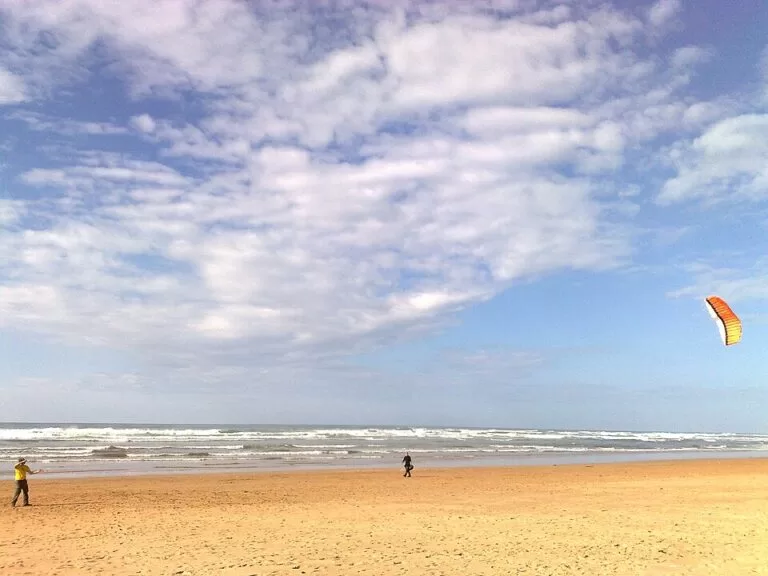
Natural parkThe Liencres Dunes (Dunas de Liencres) are one of the largest dune systems on the north coast of Spain, at the mouth of the Pas river in Piélagos, about 13 km west of Santander in a straight line. You reach them by car on the CA-305, which leaves the coast road CA-231 and runs 6 km to the sea, ending at car parks behind Valdearenas beach, 2,800 m of golden sand backed by dunes and a pine wood. They suit walkers, families who want space on a long beach, surfers and birdwatchers; skip them if you want calm water, a promenade or bars on the sand.
Quick facts
- Names: Dunas de Liencres (Spanish); the protected area is the Parque Natural de las Dunas de Liencres y Costa Quebrada. The main beach is Valdearenas; the smaller one at the western end is Canallave.
- Where: Piélagos, Cantabria, on the right bank of the Pas estuary (Ría de Mogro), between the village of Liencres and the sea. The park also takes in coast in Miengo and Santa Cruz de Bezana.
- Coordinates: 43.4501, -3.9617 (beach access at Valdearenas, OpenStreetMap).
- Size: the natural park covers 1,753 hectares (spain.info). The first park, declared in 1986, protected only about 195 ha of dunes, beaches and pine wood; it was extended and renamed by a Cantabrian law of 2021 (Wikipedia, citing the Boletín Oficial de Cantabria).
- Beaches: Valdearenas, 2,800 m long and 50 m wide; Canallave, 220 m by 50 m. Both have golden sand and strong, windy surf (spain.info).
- Geopark: the coast east of the dunes, Costa Quebrada, was certified a UNESCO Global Geopark in 2025 (spain.info).
- Entry: free; there is no ticket or gate.
Access and parking
By car: from Santander or Torrelavega follow the CA-231, which runs parallel to this coast, and turn off on the CA-305 towards the sea; the dunes are 6 km along it (spain.info, Liencres natural park). The road ends behind the beaches. spain.info’s beach sheets name the CA-305 as the nearest main road and list car access only.
Parking: spain.info says there are car parking facilities at Valdearenas, and that Canallave has easy parking. OpenStreetMap maps a free surface car park next to Canallave and further car parks in the pine wood behind Valdearenas. On sunny summer weekends arrive early: the access road is a dead end.
By public transport: we found no bus stop near the beach on OpenStreetMap and could not confirm a bus service to the dunes. The village of Liencres, about 3 km away, is the nearest settlement.
On foot: Wikipedia describes a coastal walk from the point and bay of Somocuevas, 500 m from the village of Liencres, west to the Mogro estuary and back, with the climb to La Picota (239 m).
What to expect
The dunes lie on a sandy peninsula bordered by the Mogro estuary and several beaches. spain.info calls them one of the most important dune enclaves on the Cantabrian coast. From the sea inland you cross a sandbar, mobile dunes, a wide field of dunes partly covered by plants, and then older dunes fixed by pine trees. That pine wood was planted from 1949 to 1973, mostly maritime pine, to stop the sand from moving, and today it has paths and is used for picnics and walks (Wikipedia).
Valdearenas is the beach most people come for. spain.info describes a long beach on a huge stretch of sand, with the dunes reaching right down to it and rich vegetation behind. Canallave, at the western end, is smaller, sheltered by a line of rocks and, in spain.info’s words, a real sports beach: surfers, beach volleyball and paragliding. Both have showers, footwashes and bins, and spain.info lists a surf practice area at each.
Along the estuary at low tide you can see layers of marine sand alternating with river clay and silt (Wikipedia). The dunes and the estuary are a resting place for migrating waders, and spain.info also mentions lizards, snakes, the midwife toad and three species of newt. East of the dunes the coast turns to cliffs, rock platforms, islets and small coves: this is Costa Quebrada, the “broken coast”, which spain.info calls an open-air laboratory where you can see geology in action.
Practical details
- Facilities: showers, footwashes, bins and a cleaning service at Valdearenas and Canallave (spain.info). OpenStreetMap shows a bar and a restaurant near Canallave; there is nothing on the open sand of Valdearenas.
- Information: the Piélagos tourist office answers on +34 942 579 878 and oficinadeturismo@pielagos.es; the Costa Quebrada Geopark on +34 604 455 946. The geopark’s office is on Avenida Marqués de Valdecilla in Soto de la Marina, Santa Cruz de Bezana (spain.info).
- Orientation course: OpenStreetMap maps a permanent orienteering course, run by Piélagos town council, by the Valdearenas access.
- Rules: keep to marked paths in the dunes; trampling destroys the plants that hold the sand. We could not confirm the park’s rules on dogs, camping or drones from an official page, so follow the signs at the entrances.
Accessibility and safety
spain.info rates swimming conditions at both Valdearenas and Canallave as “strong waves, windy”. This is the open sea, and we could not confirm lifeguard cover from an official source, so do not swim far out and keep children close. Do not try to wade across the Mogro estuary, where the river meets the tide. The walk from the car parks crosses soft sand and dunes, which is hard going with a wheelchair or pushchair; we found no adapted access.
Best time to visit
For walking and birdwatching, spring and autumn are best: the paths are quiet and migrating birds use the estuary. Summer is the season for the beach, when the car parks fill on sunny weekends. Surfers come all year. The weather on this coast changes quickly, so bring a windproof layer even in August.
Nearby alternatives
- Santander, 12.8 km away: Cantabria’s capital, with the Magdalena Palace, the Centro Botín and its own city beaches.
- Santillana del Mar, 13.3 km away: the medieval village around the Romanesque collegiate church.
- Camping Santillana del Mar, 13.8 km away: the nearest campsite on CostaMap.
- Altamira, 15.3 km away: the museum and Neocave replica of the painted cave.
- El Sardinero, 14.5 km away: Santander’s long city beach with a promenade and full services.
- Somo beach, 18.6 km away: the long surf beach across the Bay of Santander.
Distances are in a straight line from the Valdearenas beach access.
FAQ
How do I get to the Liencres Dunes?
By car. Take the CA-231 coast road between Santander and Torrelavega, then the CA-305 for 6 km to the sea; it ends at the car parks behind Valdearenas and Canallave.
Is there parking at Valdearenas beach?
Yes. spain.info lists car parks at the beach, and OpenStreetMap shows a free car park by Canallave and more in the pine wood behind Valdearenas. They fill on summer weekends.
Can you swim at Liencres?
You can, but with care. spain.info describes strong, windy waves at both beaches, so stay near the shore and check the flags.
Is Liencres good for surfing?
Yes. spain.info lists a surf practice area at Valdearenas and Canallave and calls Canallave a real sports beach popular with surfers.
How big is the Liencres natural park?
1,753 hectares, including the dunes, the Pas estuary and the Costa Quebrada coast, part of a UNESCO Global Geopark since 2025.
Sources and freshness
Checked 9 November 2026 · 5 sources Show
Checked 9 November 2026. Official: spain.info (Turespaña) on the Dunes of Liencres and Costa Quebrada Natural Park (area, wildlife, geopark, roads, contacts), and the beach sheets for Valdearenas and Canallave (size, sand, swimming conditions, services, access). The Cantabria tourist board site blocked our requests and the park and geopark sites could not be reached. Background: Wikipedia, Parque natural de las Dunas de Liencres y Costa Quebrada (history, dunes, pine wood, coastal walk). Location, car parks, bar and orienteering course: OpenStreetMap contributors (ODbL). Photos: Wikimedia Commons, licences as credited.
How this page is made. CostaMap is written with an AI editorial system run by Ebizapple. This page is based on the sources listed above. Last updated 9 November 2026. Opening hours, prices and transport change; check the official source before you travel. How we work · Partner links and ads