
Silk Exchange (La Lonja de la Seda), València
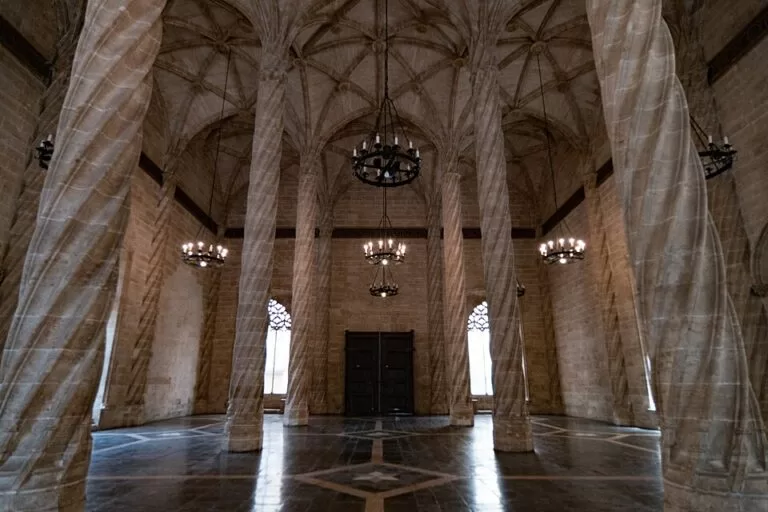
Historic siteThe Silk Exchange (La Lonja de la Seda, Llotja de la Seda in Valencian) is a late Gothic merchants’ hall in the old town of València, on the Plaza del Mercado directly opposite the Central Market. Built mostly between 1482 and 1492 under the master mason Pere Compte, it has been a UNESCO World Heritage Site since 1996. Inside you see the Hall of Columns with its twisted pillars, the tower, the Sea Consulate and a courtyard of orange trees. It is a 5-minute walk from the cathedral. It suits anyone interested in architecture or history; skip the inside if you only have time for one paid sight and prefer the cathedral.
Quick facts
- Names: Silk Exchange, La Lonja (English); Lonja de la Seda (Spanish); Llotja de la Seda (Valencian).
- Where: Plaza del Mercado, Ciutat Vella, València, opposite the Central Market (Comunitat Valenciana).
- Coordinates: 39.4744, -0.3783 (OpenStreetMap).
- Built: mostly 1482–1492 under Pere Compte, finished by a pupil after his death, which explains its Renaissance details (Spain.info). Decorative work and the Consulate went on into the 16th century.
- Size: more than 2,000 m² indoors and out, in four parts: the Tower, the Sea Consulate, the Orange-tree Courtyard and the Hall of Columns.
- Status: UNESCO World Heritage Site since 1996.
- Tickets: sold by València City Council; we could not confirm the current price or hours.
Access and getting there
On foot: the Silk Exchange is in the heart of the old town, which Spain’s tourist board says is best explored on foot. It is about 300 m from the cathedral and Plaza de la Reina, about 550 m from the Serranos Towers and about 900 m from Estació del Nord, the station for local Cercanías trains (straight-line distances, OpenStreetMap).
By public transport: Estació del Nord has the Xàtiva metro stop on lines 3, 5 and 9, and metro lines 3 and 5 also run from the airport to the city in about 20 minutes (Spain.info). From there it is a walk of about 15 minutes. City buses cover the whole centre.
By car: do not drive to it. Large parts of the centre are Low Emission Zones where driving and parking are restricted, also for foreign-registered cars (Spain.info). Use a car park on the edge of the centre or come by metro.
What to see inside
The Hall of Columns. The trading hall, the Sala de Contratación, is the reason to go in. Eight columns hold up the vaulted ceiling and divide the space into three aisles; Spain.info calls them delicate spiral columns, and they twist like rope up into the ribs of the vault. The regional tourist board calls this the most beautiful space in the building (Comunitat Valenciana). A band of text in Latin runs round the walls: it says the house was built in fifteen years and praises trade that is honest and lends no money at interest (Wikipedia).
The Tower. The central tower holds the chapel and the prison where merchants who could not pay their debts were held.
The Sea Consulate. The Consulado del Mar was the seat of the maritime trade court. It has a hall with a carved wooden coffered ceiling and a painting by Espinosa.
The Orange-tree Courtyard. The Patio de los Naranjos is a walled garden of orange trees between the buildings, a quiet place to sit after the hall.
From outside, look at the walls. Spain.info compares the building to a medieval castle because of its fortress-like stone walls, and it calls the Lonja one of Europe’s most beautiful examples of Gothic civil architecture. On Sundays there is a coin and stamp market at the Lonja.
Why it matters
The Lonja was built at the height of València’s 15th-century trading wealth, when the city’s merchants dealt in silk and other goods. The regional tourist board describes it as the centre of the prosperous silk trade. An older exchange, the Oil Exchange, stood on the site before it (Wikipedia). UNESCO listed the building in 1996 as an exceptional example of a secular late Gothic building that shows the power and wealth of a great Mediterranean trading city.
Prices and opening
The Lonja is run by València City Council, which sells tickets through its own ticket site, linked from Spain’s tourist board page (Spain.info). We could not open the council’s pages, so we cannot confirm current prices, opening hours or free-entry days. Check the council’s museum pages or ask at a tourist office before you plan around a visit.
Accessibility
We could not confirm which parts of the building have step-free access or whether there is a lift to the upper rooms of the Sea Consulate. Ask at the entrance or contact the council’s museum service before you go if you need step-free access.
Best time to visit
Come early in the day, when the hall is quietest, and combine it with the Central Market across the square. Spain.info’s two-day plan for València puts the cathedral, the Miguelete tower, Plaza Redonda, the Lonja and the Central Market together in one morning walk, then lunch in the market or on the squares around the Lonja (Spain.info).
Nearby alternatives
- Central Market (Mercado Central), 0.1 km away: the 1928 Art Nouveau food market across the square.
- Valencia Cathedral, 0.3 km away: the Holy Chalice and the Miguelete bell tower.
- Torres de Serranos, 0.6 km away: the 14th-century city gate above the Turia Gardens.
- City of Arts and Sciences, 3 km away: reached through the Turia Gardens.
- La Malvarrosa beach, 4.7 km away: the city beach, a tram ride from the centre.
Distances are in a straight line. For the whole city, see our Valencia guide.
FAQ
Is the Silk Exchange in Valencia worth visiting?
Yes, if you like architecture. Spain’s tourist board calls it one of Europe’s most beautiful examples of Gothic civil architecture, and it has been a UNESCO World Heritage Site since 1996.
Do you need tickets for La Lonja?
Yes, entry to the inside is ticketed by València City Council. We could not confirm the current price; check the council’s ticket site before you go.
Why is it called the Silk Exchange?
It was built as a merchants’ exchange when silk was one of València’s most valuable trades, and it served the silk trade for centuries.
Where is the Silk Exchange in Valencia?
On the Plaza del Mercado in the old town, opposite the Central Market and about 300 m from the cathedral.
What is there to see inside La Lonja?
Four parts: the Hall of Columns with its twisted pillars, the tower with its chapel and debtors’ prison, the Sea Consulate with its carved wooden ceiling, and the courtyard of orange trees.
Sources and freshness
Checked 7 November 2026 · 7 sources Show
Checked 7 November 2026. Official: Turisme Comunitat Valenciana on the Lonja de la Seda and on València; Spain.info on the Silk Exchange, València (transport, Low Emission Zones) and Valencia in two days. Background: Wikipedia (inscription, Oil Exchange, UNESCO wording). Location and distances: OpenStreetMap contributors (ODbL). Photo: Wikimedia Commons, licence as credited. Not confirmed: ticket prices, opening hours, free days, lift access.
This place is part of our Costa Valenciana Map: Valencia, Gandia and the Albufera — see every town, beach and cove we have mapped on that coast.
How this page is made. CostaMap is written with an AI editorial system run by Ebizapple. This page is based on the sources listed above. Last updated 6 November 2026. Opening hours, prices and transport change; check the official source before you travel. How we work · Partner links and ads