
Tortosa Cathedral and the Castell de la Suda
Historic siteTortosa Cathedral (the Catedral de Santa Maria) and the Castell de la Suda are the two big sights of Tortosa’s old town, 200 m apart: the Gothic cathedral beside the Ebro, and the Moorish castle on the hill above it, now a Parador hotel. Tortosa is 23 km from La Ràpita in a straight line, so the pair makes an easy morning or rainy-day trip from the coast. This guide covers just these two monuments; for the rest of the city, the market and where to eat, see our Tortosa town guide. Skip it if religious art and history leave you cold.
Quick facts
- Names: Tortosa Cathedral, Catedral de Santa Maria de Tortosa in Catalan; Castell de la Suda, also called the Castle of Sant Joan.
- Where: cathedral at Carrer Porta del Palau, s/n, in the old town by the river; castle at Castell de la Suda, s/n, on the hill directly above it. Both 43500 Tortosa (Baix Ebre).
- Coordinates: cathedral 40.8141, 0.5223; castle 40.8153, 0.5241.
- Cathedral built: first stone laid on 21 May 1347; main altar consecrated in 1441; the Baroque façade was only finished in 1757.
- Castle founded: 944, in the Muslim period; reworked as a royal palace in the 14th century; now the Parador de Tortosa hotel.
- Protection: the cathedral and the Episcopal Palace were declared a national monument in 1931; the cathedral holds the title of basilica.
- From La Ràpita: 23 km in a straight line.
Access and parking
By car: from La Ràpita (town guide) or Amposta, follow the Ebro upstream to Tortosa. The cathedral stands in the old town by the river; the castle crowns the hill just behind it, 0.2 km away. The old town streets are narrow, so most visitors park on the edge of the centre and walk in. We could not confirm current parking rules or prices with the city.
Walking between the two: the castle is a short but steep climb above the cathedral. The Parador sits inside the castle walls, and the hill looks down over the old town and the river.
Without a car: Tortosa can be reached by train (Renfe) and by HIFE buses, according to the Generalitat. Check current timetables from La Ràpita before you rely on them.
What to expect
Tortosa Cathedral
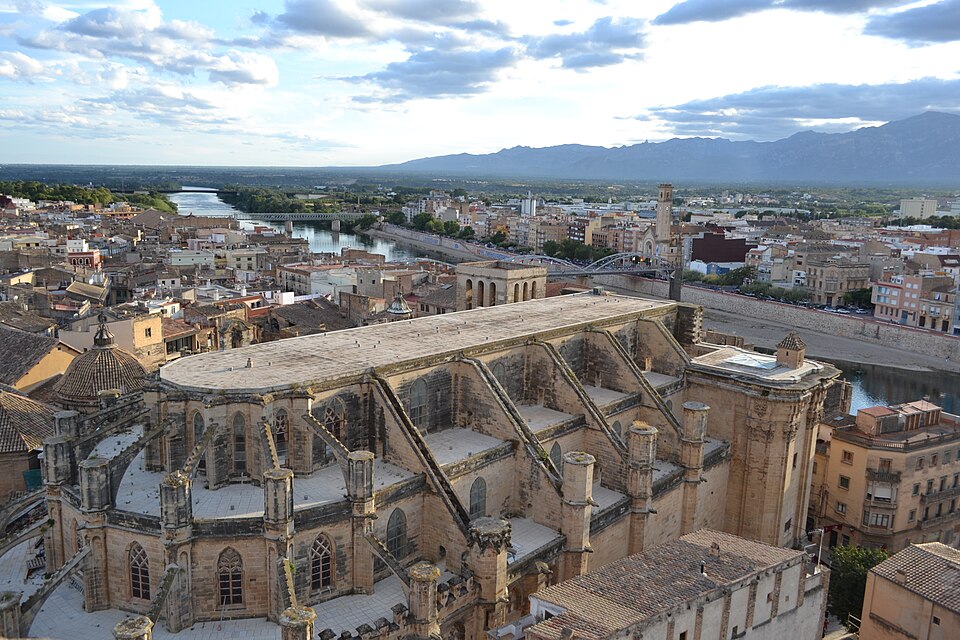
The cathedral stands roughly where the Roman forum was, and on the site of the city’s main mosque, which the bishop received after Ramon Berenguer IV took Tortosa in 1148. A Romanesque cathedral followed, consecrated in 1178; the present Gothic building replaced it from 1347. Building went on for centuries, which is why the style shifts as you walk from the apse to the Baroque west front.
Inside there are three naves with side chapels between the buttresses. The highlight is the apse: a double ambulatory, the only one of its kind in Catalonia, with radial chapels and three levels of stained glass. Look for:
- The main altarpiece, with 14th-century paintings, and the choir stalls by Cristóbal de Salamanca (spain.info).
- The 15th-century baptismal font, which came from the papal castle at Peníscola and carries the arms of Pope Benedict XIII. It was a garden fountain before it became a font.
- The chapel of the Mare de Déu de la Cinta, built between 1672 and 1725 for Tortosa’s patron, with Italian marble, local jasper and painted frescoes begun in 1718.
- The 13th-century cloister on the south side, with medieval tombstones, six sundials and a trilingual stone (Latin, Hebrew and Greek) recalling the city’s Jews.
- Under the cloister, a large air-raid shelter built in 1937–38, much of which can be visited, and a permanent exhibition opened in 2007.
The façade looks unfinished: the 17th-century plan stalled for lack of money, poor foundations and because the army would not let it rise into the castle’s line of fire.
Castell de la Suda
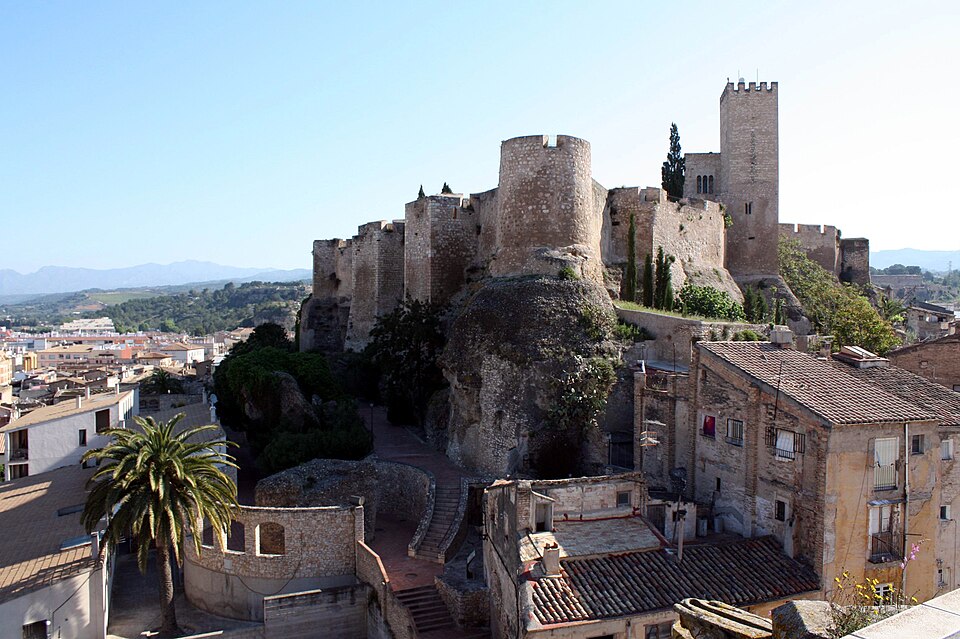
The castle guarded the crossing of the Roman Via Augusta and the Ebro, and was the seat of a Muslim taifa kingdom. Founded in 944, it keeps its Arab perimeter walls, which follow the shape of the hill, with square towers and the round Túbal (or Diamant) tower on a rocky spur facing the city. Most of the buildings inside, the arsenal, bailey, underground galleries, silos and central well, date from 14th-century Gothic works, when it served as a royal palace. The castle was the start of the medieval city walls; the 14th-century Remolins gateway still stands below (spain.info). Today it is a Parador hotel, so you can sleep inside the walls.
Practical details
- Cathedral hours and tickets: we could not check them. The tourist office lists a visit to “the cathedral and the permanent exhibition”, but its website and the diocese website were not reachable when we checked. Ask the tourist office on +34 977 446 110.
- Castle: it is a working Parador hotel. We could not confirm which parts are open to non-guests or when.
- Tourist office: the Oficina de Turisme de Catalunya a les Terres de l’Ebre is at Rambla Felip Pedrell 3, in the old slaughterhouse; tel. 977 44 96 48. It also acts as Tortosa’s tourist office (Generalitat).
- Next door: the 14th-century Episcopal Palace, with a chapel from 1316.
Accessibility and safety
The cathedral is at river level in the old town, but expect steps at doors, in the cloister and in the shelter beneath it; we could not confirm step-free access. The climb from the cathedral to the castle is short but steep, and the castle sits on a rocky hill with walls and drops. The old town has narrow streets with some traffic; keep children close.
Best time to visit
Any time of year: both sights are good on a wet or windy beach day. Go in the morning so you can see the cathedral and then climb to the castle for the light over the Ebro. Tortosa’s summer Renaissance Festival fills the old town with period costume; see the Tortosa town guide. Combine the visit with an afternoon in Els Ports or on the Via Verda.
Nearby alternatives
- Tortosa town guide: the market, the old Jewish quarter, river trips and where to eat.
- Els Ports Natural Park: the mountains west of the city; the Caro viewpoint is 15 km away.
- Via Verda greenway: the old railway line that starts at Tortosa and heads up to the Terra Alta.
- Miravet Castle, 25 km upstream: the Templar castle above the Ebro.
- Ebro Delta, 20 km away, and the delta towns of Amposta and Deltebre. Our Ebro Delta coast guide covers the whole area.
Distances are in a straight line from the cathedral.
FAQ
How far is Tortosa Cathedral from La Ràpita?
About 23 km in a straight line, inland up the Ebro. Tortosa can also be reached by train and bus.
Can you visit the Castell de la Suda?
The castle is now the Parador de Tortosa hotel, so you can stay there. We could not confirm opening times for non-guests; ask the tourist office.
How old is Tortosa Cathedral?
The present Gothic building was begun on 21 May 1347, on the site of a Romanesque cathedral and before that a mosque. The main altar was consecrated in 1441 and the façade finished in 1757.
What is special about Tortosa Cathedral?
Its double ambulatory around the apse, the only one in Catalonia, the 14th-century main altarpiece, a font from the papal castle at Peníscola, and the Baroque chapel of the Virgin of the Cinta.
How far apart are the cathedral and the castle?
About 200 m, a short, steep walk up the hill.
Sources and freshness
Checked 10 November 2026 · 6 sources Show
Checked 10 November 2026. Official: spain.info (Turespaña) on Tortosa Cathedral, the Castle of Sant Joan or La Suda and Tortosa; Generalitat de Catalunya, tourist office details. The Tortosa tourism, city council and diocese websites could not be checked when we checked, so hours and prices are not given. Background: Catalan Wikipedia, Catedral de Tortosa (dates, ambulatory, font, cloister, shelter, façade). Location and distances: OpenStreetMap contributors (ODbL). Photos: Wikimedia Commons, licences as credited.
This place is part of our Costa Dorada map and travel guide: Roman Tarragona, Salou and the Ebro Delta — see every town, beach and cove we have mapped on that coast.
How this page is made. CostaMap is written with an AI editorial system run by Ebizapple. This page is based on the sources listed above. Last updated 10 November 2026. Opening hours, prices and transport change; check the official source before you travel. How we work · Partner links and ads