
Tui is a walled cathedral town on the River Miño, on the Portuguese border about 22 km south-east of Vigo, where its old town climbs a hill crowned by the fortress-like Cathedral of Santa María. It is the start of the Spanish stretch of the Portuguese Way to Santiago, and an iron bridge of 1886 links it with Valença in Portugal. You reach it on the A-55 motorway from Vigo, and you explore it on foot. It suits history and architecture lovers, Camino walkers and anyone driving between Galicia and Porto; skip it if you are looking for a beach, because Tui is a river town and the nearest long sandy beach is about 17 km away.
Quick facts
- Names: Tui in Galician (the official name); often written Tuy in Castilian. The cathedral is the Catedral de Santa María de Tui.
- Where: province of Pontevedra, on the north bank of the Miño opposite Valença (Portugal), in the Baixo Miño district.
- Coordinates: 42.0459, -8.6444 (the cathedral).
- Status: declared a Historic-Artistic Site (spain.info); the cathedral is a Site of Cultural Interest (BIC).
- History: an episcopal city and capital of one of the seven former provinces of the old Kingdom of Galicia; important in the Suebi and Visigothic periods (Turismo Rías Baixas).
- Camino: the Portuguese Way starts its Galician section in Tui: 118.8 km to Santiago in 7 recommended stages (Turismo Rías Baixas).
- Tourist office: Paseo Calvo Sotelo 16, phone +34 677 418 405 (Turismo Rías Baixas).
Access and parking
By car: the A-55 links Vigo with Tui and the Portuguese border at Valença, and continues to Porto as the Portuguese A3 (Turismo Rías Baixas). The old town is steep and narrow, so park below it. OpenStreetMap shows free, unpaved car parks by the river walk east of the old town and north-west of the centre, and several reserved spaces for disabled drivers around the main square.
By train: the tourist board lists the Guillarei halt about 4 km from the cathedral as the nearest station. Check Renfe for which trains stop there.
From Portugal: the old iron International Bridge carries road and rail across the Miño from Valença; the modern motorway bridge has taken over the through traffic (spain.info).
On foot: the centre is compact. From the main square by the bandstand it is a few minutes’ walk up to the cathedral, and lanes lead down from there to the river.
What to see
The cathedral
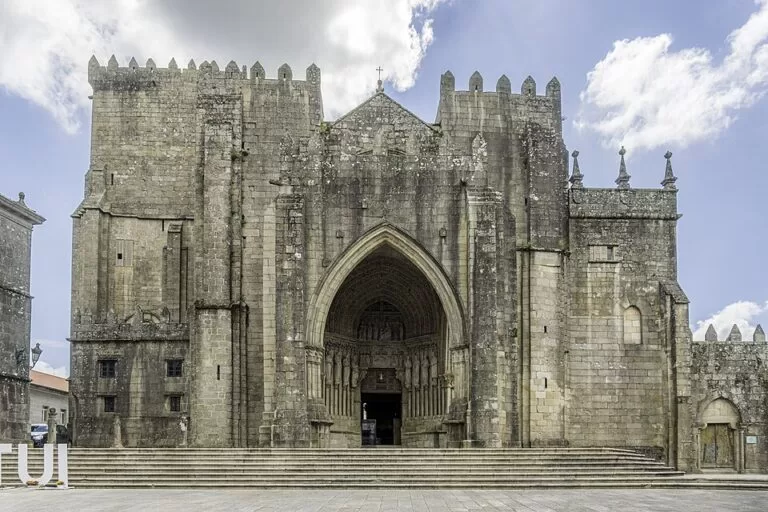
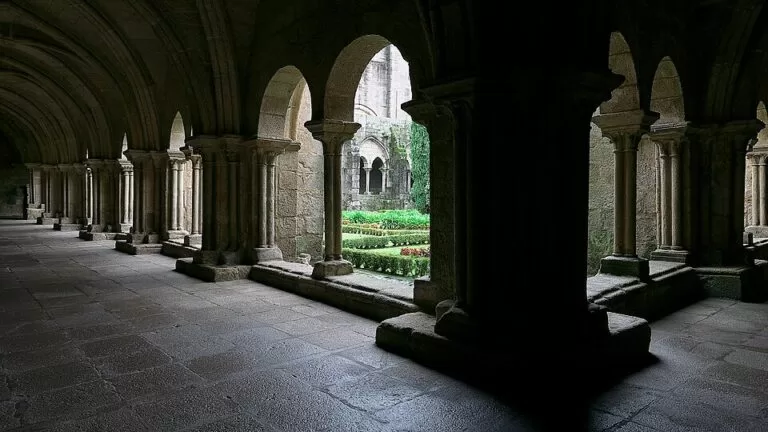
The tourist board calls the cathedral the best example of Tui’s artistic wealth. Building began in 1120 and it was consecrated in 1225 under Alfonso IX; its layout, outer walls, north entrance and carved capitals are Romanesque, and from outside it looks like a fortress (Turismo Rías Baixas). It was the first cathedral in the Iberian Peninsula with a Gothic façade, whose tympanum shows scenes of the birth of Christ. Inside, look for the altarpiece, the reliquary altar of the Relic Chapel, the Romanesque chapter house of the 12th century and the cloister, the only Gothic cloister of any Galician cathedral. The views from the Soutomaior Tower are a highlight, and the Cathedral Museum is in the chapel of Santa Catalina (Turismo Rías Baixas).
The old town
From the cathedral a maze of medieval streets runs down to the Miño, with narrow arcaded lanes around the cathedral. The tourist board points to the Encerradas Convent of the 17th and 18th centuries, the Gothic church of Santo Domingo with Baroque altarpieces, the San Francisco Convent on the site of the old bishops’ palace, and remains of the 12th-century town wall (Turismo Rías Baixas). OpenStreetMap maps two old gates, the Porta do Arco and the Porta dos Ferreiros, and the Diocesan Museum in the former Hospital for Pilgrims and the Poor beside the cathedral. The tourist board lists guided tours in four languages, English included.
The Chapel of San Telmo is the only example of Portuguese Baroque in Galicia. It was built over the house where the Dominican Saint Telmo died in the 13th century, begun in 1769 and finished in 1803, with a circular plan, a notable vault and early 19th-century frescoes (Turismo Rías Baixas).
The International Bridge
The iron bridge over the Miño links Tui and Valença by road and rail. Legend credits an apprentice of Eiffel, but it was designed by the engineer Pelayo Mancebo and inaugurated in 1886. It is a 399 m lattice-girder bridge on stone piers (Turismo Rías Baixas), and it remains one of the best-known images of Tui (spain.info).
Monte Aloia
Above the town, Monte Aloia rises to almost 631 m. Declared a natural park in 1978, it was the first in Galicia and covers 746 ha, with a Gallaecian-Roman walled enclosure, the chapel of San Xián rebuilt in 1713 on a Romanesque temple, an interpretation centre in the Casa Forestal, hiking trails and viewpoints (Turismo Rías Baixas). Spain.info says it looks over the Ría de Vigo and the Louro valley.
Practical details
- Cathedral hours: the tourist board lists Monday to Saturday 10:45–14:00 and 16:00–19:00, Sunday 9:00–12:30 and 16:00–19:00 (checked November 2026). We could not reach the cathedral’s own website to confirm hours or the ticket price for the cloister, tower and museum.
- Fiestas: the feast of San Telmo fills the old and new town on the first weekend after Easter Sunday, with a folklore festival, the San Telmo procession, a horse fair and theatre (Turismo Rías Baixas).
- Camino: Tui sights on the Portuguese Way include the cathedral, the church of San Domingos, the 12th-century church of San Bartolomé de Rebordáns and the medieval bridge of San Telmo, also called Ponte das Febres (Turismo Rías Baixas).
Accessibility and safety
The old town is on a steep hill, with cobbles, steps and narrow lanes; the cathedral sits at the top. OpenStreetMap shows reserved parking spaces and step-free access to the tourist office, but we could not confirm step-free routes into the cathedral, cloister or tower. The tower climb involves stairs.
Best time to visit
Tui works all year because its sights are indoors or in the streets. Spring brings the San Telmo fiesta after Easter. Visit the cathedral in the morning opening and walk the river in the evening. Check the cathedral’s hours on holidays.
Nearby alternatives
- Praia América (Nigrán), 17 km north-west: the nearest long sandy beach, on the bay of Baiona.
- Baiona, 19 km west: the Monterreal fortress and the La Pinta replica.
- Samil Beach (Vigo), 22 km north-west: Vigo’s longest city beach.
- Vigo Old Town and Monte do Castro, 23 km north-west: the city’s old quarter and its hill-top fort.
- Monte Santa Trega (A Guarda), 25 km south-west: the Iron Age hillfort above the mouth of the Miño.
Distances are in a straight line from the cathedral.
FAQ
Is Tui worth visiting?
Yes, for its cathedral, the only Galician cathedral with a Gothic cloister, and one of the best-preserved historic towns in Galicia, according to the tourist board. Allow at least half a day.
How do I get from Vigo to Tui?
By car on the A-55, about 22 km in a straight line, or by train to the Guillarei halt about 4 km from the centre.
Is Tui on the border with Portugal?
Yes. Tui faces Valença across the Miño, and the 1886 International Bridge links the two towns by road and rail.
Where does the Portuguese Camino start in Spain?
In Tui. From here the Portuguese Way runs 118.8 km to Santiago de Compostela, in seven recommended stages of about 17 km.
What are the opening hours of Tui Cathedral?
The tourist board lists Monday to Saturday 10:45–14:00 and 16:00–19:00 and Sunday 9:00–12:30 and 16:00–19:00 (checked November 2026). Confirm before you go.
Sources and freshness
Checked 9 November 2026 · 12 sources Show
Checked 9 November 2026. Official: Turismo Rías Baixas pages on the cathedral (also the Spanish page), the historic town, the International Bridge, the Chapel of San Telmo, the San Telmo fiesta, Monte Aloia, the Portuguese Way, the tourist office and how to get there; spain.info, Tui. Car parks, gates, museum and distances: OpenStreetMap contributors (ODbL). The cathedral and town hall websites could not be reached. Photos: Wikimedia Commons, licences as credited.
How this page is made. CostaMap is written with an AI editorial system run by Ebizapple. This page is based on the sources listed above. Last updated 9 November 2026. Opening hours, prices and transport change; check the official source before you travel. How we work · Partner links and ads