
Costa del Maresme · Mid Maresme
Sant Pol de Mar to Caldes d’Estrac travel guide: the middle Maresme coast
The white fishing village of Sant Pol, Modernisme in Canet de Mar, the fishing port of Arenys de Mar and the thermal baths of Caldes d’Estrac, all on one railway line north of Barcelona.
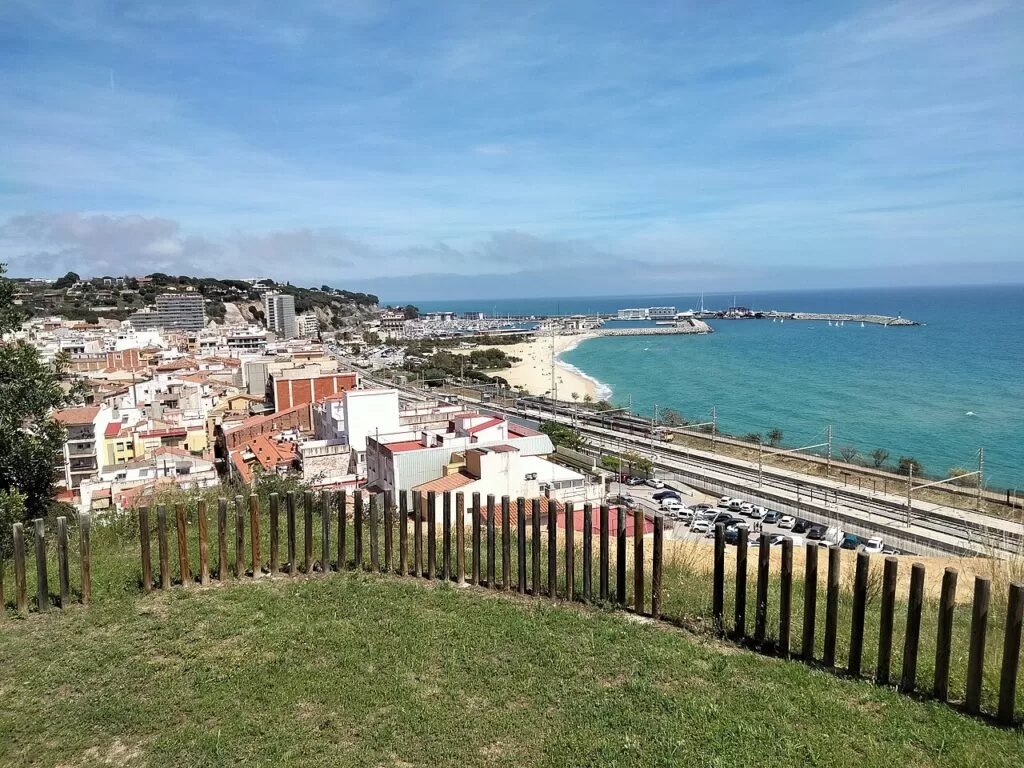
Arenys de Mar and its port from the Camí de la Pietat · Photo: Enric, CC BY-SA 4.0
Part of the Costa del Maresme guide · Middle: Sant Pol de Mar to Caldes d’Estrac
The middle Maresme is the stretch of coast north-east of Barcelona between Sant Pol de Mar and Caldes d’Estrac, with Canet de Mar and Arenys de Mar in between: about 9 km of beaches along the railway, with the hills of the Montnegre behind. It is a coast of smaller towns rather than big resorts, known for Modernista houses, a working fishing port, hot springs and food, and every coast town has a Rodalies R1 station. This guide covers each town and the inland villages behind them, the beaches, what to do, where to base yourself, getting there and a two-day route.
At a glance
- Where the middle of the Maresme comarca in Barcelona province, from Sant Pol de Mar, next to Calella, to Caldes d’Estrac, next to Sant Vicenç de Montalt.
- Towns Sant Pol de Mar, Canet de Mar, Arenys de Mar and Caldes d’Estrac; inland Sant Cebrià de Vallalta, Sant Iscle de Vallalta and Arenys de Munt.
- Best for car-free beach trips from Barcelona, Modernisme, a fishing port and fish auction, thermal baths, Picasso in Caldes and walks in the Montnegre.
- Getting there the Rodalies R1 from Barcelona stops in all four coast towns; Barcelona Airport is about 48–56 km away in a straight line.
- On CostaMap guides to Sant Pol de Mar, Canet de Mar, Arenys de Mar and Caldes d’Estrac, the Domènech i Montaner House-Museum, the Castle of Santa Florentina and a campsite.
Map of the middle Maresme
The places between Sant Pol de Mar and Caldes d’Estrac that have a CostaMap page. Click a marker to see the place in the panel.
Place type
Area · next level
 Area map
Sant Pol de Mar to Caldes d’Estrac
Click a marker to see the place here. The middle Maresme: Sant Pol, Canet de Mar, Arenys de Mar and Caldes d’Estrac.
Towns and villagesTowns and villages
From north-east to south-west, starting at the Calella end. Descriptions are from catalunya.com, the official tourism site of Catalonia, unless another source is named. The three inland villages are reached from the coast towns below them.
Sant Pol de Mar
An old fishing village of white houses, narrow quiet streets, rocky coves and sandy beaches, with about 5,200 inhabitants. The Ermita de Sant Pau, a Benedictine monastery at least since 955, stands on the headland above the station and gives the best view of the coast towards Barcelona. In the village are the late-Gothic church of Sant Jaume and the Museu de Pintura, with works by Ramon Casas and Joan Miró (catalunya.com). In August the Firamar fair recalls its seafaring life. See our new Sant Pol de Mar guide.
Sant Cebrià de Vallalta
Inland from Sant Pol, at the foot of the Montnegre massif, among pine and oak woods. Sant Cebrià is known for strawberries and mushrooms, and keeps scattered farmhouses that make it, in catalunya.com’s words, “an agricultural reserve by the sea”. Sant Pol was its maritime quarter until 1599. Walk the path of the Coll de Can Benet up to the Turó Gros for a view over the coast. The Strawberry Festival in spring and a mushroom and chestnut fair in September are the main dates (catalunya.com). A town bus links it with Sant Pol.
Sant Iscle de Vallalta
A small village of about 1,400 people further up the Vallalta valley, between the Montnegre and the Corredor. Its best-known spot is Dones d’Aigua, a place on the stream where, according to legend, water nymphs live, and which is also an entrance to the Montnegre i el Corredor Natural Park for walks and mountain-bike routes. The stream has natural pools for bathing in summer (catalunya.com). Buses run to Sant Pol and Calella.
Canet de Mar
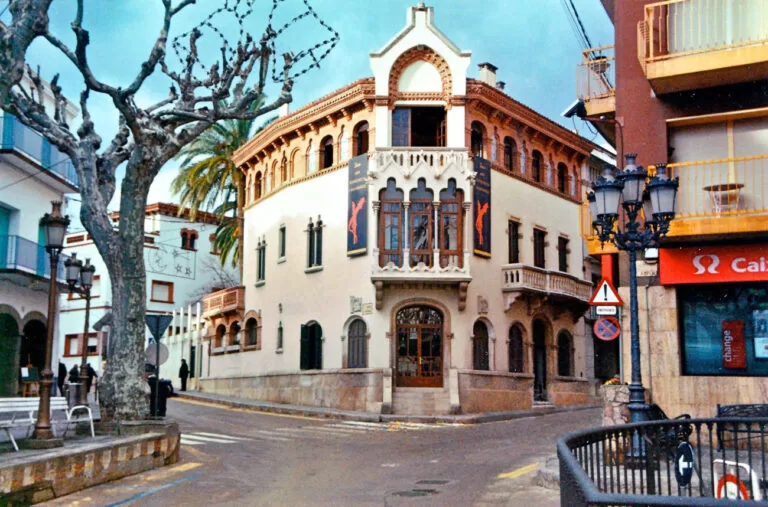
Canet’s calling card is Modernisme. Lluís Domènech i Montaner, architect of the Palau de la Música, spent long periods here: his house is now the Lluís Domènech i Montaner House-Museum, which also serves as the tourist office and runs a Modernista route with seven guided itineraries. On the Pedracastell hill above the town he rebuilt the Castle of Santa Florentina. Other stops are the 16th-century church of Sant Pere, whose bell tower is nicknamed the Pubilla de la Costa, and the Neo-Gothic Santuari de la Misericòrdia. Canet has about 14,200 people and, catalunya.com notes, 14 hotels with 900 beds and four campsites (catalunya.com). See our Canet de Mar guide.
Arenys de Munt
The inland twin of Arenys de Mar, about 3.4 km up the Sobirans valley, from which the sea town split off. Its riera is one of the few urban sandy stream beds still kept, lined with plane trees and the heart of village life. The 16th-century church of Sant Martí keeps an altarpiece by the Renaissance poet and painter Pere Serafí,, and a sapling of the Gernika tree grows at the Can Jalpí castle-house. It is known for bobbin lace and d’en Roca cherries (catalunya.com). Town buses connect it with the train at Arenys de Mar.
Arenys de Mar
The largest town of the stretch, with about 15,000 people and the port of most of the Maresme’s fishing fleet, which also holds a marina. From Monday to Friday at four in the afternoon the fishermen’s guild holds the fish auction at its fish market (catalunya.com). The parish church of Santa Maria has one of the best-preserved Baroque altarpieces in Catalonia, by Pau Costa; the Museu Marès de la Punta shows bobbin lace. On a hill above the town, the cemetery opened in 1868 has Modernista tombs with sculpture by Josep Llimona and Venanci Vallmitjana; the poet Salvador Espriu, who called the town Sinera, is buried there (catalunya.com). The Can Titus baths have used mineral-medicinal water for more than two hundred years (catalunya.com). See our Arenys de Mar guide.
Caldes d’Estrac
Caldetes, as everyone calls it, is the smallest town of the stretch, about 1 km² with some 3,100 people, and it exists because of its hot springs: the Romans named it Aquae Calidae. Its spa in the centre is the only publicly owned one in Catalonia. From the late 18th century it was one of the most fashionable summer resorts of the Catalan upper class, and the mansions of that time still line the Passeig dels Anglesos. The Fundació Palau holds about seventy works by Picasso collected by the poet Josep Palau i Fabre (catalunya.com). See our new Caldes d’Estrac guide.
South-west of Caldes the coast continues into Sant Vicenç de Montalt and Sant Andreu de Llavaneres, covered in the Mataró to El Masnou guide.
Beaches and coves
Mostly long beaches of golden sand beside the railway, with small rocky coves around Sant Pol. Lengths are from the spain.info (Turespaña) beach sheets.
Sant Pol’s eight beaches
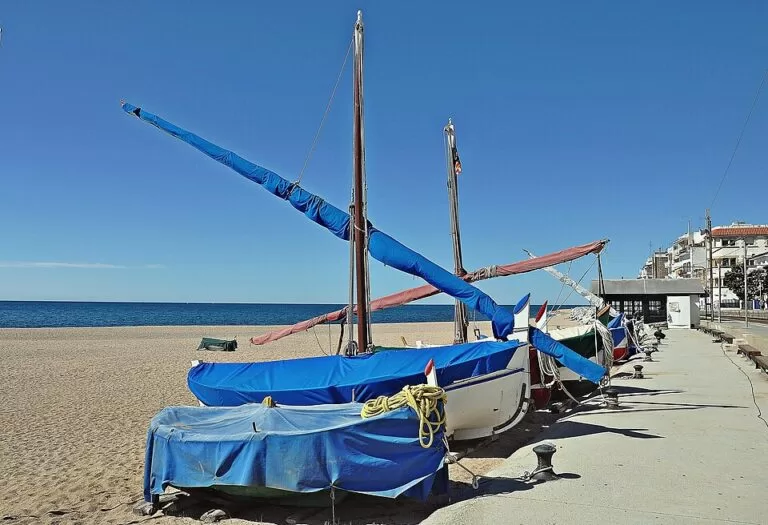
Catalunya.com lists eight, from the village beaches of Les Escaletes (225 m) and Les Barques to Can Villar (788 m, lifeguards), La Murtra (1,258 m, isolated) and Les Roques Blanques (419 m). La Platjola is the one with step-free access (spain.info).
See the Sant Pol de Mar guide →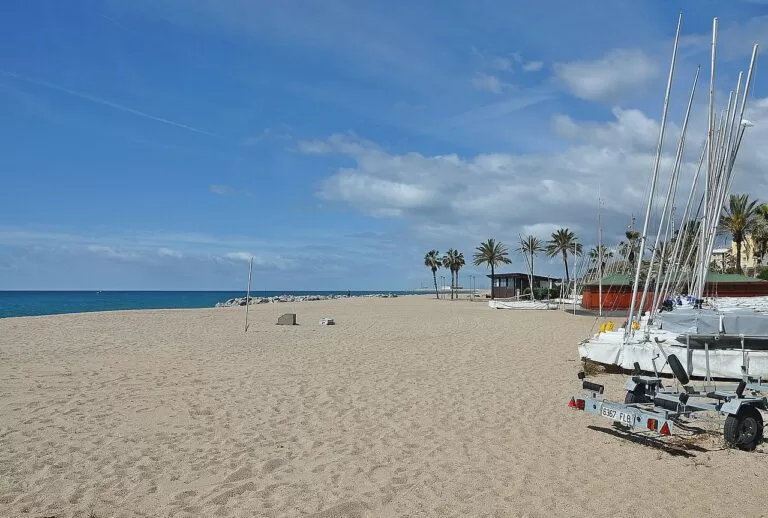
Canet de Mar
More than 2 km of coast, partly low and sandy, below the seafront promenade; catalunya.com describes extensive golden sandy beaches. Platja de Canet and El Cavaió run towards Arenys (OpenStreetMap).
See the Canet de Mar guide →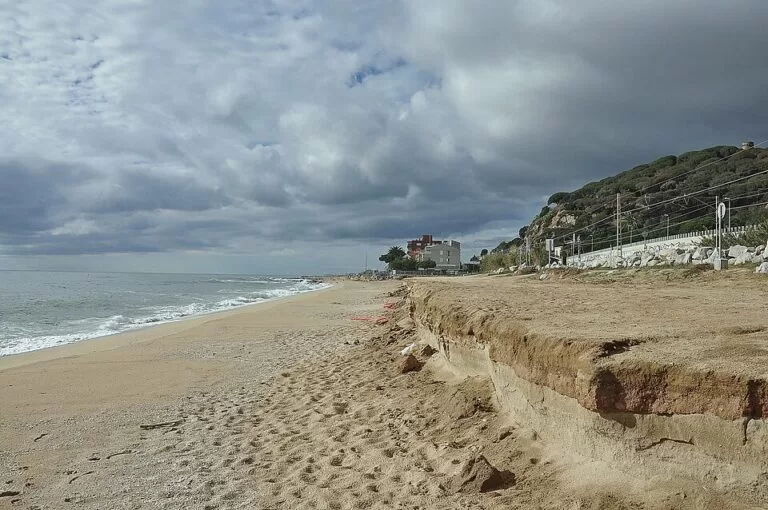
La Musclera and La Picòrdia
South of the port, La Picòrdia (500 m) is quiet, and La Musclera (620 m, rock and sand, with hire and a sports area) is popular with young people (spain.info). Catalunya.com suggests the coastal path from the port to La Musclera.
See the Arenys de Mar guide →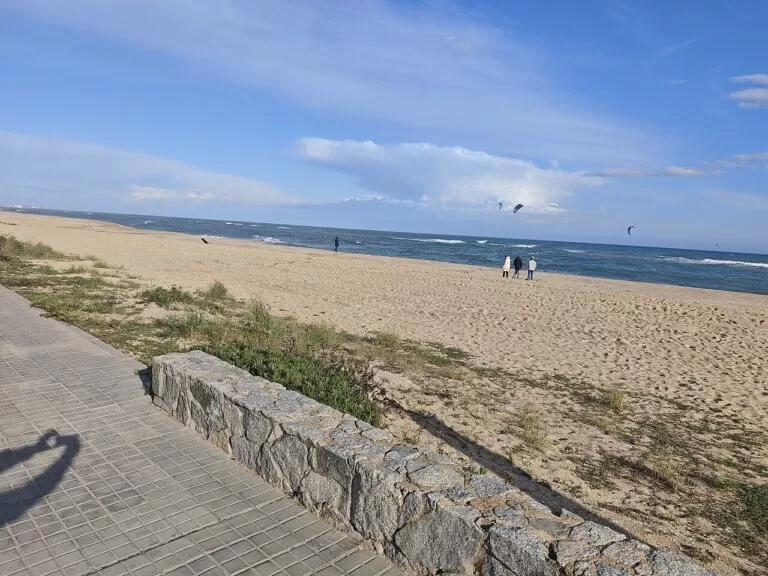
Els Tres Micos
600 m by 40 m of rock and golden sand in front of a wooded estate, well equipped, with hire, showers, a sports area and a children’s area (spain.info). Les Barques, Els Nàufrags and El Bassiot lie nearer the centre (OpenStreetMap).
See the Caldes d’Estrac guide →Things to do
Modernisme and the indianos
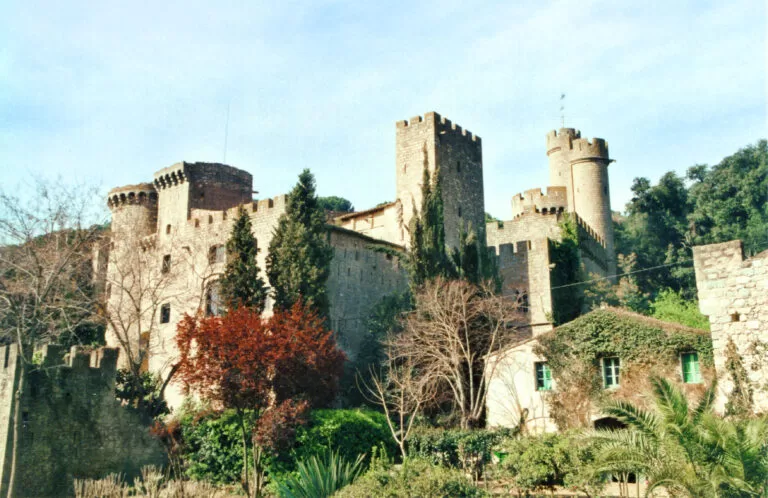
Canet is the centre: the Domènech i Montaner House-Museum combines the 16th-century Rocosa manor and the Domènech house of 1908–1910, opened as a museum in 1998 (catalunya.com). The Castle of Santa Florentina, documented in 1217 and rebuilt by Domènech i Montaner from 1900, opens on the first and third Saturday of each month and holds a classical music festival in summer (catalunya.com). Canet holds a Modernista fair in September. Many grand houses here were built by indianos, emigrants who came back rich from America after 1778 (catalunya.com).
The sea: fish auction, boats and baths
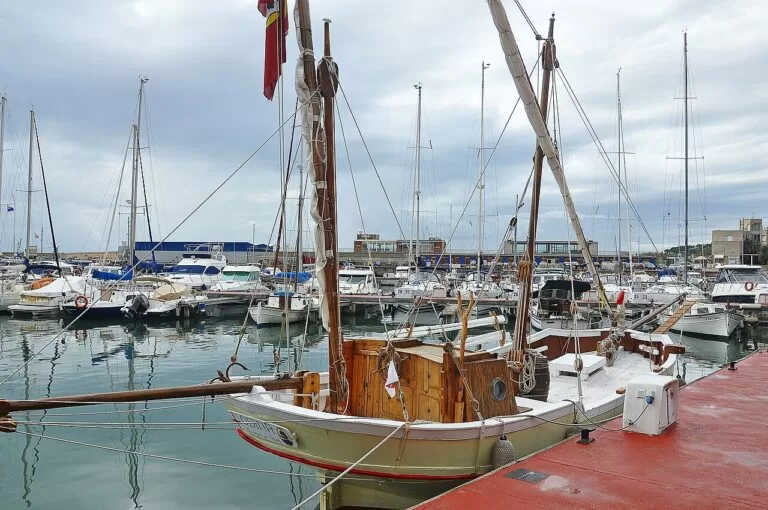
At Arenys de Mar, watch the boats come in followed by gulls and the auction in the fish market on weekday afternoons. In Sant Pol, the summer guided walk “The Fishermen’s Sant Pol” passes the fishermen’s house and the boats on Les Barques beach (catalunya.com). Caldes d’Estrac and Arenys de Mar both have thermal waters, known since Roman times in Caldes (catalunya.com).
Nature: the Montnegre behind the coast
Behind the towns rise the hills of the Montnegre i el Corredor Natural Park. Walk up from Sant Cebrià to the Turó Gros, from Sant Iscle to the Dones d’Aigua stream, or from Arenys de Munt along the Lourdes path. The GR 5, the Sender dels Miradors, makes a wide arc around Barcelona through five natural parks from Sitges and ends at Canet de Mar (catalunya.com). In Caldes, the Parc Muntanyà is a landscaped wood with guided visits.
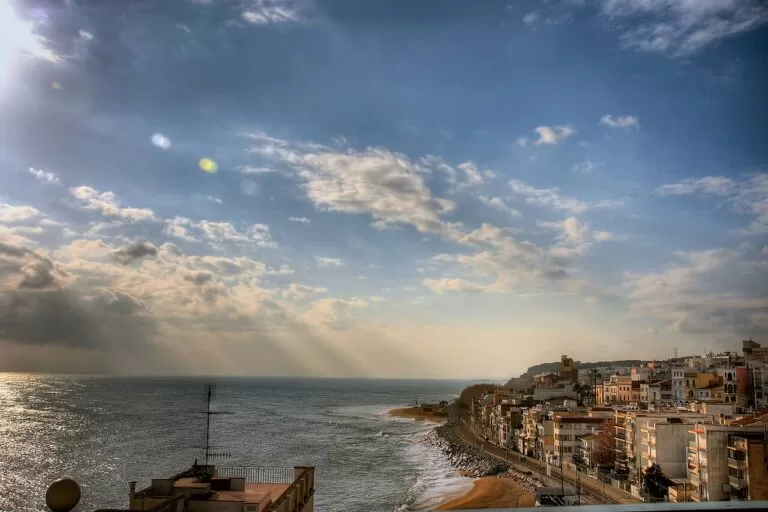
Food through the year
Strawberries in spring, with Canet’s Diada de la Maduixa from 27 April to 27 May; peas at Caldes’ Pesolada until the end of April; cherries at the Arenys de Munt fair; mongetes del ganxet beans in Caldes after All Saints; and fish from the Arenys market all year. Sant Pol holds a gastronomic exhibition in June.
Where to stay by town
All four coast towns have a station on the R1 line, so you can base yourself in one and reach the others by train.
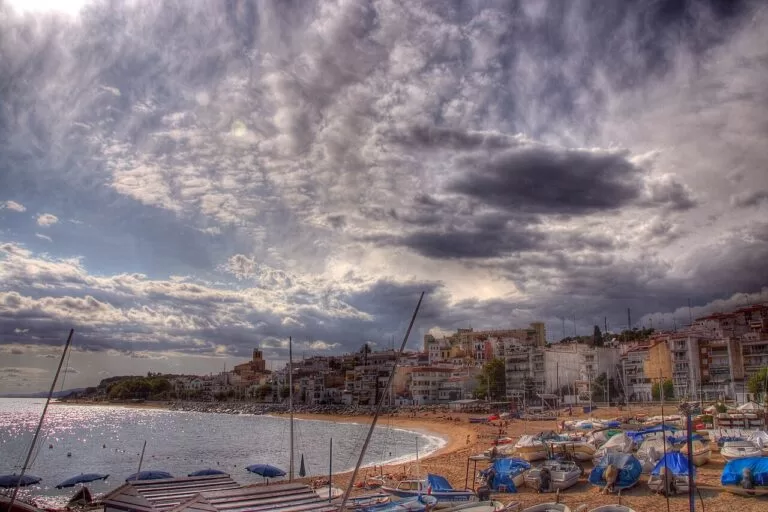
Sant Pol de Mar
The prettiest village of the stretch, with the station on the seafront and beaches on both sides. Catalunya.com mentions ample hotel rooms and holiday estates. Best for a quiet weekend and food.
Couples and food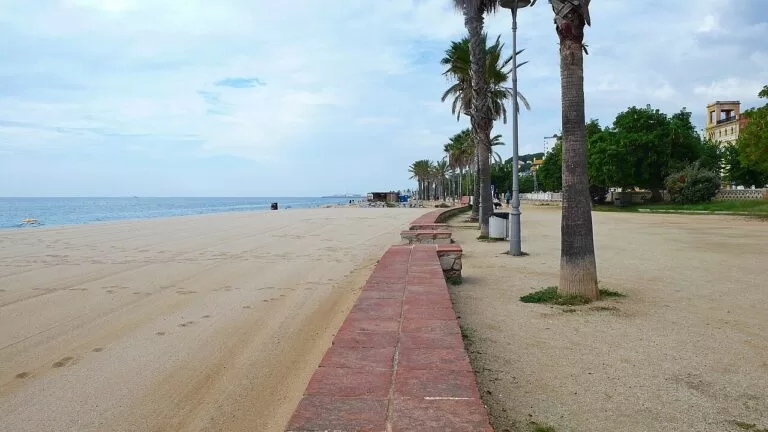
Canet de Mar
The most beds: 14 hotels with 900 beds and four campsites, among them Camping Globo Barcelona on the coast towards Sant Pol. Best for families and Modernisme.
Families and campers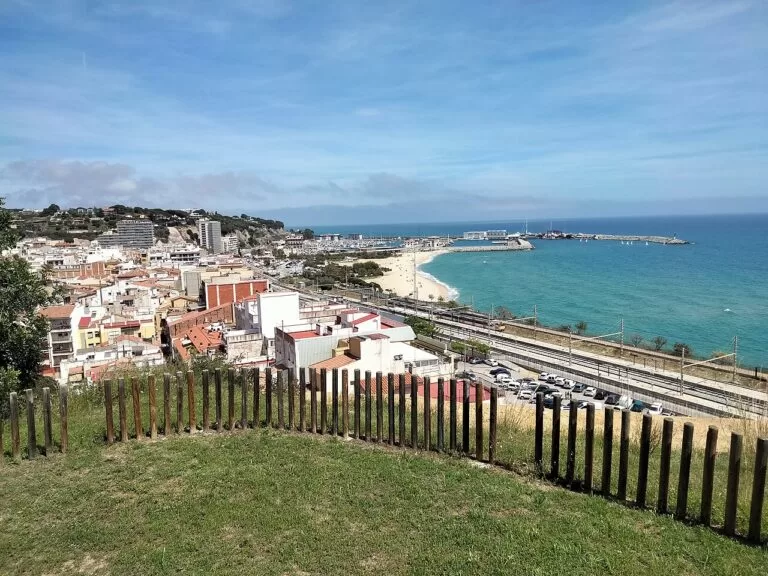
Arenys de Mar
A working town with the port, the market, a Saturday market and summer nightlife. Best if you want shops, restaurants and the sea all year round.
Town life and seafood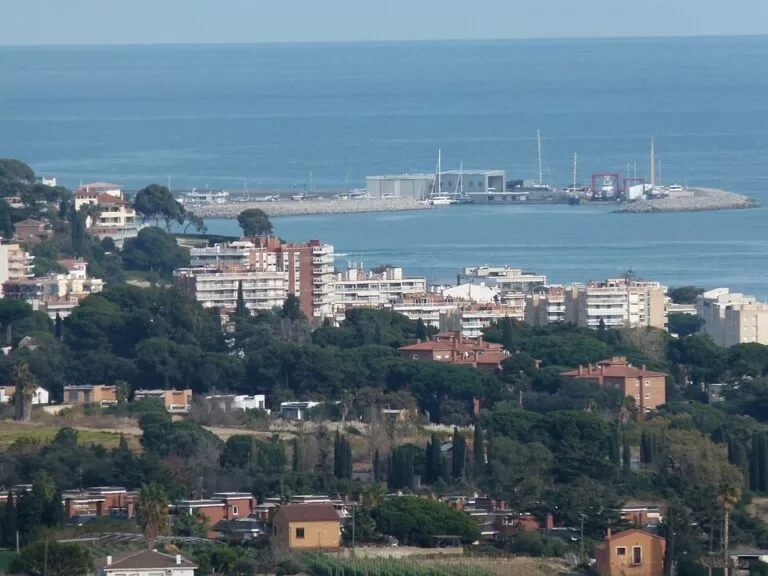
Caldes d’Estrac
A small, walkable spa village with a few hotels, among them one with thalassotherapy, and the shortest train ride to Barcelona of the four. Best for rest and the baths.
Spa and restGetting there and around
By train
The Rodalies R1 runs along the shore from Barcelona to Blanes, with stations at Caldes d’Estrac, Arenys de Mar, Canet de Mar and Sant Pol de Mar (catalunya.com; OpenStreetMap). Catalunya.com describes Arenys as about 30 minutes from Barcelona. The line reached Sant Pol in 1859.
By air
Barcelona Airport is about 48 km from Caldes and 56 km from Sant Pol, and Girona-Costa Brava Airport about 35 km from Sant Pol, in a straight line (OpenStreetMap). Road distances are longer.
By car
The N-II coast road links all four coast towns and gives access to every beach (spain.info). Parking near the beaches fills up in summer; the train is easier.
By bus and bike
Town buses link Sant Pol with Sant Cebrià, Sant Iscle with Sant Pol and Calella, and Arenys de Mar with Arenys de Munt. Cycle lanes join Caldes, Arenys and Sant Vicenç de Montalt (catalunya.com).
A two-day route
By train or car, south-west to north-east, with a night in Canet de Mar or Sant Pol.
Day 1
Caldes d’Estrac and Arenys de Mar
Start in Caldes with the Picasso rooms of the Fundació Palau, the Passeig dels Anglesos and the thermal baths (check opening times first). Take the train one stop to Arenys de Mar, walk up to the cemetery for the view, and be at the fish market by four o’clock on a weekday for the auction.
Day 2
Canet de Mar and Sant Pol de Mar
Visit the Domènech i Montaner House-Museum in Canet and follow part of the Modernista route; on the first or third Saturday of the month add the Castle of Santa Florentina. In the afternoon go on to Sant Pol: climb to the Sant Pau hermitage, see the Museu de Pintura and end on one of the small beaches such as La Platjola or Les Escaletes.
FAQ
Which towns are on the middle Maresme coast?
From north-east to south-west: Sant Pol de Mar, Canet de Mar, Arenys de Mar and Caldes d’Estrac, with the inland villages of Sant Cebrià de Vallalta, Sant Iscle de Vallalta and Arenys de Munt behind them.
Can you visit Sant Pol, Canet, Arenys and Caldes by train from Barcelona?
Yes. All four have stations on the Rodalies R1 towards Blanes, 2–4 km apart, so you can hop between them in a day.
When is the fish auction in Arenys de Mar?
Monday to Friday from four in the afternoon at the fish market of the fishermen’s guild, according to catalunya.com.
Can you visit the Castle of Santa Florentina?
Yes, on the first and third Saturday of every month, according to catalunya.com; in summer it hosts a classical music festival.
Where are the thermal baths on the Maresme?
In Caldes d’Estrac, whose spa is the only publicly owned one in Catalonia, and in Arenys de Mar at the Can Titus baths.
Other areas of the Costa del Maresme
Costa del Maresme
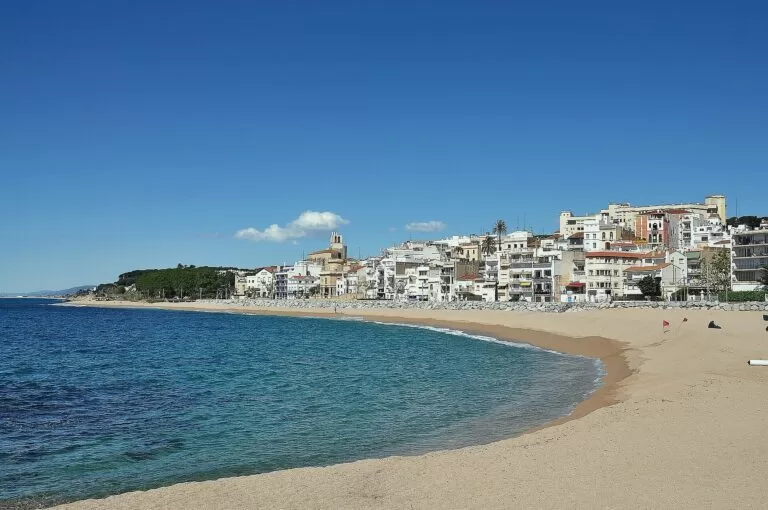
The whole Maresme from Malgrat de Mar to El Masnou, with the map, the three areas and the inland day trips.
Costa del Maresme guide →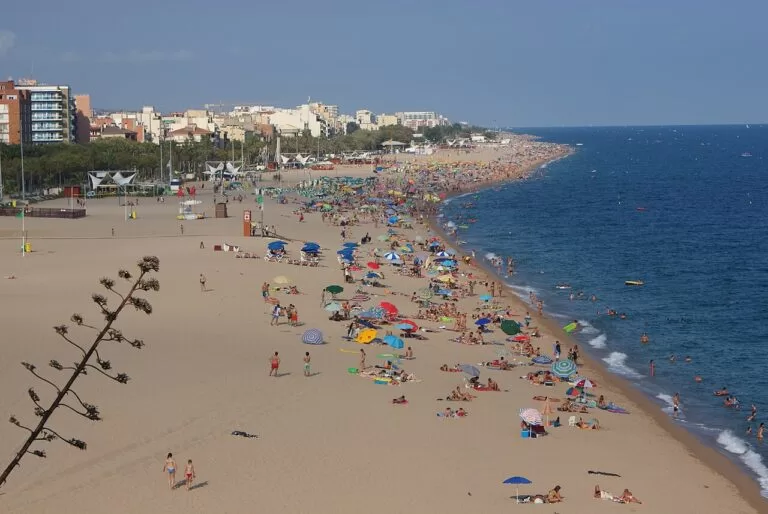
Malgrat de Mar to Calella
The resort beaches between the Tordera and Calella: Malgrat, Santa Susanna, Pineda de Mar and Calella with its lighthouse, 2 km from Sant Pol.
Malgrat, Pineda and Calella guide →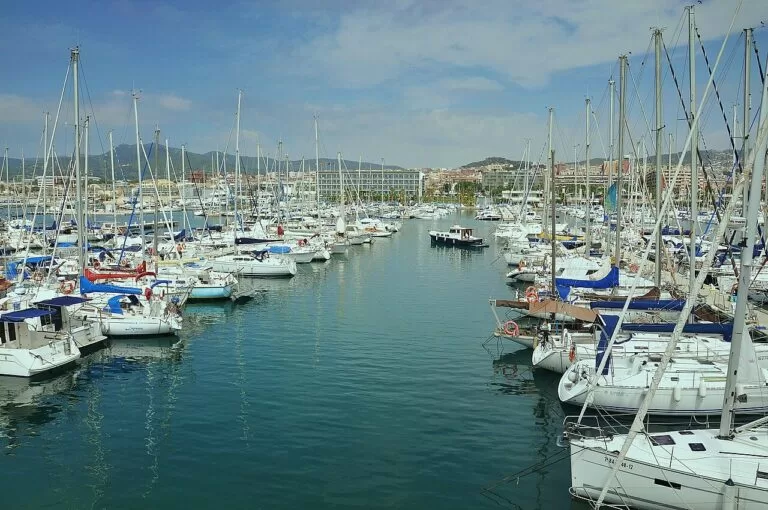
Mataró to El Masnou
Mataró, the capital of the comarca, then the marinas and the DO Alella vineyards on the way down to Barcelona, 8 km from Caldes.
Mataró to El Masnou guide →Sources and freshness
Checked 9 November 2026. Catalunya.com (Agència Catalana de Turisme) on the Maresme and the towns of Sant Pol de Mar, Sant Cebrià de Vallalta, Sant Iscle de Vallalta, Canet de Mar, Arenys de Munt, Arenys de Mar and Caldes d’Estrac; on the Domènech i Montaner House-Museum, Santa Florentina Castle, Arenys de Mar cemetery, the Fundació Palau, the Arenys fish auction, the Fishermen’s Sant Pol walk and the GR 5. Spain.info (Turespaña) beach sheets for Les Escaletes, La Platjola, Can Villar, La Murtra, Les Roques Blanques, La Picòrdia, La Musclera and Els Tres Micos. Map data, stations, beach names and straight-line distances: OpenStreetMap (ODbL). Not confirmed: opening hours and prices of the Caldes baths, the museums and the castle, current train timetables, lifeguard seasons and Blue Flags. The Barcelona provincial tourism site and the town hall sites could not be reached when we checked. Photos from Wikimedia Commons: Arenys from the Pietat path by Enric (CC BY-SA 4.0); Sant Pol beaches (CC BY-SA 4.0), Canet beach and promenade, Arenys harbour, La Musclera and Mataró marina (CC BY 3.0) by Alberto-g-rovi; Sant Pol views by miki (CC BY-SA 3.0); Caldes by Pere López Brosa and Els Tres Micos by Friviere (CC BY-SA 4.0); Santa Florentina and the Casa Museu by jordi domènech (CC BY-SA 3.0); Canet avenue by Enfo (CC BY-SA 4.0); Calella by Mari0T (CC BY-SA 3.0).