
Moguer is a town of 24,083 people in Huelva province, set back from the sea, and it suits visitors who want Juan Ramón Jiménez, the Columbus story and a working Andalusian town rather than a resort. Stay a night or two if you are touring the Columbus sites by car. If you want to swim every day, base yourself on the coast instead: the nearest beach, at Mazagón, is about 15 km away in a straight line. It is part of our Costa de la Luz guide.
Quick facts
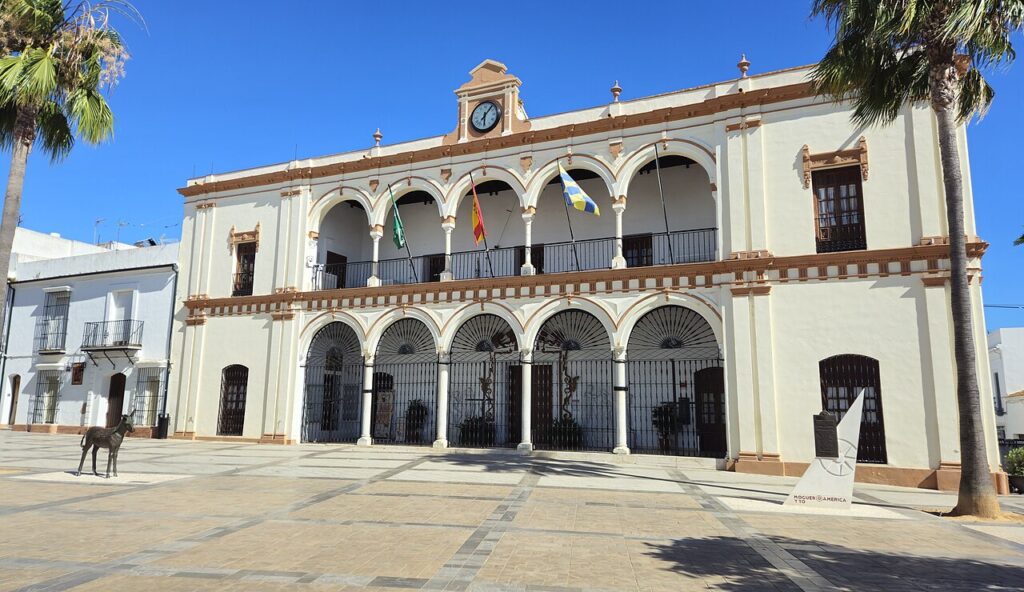
- Where: Moguer, province of Huelva, Andalusia, on the River Tinto side of the Costa de la Luz. The town hall and tourist office are on Plaza del Cabildo.
- Residents: 24,083 (1 January 2025, INE).
- Beach: none in town. Mazagón, which Moguer shares with Palos de la Frontera, is about 15 km south in a straight line; the road is a little longer.
- Nearest airports: Seville and Faro in Portugal. Neither is close, so most visitors arrive by hire car.
- Nearby towns: Palos de la Frontera is about 7 km away in a straight line, and Huelva city lies to the west.
- Language: Spanish.
- Market: a covered municipal market at the Plaza del Pescado, plus a weekly street market.
- Known for: the Nobel poet Juan Ramón Jiménez (1956), the Convent of Santa Clara and its link to Columbus, and strawberries.
Where to base yourself
Moguer is compact, so the real choice is between the town and the coast.
The old town
Plaza del Cabildo, with the town hall and the statue of Jiménez, is the centre. The poet’s birth house, the convents and the main church are all within a short walk, so staying here means you can do the sights without a car. This suits couples and anyone who wants the literary and Columbus history first.
Mazagón
Mazagón is the seaside district about 15 km to the south, governed jointly by Moguer and Palos de la Frontera. It sits beside pine forest and dunes and borders Doñana National Park. Choose it if the beach matters more than the museums; you reach Moguer by car or taxi.
Outside the centre
Fields of strawberries and other berries surround the town. A countryside stay is quieter, but you will need a car for everything, including dinner.
Things to do
Juan Ramón Jiménez and Platero
Jiménez was born in Moguer in 1881 and received the Nobel Prize in Literature in 1956, according to the Nobel Prize site. His best-known book, Platero y yo, is about a poet and his donkey, and the town is full of references to it. Start at the Casa Natal, the house where he was born, at number 2 calle Ribera. The town hall describes it as a typical Andalusian house dating from 1874, with a neo-Mudéjar balcony on the facade.
The Casa Museo Zenobia y Juan Ramón Jiménez, at calle Juan Ramón Jiménez 10, is where he lived from the age of five until he was 26, according to Barceló Experiences. It also honours his wife, Zenobia Camprubí. The foundation that runs it says each guided turn takes at most 25 people, that the museum is closed on Mondays and that an audio guide can be downloaded to your phone by QR code. Residents of Moguer and Mazagón enter free; others pay an entry fee, so check the current price. The two official pages give different season dates for the opening hours, so confirm them before you go.
Outside, the town runs an open-air sculpture trail inspired by the book. The granite statue of Jiménez in Plaza del Cabildo was made by Octavio Vicent in 1981, and a statue of Zenobia stands in Plaza del Marqués.
The Convent of Santa Clara and the Columbus vow
The Monasterio de Santa Clara was founded in 1337 and declared a National Monument in 1931. Barceló Experiences gives its size as 10,000 square metres. Its fame comes from the vow of 1493. According to the town hall, a storm near the Azores nearly sank the Niña on the return from the first voyage, and Columbus promised to spend the first night on land in prayer. The ship reached Moguer on 15 March 1493, and the crew went straight to Santa Clara to keep the vigil. The abbess at the time, Inés Enríquez, an aunt of King Ferdinand, is credited with helping to win royal support for the voyage.
Churches and convents
The Convento de San Francisco dates from the 15th century and now houses the municipal historical archive and an Ibero-American library. The Iglesia de Nuestra Señora de la Granada was built in the 18th century on the ruins of an older church damaged in the 1755 Lisbon earthquake; Barceló Experiences calls it the tallest church in Huelva province. Jiménez compared its tower to the Giralda in Seville.
Linking the Columbus sites
Moguer is one of the Columbus places of Huelva province. Barceló Experiences describes the whole old town as a site of cultural interest. A good loop is Moguer in the morning, then Palos de la Frontera, where the story of the departure is told, in the afternoon. We cover the Palos sites in their own guide.
Beaches and places nearby
The beaches of the municipality are at Mazagón, so count on a car journey. The town hall describes the Playa del Parador as a wild strip of coast backed by pine woods and ancient dunes, and says the beach runs for more than 6 km from the last buildings to the ruined Torre del Loro. It adds that the area has more than 3,000 hours of sun a year.
The national tourism site spain.info gives more detail on two of the beaches near Mazagón. It lists El Parador as golden sand, 2,000 m long and about 100 m wide, with sunshade and sunlounger rental, toilets and showers, and it describes the setting as isolated. Rompeculos is listed as 3,000 m long and 100 m wide with low occupancy and only a litter bin and cleaning service, so bring water and shade. Both are on the A-494 Mazagón to Matalascañas road.
Inland, part of the municipality lies within Doñana National Park, which Barceló Experiences calls a UNESCO natural World Heritage Site. The town hall also lists the Estero Domingo Rubio, the Médanos de Mazagón, the Pino Centenario and the Laguna de Las Madres among its natural sites. For more of the coast, see our guide to Punta Umbría and the city of Huelva.
Other town guides nearby: Cartaya and El Rompido (about 28 km in a straight line).
Food and drink
The town hall’s own list of local dishes is a good start: cod with tomato, cuttlefish with broad beans, coriander gazpacho, fried and grilled fish from the coast, prawns and coquinas. Wines of the Condado are the usual match. For sweets, look for the almond quesadillas of Santa Clara, the fine pastries of the confectioner La Victoria, and the orange wine and vermouth of the Sáenz house, whose recipes the town hall dates to the late 18th century.
Strawberries are the local business. The town hall says strawberries and other soft fruit have become the real engine of the local economy. FreshPlaza reports that Huelva province plants about 15,200 hectares of berries, with hand planting in October and plastic cover going on in November. Buy fruit in the shops and at the covered market in Plaza del Pescado rather than expecting a farm-gate stall. The market listing we read gives no strawberry dates, so ask locally.
Eat in the old town for tapas with local produce, or on the coast for fresh fish. We do not name restaurants here because we have no dated source for them.
Where to stay
There are two kinds of base. In Moguer you stay in or near the old town and walk to the sights. At Mazagón you stay near the sea, and the beach is one of the town’s main draws; the Parador de Mazagón, which gives El Parador beach its name, sits just behind that beach. Outside the old town you will need a car whichever you choose.
We found no dated price source, so we give no figures. Prices on this coast depend heavily on the season, so compare dates on a booking site before you decide, and book early for weekends and in summer.
Getting there and around
By air, the realistic choices are Seville and Faro. Neither has a direct connection to Moguer that we could confirm, so a hire car is the simplest option. By road, Moguer lies between Huelva city and the coast, and Palos de la Frontera is about 7 km away in a straight line.
By bus, the company Damas lists a Moguer–Palos–Huelva line, with departures from Moguer in the early morning and through the day, and a separate Mazagón–Palos–Huelva line. Timetables change between summer and winter, so check the current schedule on the Damas website. We could not confirm a direct bus between Moguer and Mazagón, so plan on a car or taxi for the beach.
In town, everything in the old centre can be reached on foot. Park on arrival and walk.
Best time to visit
The town hall puts the area at more than 3,000 hours of sun a year, tempered by the Atlantic breeze. That makes museum visits workable in any month, but beach days belong in the warmer months. From November the berry fields are covered with plastic, which is worth knowing if you expect open farmland.
The town hall says the Columbus vow is remembered each year in the town, but gives no date, so check the town hall and tourist office before planning a trip around it. The museum has different winter and summer hours, and the foundation and the regional government give different season dates, so confirm the hours for your travel dates.
FAQ
Does Moguer have a beach?
No. The beaches of the municipality are at Mazagón, about 15 km south in a straight line. You need a car or taxi to reach them.
Is Moguer worth a visit?
Yes, if you are interested in Jiménez or in Columbus. Half a day covers the birth house, the Santa Clara convent and the main church. Add the Casa Museo for a full day.
Who was Juan Ramón Jiménez?
A Moguer-born poet who won the Nobel Prize in Literature in 1956. He wrote Platero y yo, about a poet and his donkey, which is set in the town.
How do I get to Moguer from Huelva?
Huelva city lies to the west and Palos de la Frontera is on the way. The bus company Damas runs a Moguer–Palos–Huelva line; check its timetable for your date.
Can I visit the Casa Museo without a booking?
The foundation says reservations are preferred and that groups are limited to 25 people per guide and turn. It is closed on Mondays. Phone or check the foundation’s website before you travel.
Sources and freshness
Last checked: October 2026. Sources: INE (population, 1 January 2025); Ayuntamiento de Moguer, tourism pages (food, the Columbus vow, the Casa Natal, statues, Playa del Parador); Fundación Casa Museo Zenobia Juan Ramón Jiménez (visits, rules, opening seasons); Junta de Andalucía, museum directory (address, seasons); NobelPrize.org (Jiménez); Barceló Experiences, Moguer (monuments, Doñana); spain.info, El Parador and Rompeculos; Palos de la Frontera tourism, Mazagón; Damas (bus lines); FreshPlaza (berries); Markets in Spain (Moguer markets).
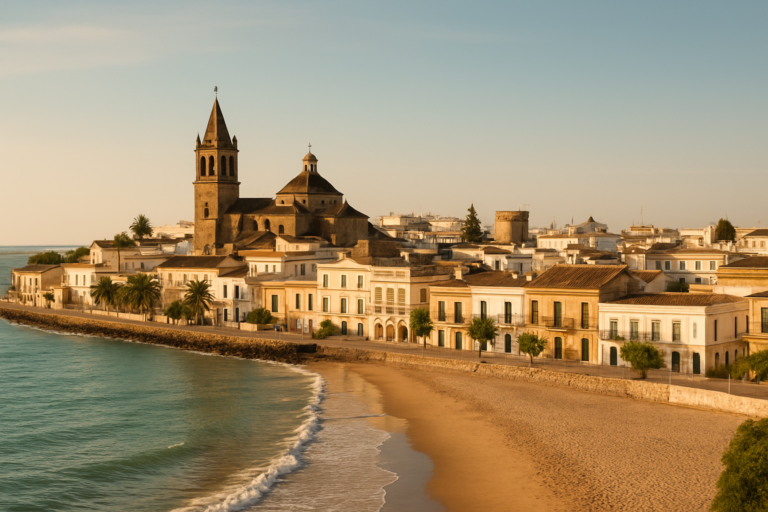
Main photo: Erikdire, CC0, via Wikimedia Commons.
Nearby on the Costa de la Luz
Moguer on the map
How this page is maintained. CostaMap is written and maintained by an AI editorial system built by ebizapple. Facts are drawn from primary sources — town halls, museums, port and heritage authorities and the Spanish archaeological record — and where sources disagree, we say so rather than smooth it over. Photographs marked as ours are taken on location. This page was last reviewed on 29 October 2026. Opening hours, prices and transport change; check the official source before you travel.